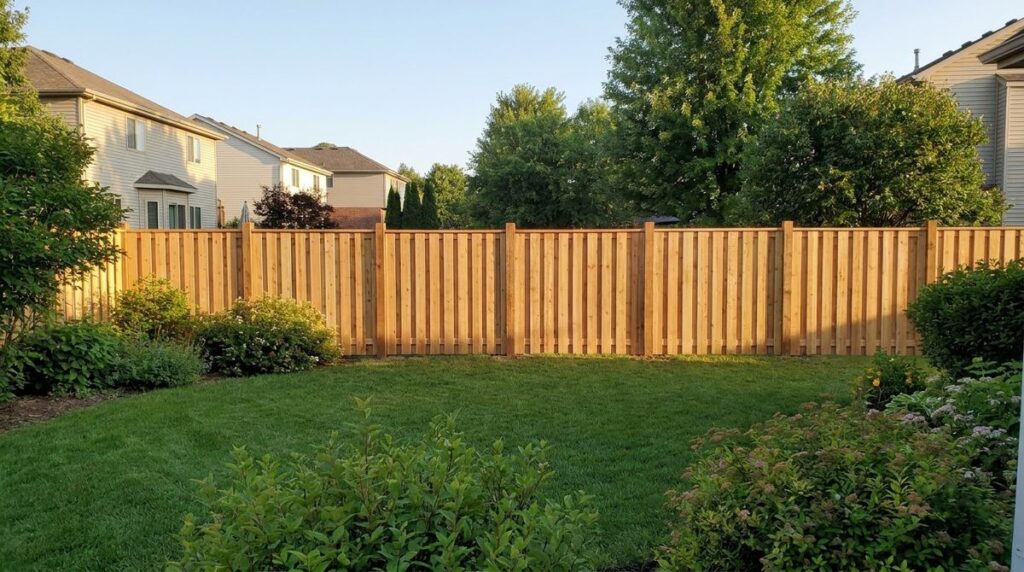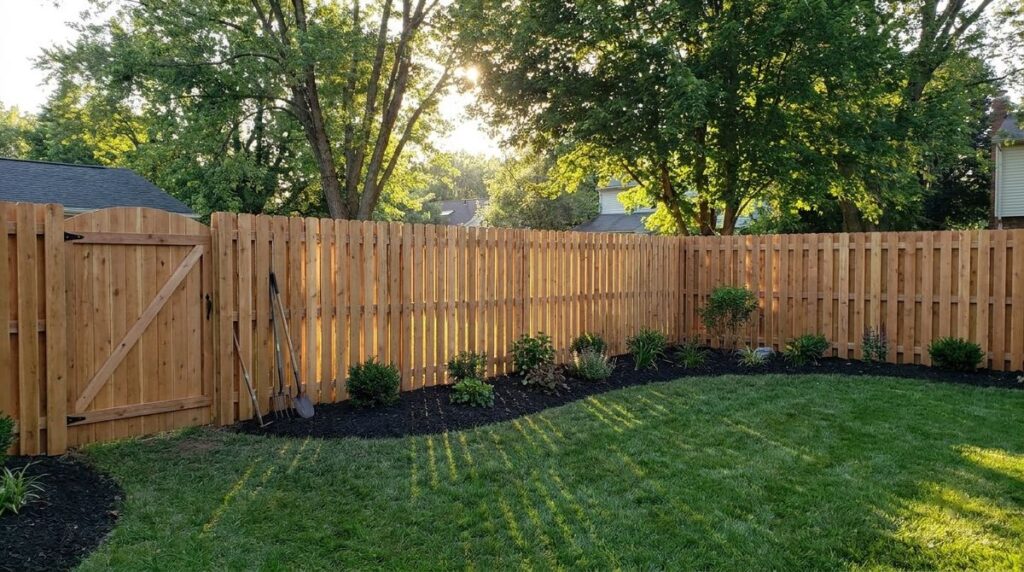
The best fence line landscaping ideas match each plant’s mature width to the strip you have, then set its center at least half that width off the fence: about 2 feet for a 3- to 4-foot-wide Emerald Green arborvitae, 6 to 9 feet for a 12- to 18-foot-wide ‘Green Giant’. Below: 18 ideas, from evergreen screens to low-maintenance mulch strips, each with sourced widths and spacing.
Key takeaways
- Plant the center at least half the mature width from the fence. A Lurvey’s nursery spec centers 4-foot-wide arborvitae 2 feet off the fence line.
- Space plants so they touch at mature size, the UF/IFAS rule for shrubs in a group; arborvitae screens go tighter, at 3 feet on center.
- A solid privacy fence cuts airflow, the University of Maryland Extension notes, so give plants beside one a little more room than the minimum.
- Vines go on a trellis 4 to 6 inches off the boards, the gap Illinois Extension gives to let air circulate and limit wood decay.
- Keep mulch, soil and raised beds off the pickets. AWPA rates fence pickets for above-ground use only.
| # | Fence line idea | Mature width | Spacing | Center from fence | Best for |
|---|---|---|---|---|---|
| 1 | Emerald Green arborvitae row | 3–4 ft | 3 ft (screen); 4–5 ft (hedge) | 2 ft | Narrow side yards, zones 3–8 |
| 2 | ‘Green Giant’ arborvitae screen | 12–18 ft | Touching at maturity | 6–9 ft | Tall screens in big yards |
| 3 | Inkberry holly hedge | 5–8 ft | 5–8 ft | 2.5–4 ft | Native evergreen hedge |
| 4 | Dwarf yaupon holly low hedge | 3–6 ft | 3–6 ft | 1.5–3 ft | Low hedge, zones 7–9 |
| 5 | Panicle hydrangea backdrop | 6–25 ft (pick a compact cultivar) | Tag width | Half the tag width | Summer flowers, sun |
| 6 | Virginia sweetspire | 3–6 ft | 3–6 ft | 1.5–3 ft | Damp or part-shade strips |
| 7 | Layered shrub and perennial border | Varies | Half of each width, added | Back row: half its width | Deeper beds |
| 8 | Serviceberry in a corner | 15–20 ft | One per corner | 7.5–10 ft | Shade and spring bloom |
| 9 | Switchgrass row | 2–3 ft | 2–3 ft | 1–1.5 ft | Tall native grass screen |
| 10 | Little bluestem strip | 1.5–3 ft | 1.5–3 ft | 9–18 in | Dry, sunny, low care |
| 11 | Coneflower and black-eyed Susan | 1–2 ft | 1–2 ft | 6–12 in | Pollinators |
| 12 | Lavender and catmint | 2–3 ft | 2–3 ft | 1–1.5 ft | Hot, well-drained strips |
| 13 | Hostas and Christmas fern | 0.5–3 ft | Match each width | 3–18 in | Shady fence lines |
| 14 | Clematis on a trellis | Stems 1–18 ft long | One per trellis panel | Trellis 4–6 in off boards | Flowers in small spaces |
| 15 | Coral honeysuckle | 3–6 ft wide, 10–20 ft tall | 3–6 ft | Trellis 4–6 in off boards | Hummingbirds, native |
| 16 | Star jasmine screen | 3–4 ft wide, up to 20 ft tall | 3–4 ft | Trellis 4–6 in off boards | Evergreen, zones 8–10 |
| 17 | Mulch or gravel strip | – | – | Below the bottom of the boards | Lowest maintenance |
| 18 | Raised beds along the fence | – | – | Bed walls clear of the pickets | Vegetables and herbs |
Mature widths from NC State Extension Gardener Plant Toolbox profiles, except idea 1 (Lurvey’s nursery spec). “Center from fence” is half the mature width; “spacing” is the mature width, so plants touch at maturity, per UF/IFAS. Cultivars vary: check the tag of the plant you buy.
How far from the fence to plant: the half-width rule
How far from the fence to plant comes down to one number on the plant tag: mature width. The Lurvey’s spec for Emerald Green arborvitae, which grows 4 feet wide, starts the row 2 feet from the fence because the plant grows 4 feet wide in all directions. That is the half-width rule: center distance equals half the mature width.
Treat half the width as the minimum. A University of Maryland Extension horticulturist called 4 feet from a fence “a bit snug” if measured from the center of a hedge shrub, but fine if measured from the plant’s projected mature edge. The same answer notes that a solid fence limits branching and reduces air circulation more than an open one.
- Between plants: UF/IFAS says plants in a group should touch when they reach mature size, so spacing equals mature width.
- Two different plants side by side: add half of each width. A 6-foot shrub next to a 2-foot perennial goes 4 feet apart.
- Room to work: add a foot or two behind shrubs if you will stain or repair the fence from your side.
Evergreen fence line landscaping ideas for privacy
Evergreen fence line landscaping ideas hide the fence all year and can add height above it. The four below run from a 3-foot-wide column to a 40-foot tree, so choose by the depth of your strip first. Hedge costs per foot are in the cheap privacy fence ideas with cost per foot.
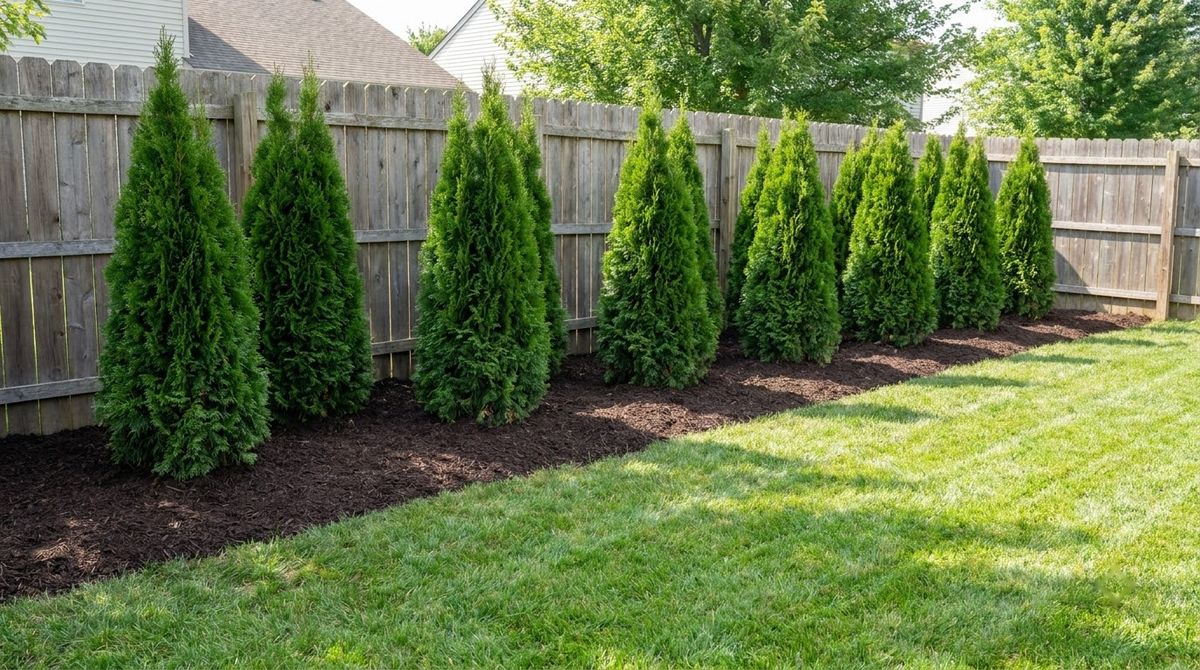
1. Emerald Green arborvitae row
Size and spacing: Lurvey’s lists Emerald Green (‘Smaragd’) at 3–4 feet wide and 10–15 feet tall, zones 3–8, spaced 3 feet center to center for a screen or 4–5 feet for a hedge. From the fence: 2 feet. A 30-foot run takes about 9 plants at 3-foot spacing, per the same spec.
Pick it if your strip is only 4 feet deep and you want a green wall. NC State notes deer browsing can be a serious problem for this species (Thuja occidentalis).
2. ‘Green Giant’ arborvitae screen
Size and spacing: NC State lists ‘Green Giant’ at 40–60 feet tall and 12–18 feet wide, zones 5–8, in full sun with light afternoon shade. From the fence: 6–9 feet. Space plants so they touch at maturity, or stagger two rows so the back row covers the gaps in the front.
Pick it if you have a deep yard and want height well above a 6-foot fence. NC State lists bagworms and root rot in poorly drained soil as its problems.
3. Inkberry holly hedge
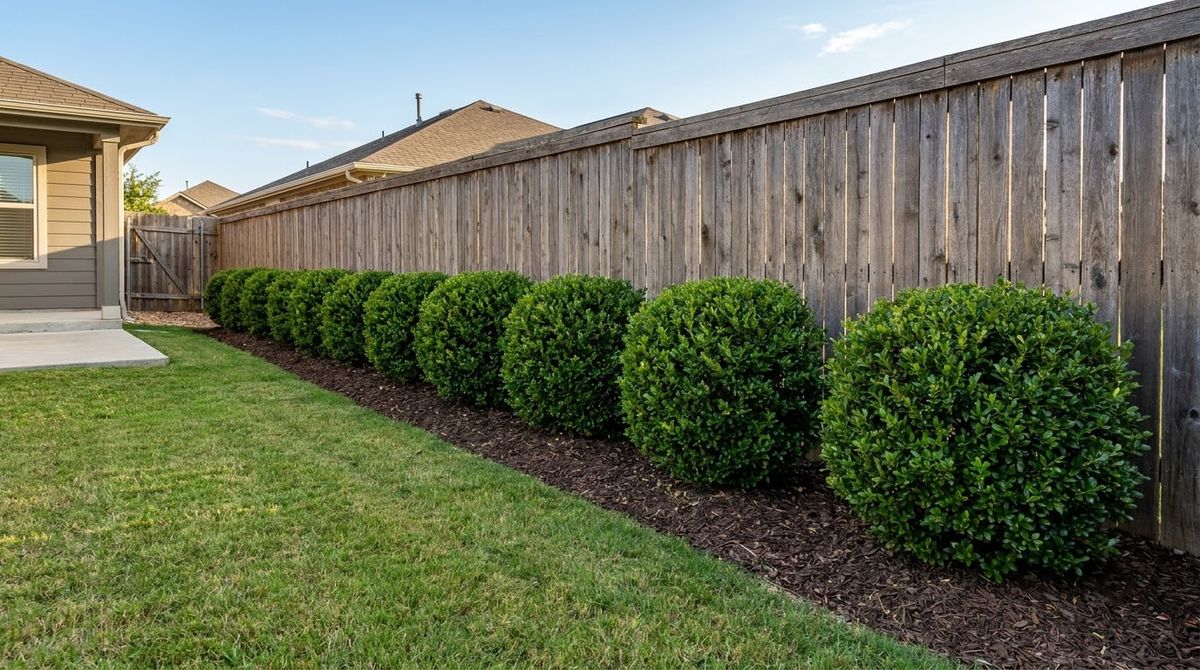
Size and spacing: NC State gives inkberry (Ilex glabra), a native evergreen, 5–10 feet of height and 5–8 feet of width, zones 4–11, in sun or part shade. Spacing: 5–8 feet. From the fence: 2.5–4 feet.
Pick it if you want a native hedge that stays below the top of a 6-foot fence in its smaller forms. Japanese holly (Ilex crenata) has the same 5–8-foot width in zones 5–8.
4. Dwarf yaupon holly low hedge
Size and spacing: NC State lists dwarf yaupon (Ilex vomitoria ‘Nana’) at 3–5 feet tall and 3–6 feet wide, zones 7–9. Spacing: 3–6 feet. From the fence: 1.5–3 feet.
Pick it if you live in the South and want a low, tidy evergreen line in front of the fence instead of a screen above it.
Flowering shrubs and a small tree along the fence
Flowering shrubs along the fence give height and color without becoming a solid wall. Widths here vary more by cultivar than with evergreens, so read the tag of the exact plant you buy and halve that number for the distance from the fence.
5. Panicle hydrangea backdrop
Size: NC State lists the species (Hydrangea paniculata) at 8–25 feet tall and 6–25 feet wide, zones 3–8, in sun or part shade. That range is why cultivar matters: NC State describes ‘Limelight’ as more compact and ‘Little Lime’ as a dwarf. From the fence: half the width on the tag.
Pick it if you want summer flowers against a plain fence and have a sunny strip at least 6 feet deep.
6. Virginia sweetspire for damp spots
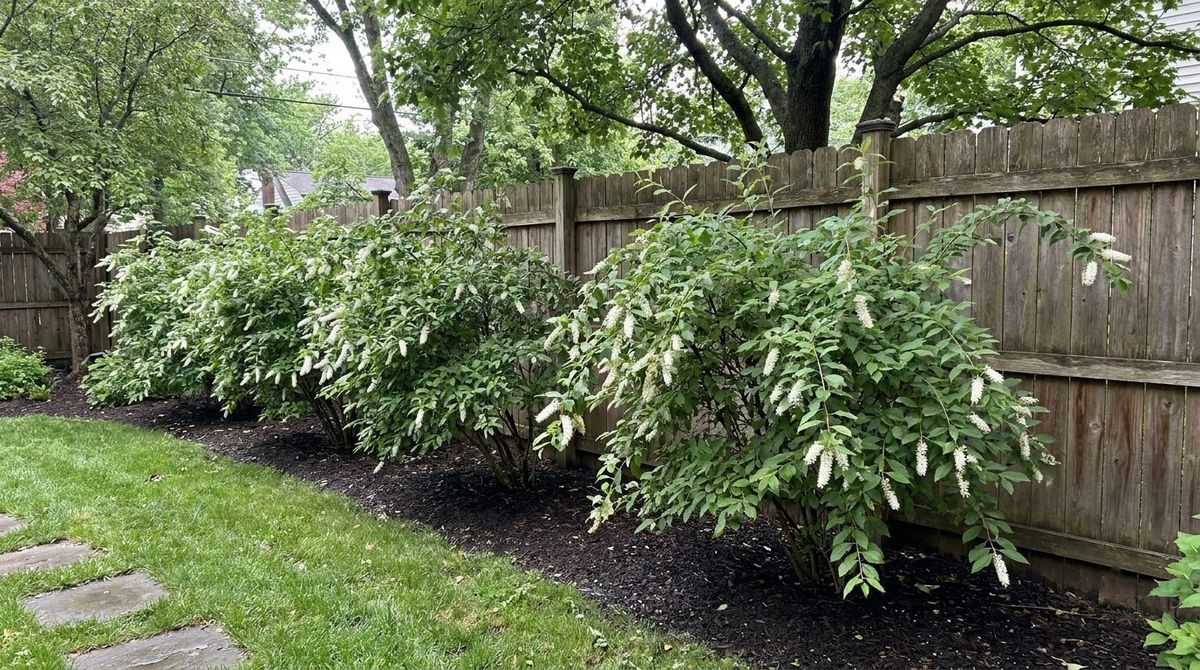
Size and spacing: NC State gives Virginia sweetspire (Itea virginica), a native shrub, 4–8 feet of height and 3–6 feet of width, zones 5–9. Spacing: 3–6 feet. From the fence: 1.5–3 feet.
Pick it if the fence line stays wet or gets part shade. NC State says it is resistant to wet soil and deer, but can be weedy because it spreads by suckering.
7. Layered shrub and perennial border
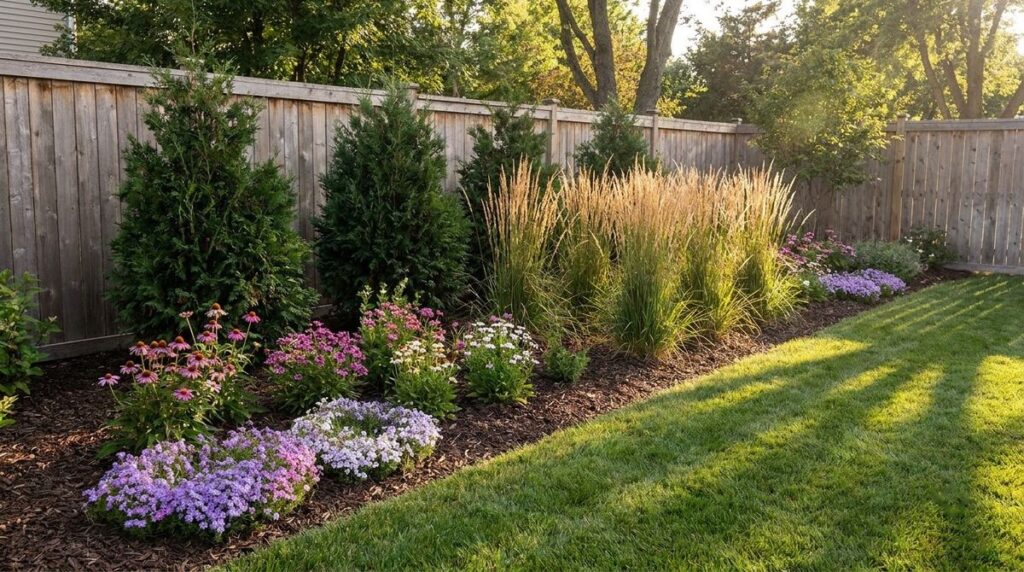
Layout: tall shrubs at the back, half their width off the fence; perennials in front. Space each pair by adding half of each plant’s width. Example: a 6-foot-wide inkberry sits 3 feet from the fence, and a 2-foot-wide coneflower goes 4 feet in front of it.
Pick it if your bed is 6 feet deep or more and you want the fence to read as a backdrop rather than a wall.
8. Serviceberry in a corner
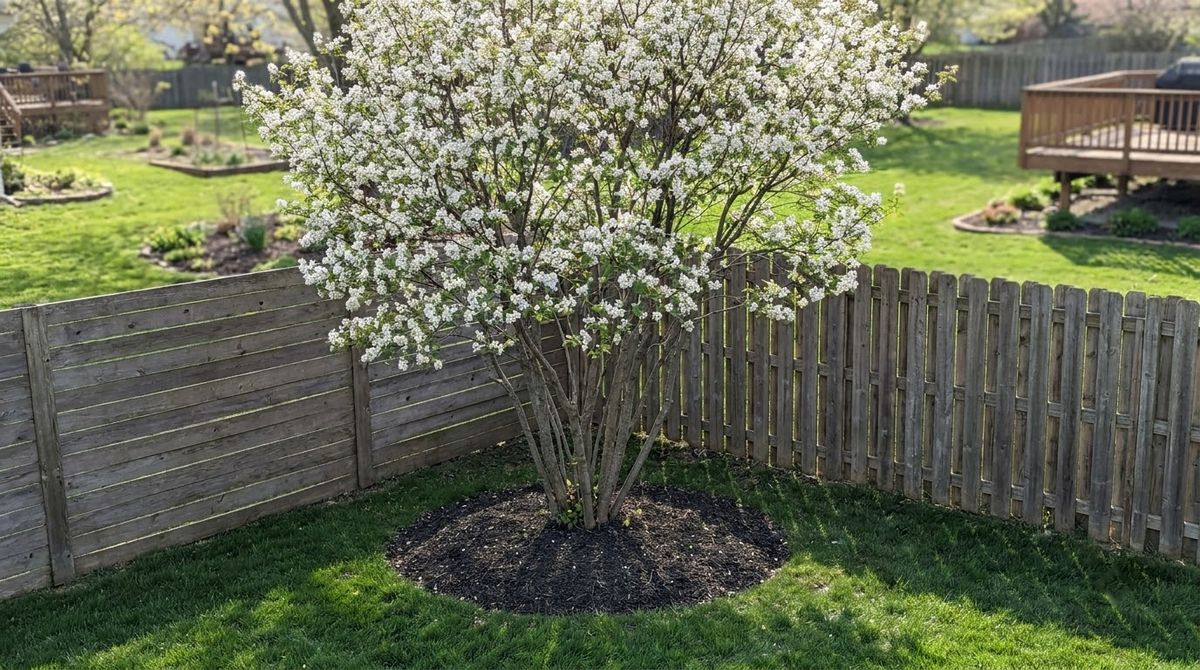
Size: NC State lists serviceberry (Amelanchier canadensis), a native, at 15–25 feet tall and 15–20 feet wide, zones 3–8, with no serious problems. From the fence: 7.5–10 feet, which in most yards means a corner where two fence lines meet.
Pick it if you want shade and spring bloom in one spot, not a row. A tree this wide will also reach over the fence into the next yard if planted close.
Low maintenance grasses and perennials along a fence
Low maintenance grasses and perennials along a fence fill a narrow strip fast and need cutting back once a year rather than shearing. Every plant here is 3 feet wide or less, so the strip can be 2 to 3 feet deep.
9. Switchgrass row
Size and spacing: NC State lists switchgrass (Panicum virgatum), a native grass, at 3–7 feet tall and 2–3 feet wide, zones 5–9. Spacing: 2–3 feet. From the fence: 1–1.5 feet.
Pick it if you want a tall, see-through screen in a sunny strip and do not mind it dying back to the ground each winter.
10. Little bluestem strip
Size and spacing: NC State lists little bluestem (Schizachyrium scoparium) at 2–4 feet tall and 1.5–3 feet wide, zones 3–9, in full sun, and notes no significant problems. Spacing: 1.5–3 feet. From the fence: 9–18 inches.
Pick it if you want the lowest-care planted strip: one cutback a year in a dry, sunny spot.
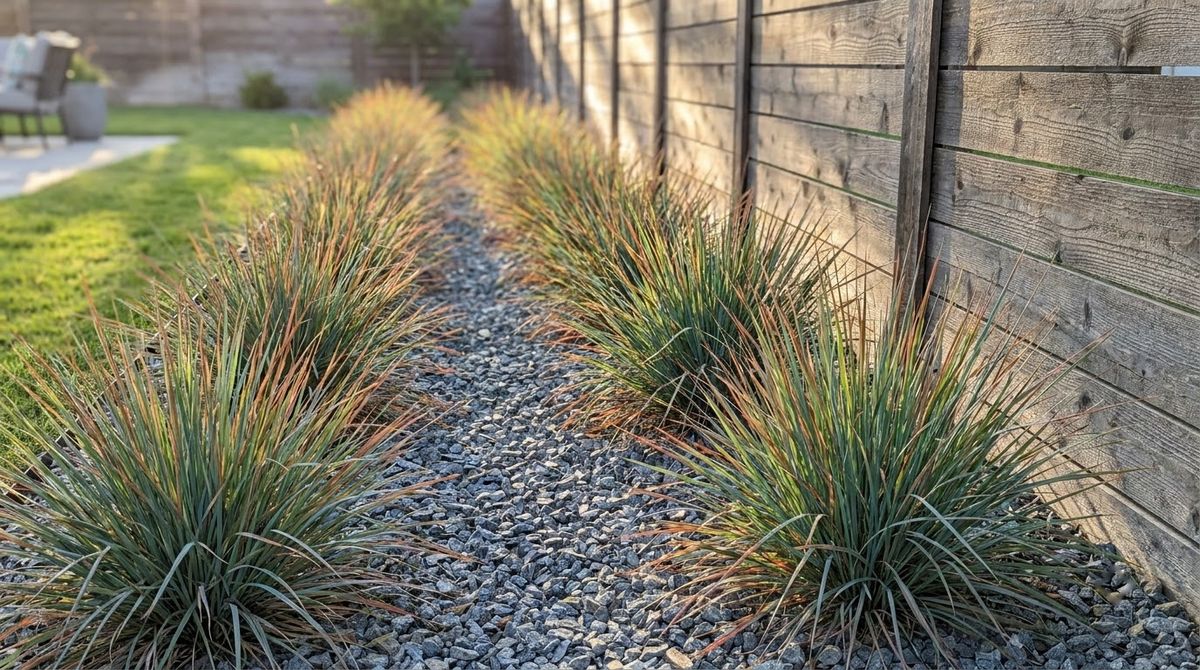
11. Coneflower and black-eyed Susan pollinator strip
Size and spacing: NC State lists purple coneflower at 3–4 feet tall and black-eyed Susan (Rudbeckia fulgida) at 2–3 feet, both 1–2 feet wide and native. Spacing: 1–2 feet. From the fence: 6–12 inches.
Pick it if the fence faces south or west and you want flowers for bees and butterflies. NC State notes Japanese beetles and leaf spot as occasional coneflower problems.
12. Lavender and catmint on a hot fence
Size and spacing: NC State lists lavandin (Lavandula × intermedia) at 2–3 feet tall and wide, zones 5–8, and catmint (Nepeta × faassenii) at 1.5–2 feet tall and 2–3 feet wide. Spacing: 2–3 feet. From the fence: 1–1.5 feet.
Pick it if the strip is sunny and dry. NC State says lavender needs good drainage to avoid root rot, so skip it where water collects along the fence.
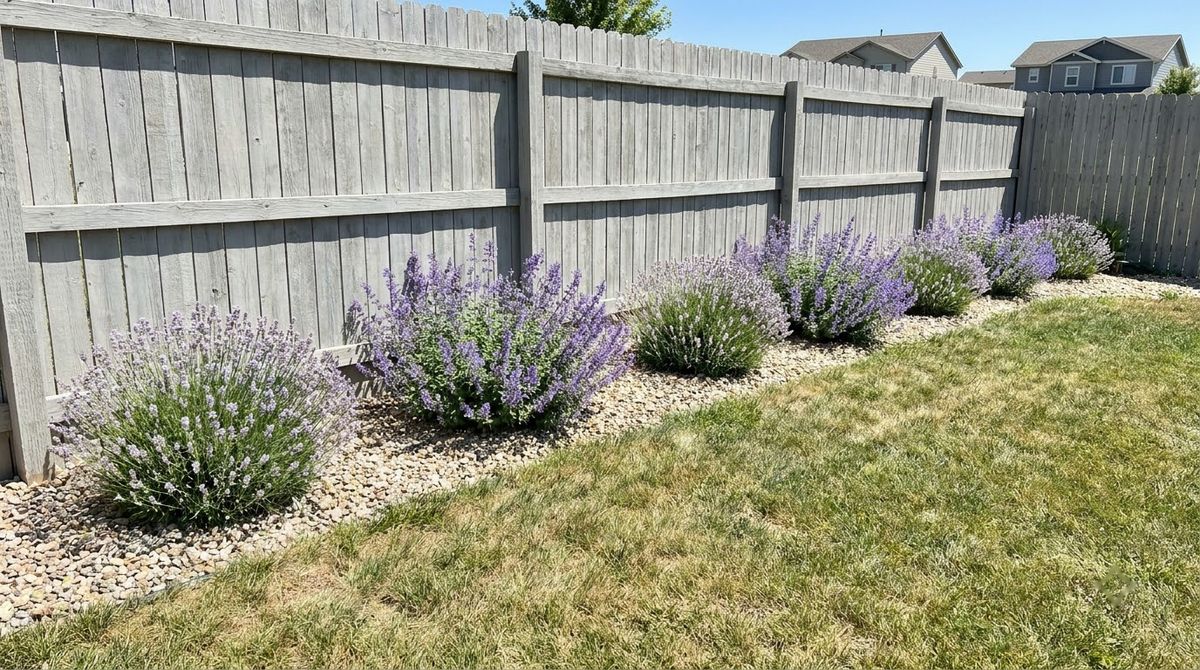
13. Hostas and Christmas fern for shade
Size: NC State lists hostas at 4 inches to 2.5 feet tall and 6 inches to 3 feet wide, and Christmas fern (Polystichum acrostichoides), a native fern, at 1–3 feet tall and wide. Both take deep shade. From the fence: half of each plant’s width, 3–18 inches.
Pick it if the fence shades the strip most of the day. NC State warns that deer and rabbits eat hosta foliage; the fern has no serious pests.
Vines and trellises on a fence line
Vines and trellises on a fence line add flowers in a strip only 1 foot deep, but they should not grow on the boards themselves. Illinois Extension says vines on a surface reduce airflow and hold moisture that can cause wood decay, and recommends a trellis set 4–6 inches from a building wall; the same gap works on a fence.
- Fasten the trellis to the fence posts or to its own posts, not to thin pickets.
- Leave the 4–6-inch gap so you can still see and treat the boards.
- Plant the vine at the base of the trellis, with mulch kept back from its stem.
14. Clematis on a trellis
Size: NC State says clematis stems grow 1 to 18 feet long depending on species and support, in zones 3–9. It prefers full sun, with afternoon shade where summers are hot. Tip: shade the roots with mulch or a groundcover, per NC State.
Pick it if you want a lot of flowers on one or two trellis panels. Pick a species whose stem length fits the panel height.
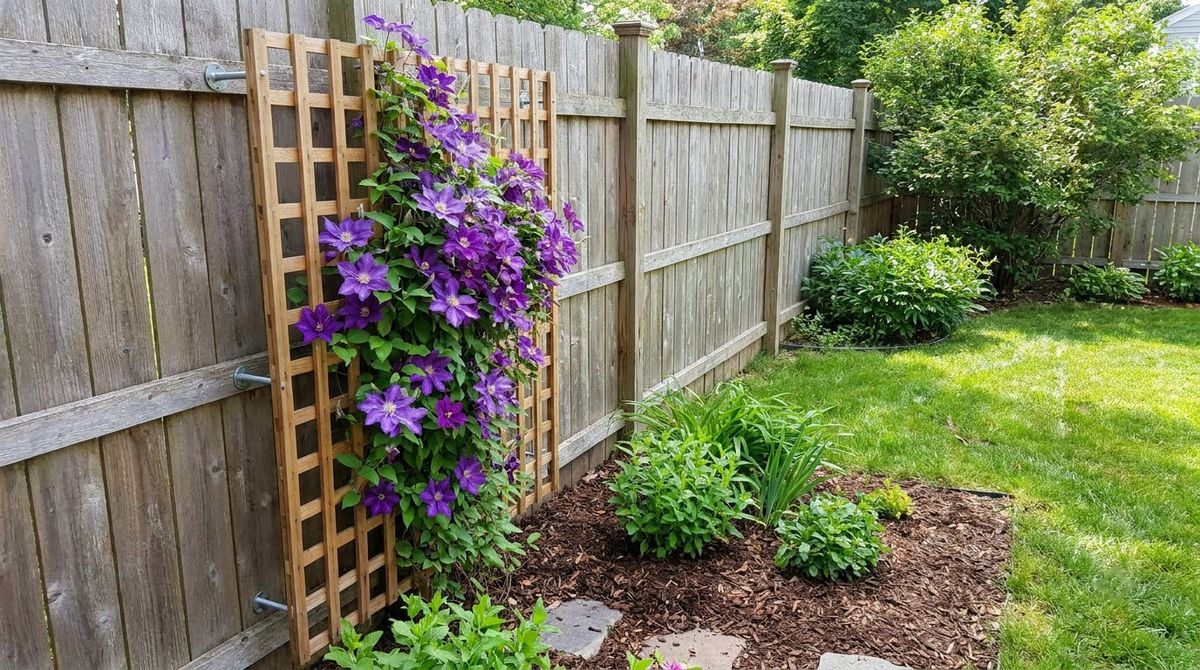
15. Coral honeysuckle
Size and spacing: NC State lists coral (trumpet) honeysuckle (Lonicera sempervirens), a native twining vine, at 10–20 feet tall and 3–6 feet wide, zones 4–9. It needs a support structure and is “an excellent choice for growing up a trellis, arbor or fence.” Spacing: 3–6 feet.
Pick it if you want hummingbirds. NC State notes its blooms are not fragrant and that powdery mildew can show up in hot, humid summers.
16. Star jasmine screen
Size and spacing: NC State lists star jasmine (Trachelospermum jasminoides) at up to 20 feet tall on a support and 3–4 feet wide, zones 8–10. It is an evergreen twining vine, drought tolerant once established, with fragrant flowers. Spacing: 3–4 feet.
Pick it if you live in the South and want an evergreen, scented screen on a trellis in front of a plain fence. Prune after flowering to keep it in bounds, per NC State.
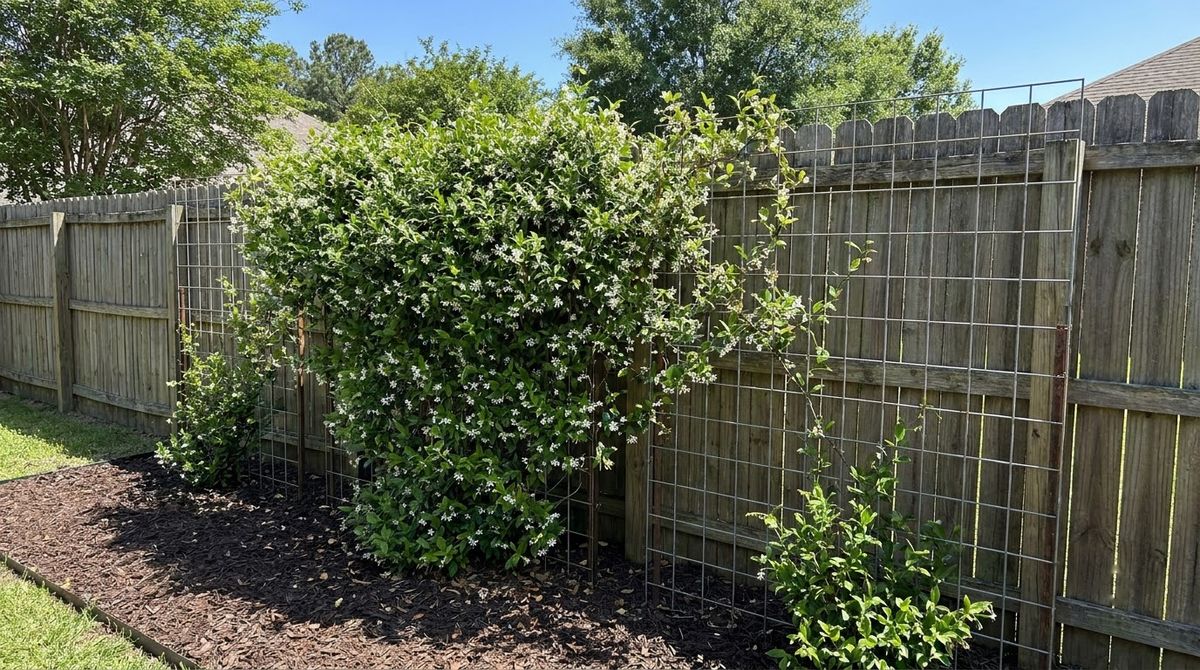
Simple backyard landscaping along a fence: mulch, gravel and beds
Simple backyard landscaping along a fence can skip plants entirely, or hold food crops. Both ideas below have one rule in common: nothing should pile up against the boards. AWPA rates fence pickets for above-ground use (UC3B) and posts for ground contact (UC4A), and notes that above-ground parts can face ground-contact hazards from how they are built.
17. Mulch or gravel strip
Layout: a mulched or graveled band along the fence, kept below the bottom edge of the boards. Around shrubs, UF/IFAS says to pull mulch at least 2 inches back from the base, because mulch that traps moisture against woody stems invites disease.
Pick it if you want the lowest-maintenance option, or a clear path behind a planted bed so you can reach the fence.
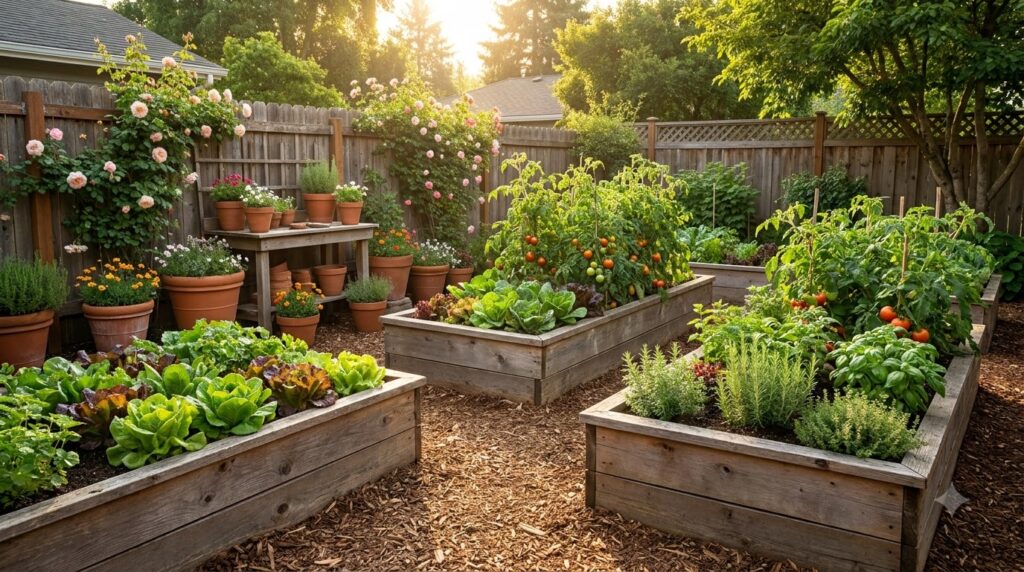
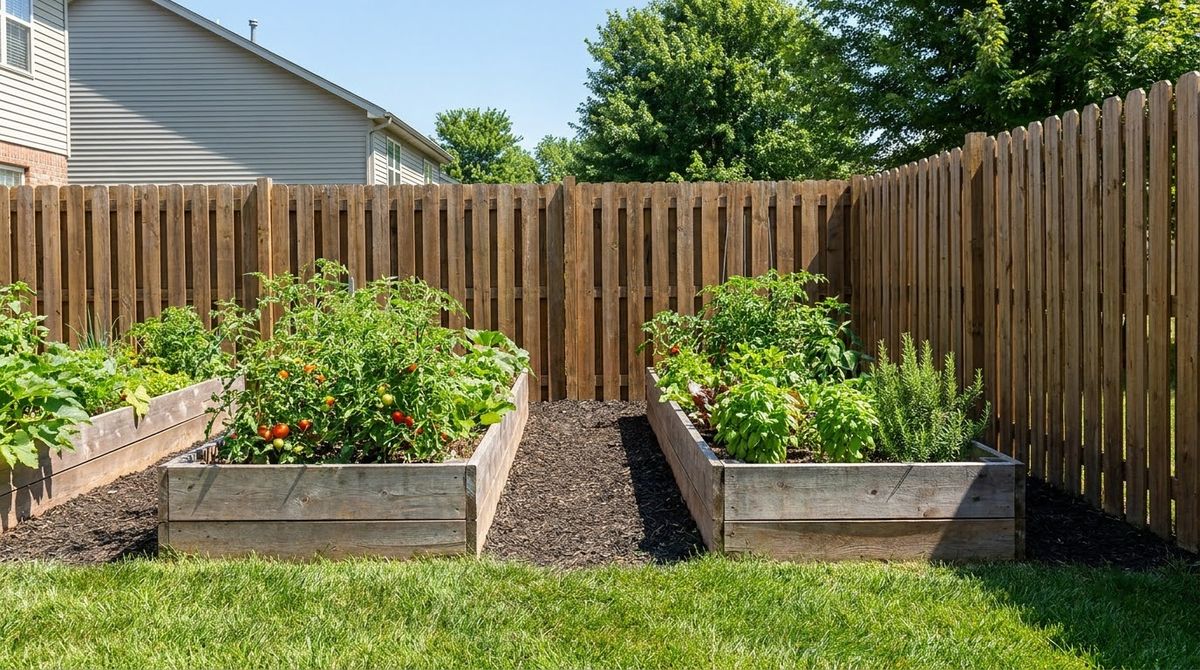
18. Raised beds along the fence
Layout: beds set parallel to the fence, with the bed walls clear of the pickets so wet soil never sits against boards rated only for above-ground use. Leave enough room behind the bed to reach the fence and the back of the bed.
Pick it if the fence line gets full sun and you want vegetables or herbs. Bed sizes, lumber and fill are covered in the raised garden bed sizes and materials guide.
Which fence line idea fits your yard: verdict by situation
- Strip under 2 feet deep: a vine on a trellis (ideas 14–16) or a mulch strip (idea 17).
- Strip 2–4 feet deep, full sun: Emerald Green arborvitae for privacy (idea 1), grasses or perennials for color (ideas 9–12).
- Shady fence line: hostas and Christmas fern (idea 13), or sweetspire if the soil stays damp (idea 6).
- You want height above the fence: ‘Green Giant’ (idea 2), only if you have 6–9 feet of depth.
- You want the least work: little bluestem (idea 10) or a mulch strip (idea 17).
- You want food: raised beds on the sunny side (idea 18).
If the fence itself is still in the planning stage, the wood privacy fence styles and lumber guide covers which styles block the view and which posts last.
Mistakes to avoid when planting along a fence
- Planting by the nursery-pot size. A small nursery ‘Green Giant’ becomes 12–18 feet wide, per NC State. Space for the tag width, not the pot.
- Measuring from the plant’s center only. The University of Maryland Extension measures room from the plant’s projected mature edge.
- Letting vines climb the boards. Illinois Extension links vines on surfaces to moisture and wood decay; use a trellis 4–6 inches off.
- Piling mulch or soil against pickets. AWPA rates pickets for above-ground use only.
- Choosing invasive grasses. NC State lists maiden grass (Miscanthus sinensis) as invasive in North Carolina; switchgrass or little bluestem are native options.
- Forgetting the neighbor’s side. Wide shrubs and trees grow over the fence; check property lines and local rules before planting near them.
Frequently asked questions
How far from a fence should I plant shrubs?
Plant each shrub’s center at least half its mature width from the fence. A Lurvey’s nursery spec centers 4-foot-wide Emerald Green arborvitae 2 feet from the fence line. The University of Maryland Extension suggests measuring room from the plant’s projected mature edge, and adding space beside a solid fence, which reduces air circulation.
What can I plant along a fence for privacy?
Evergreens give year-round privacy. Emerald Green arborvitae grows 3 to 4 feet wide and works in a narrow strip at 3-foot spacing. ‘Green Giant’ arborvitae grows 12 to 18 feet wide and 40 to 60 feet tall, per NC State Extension, so it needs a deep yard. Inkberry holly is a native option at 5 to 8 feet wide.
What are low maintenance plants to put along a fence?
Native grasses are among the easiest. NC State Extension lists little bluestem at 2 to 4 feet tall and 1.5 to 3 feet wide with no significant problems, and switchgrass at 3 to 7 feet tall. Both need one cutback a year. A mulch or gravel strip kept below the bottom of the fence boards is lower maintenance still.
Can I grow vines directly on a wood fence?
It is better not to. Illinois Extension says vines growing on a surface reduce airflow and hold moisture that can cause wood decay. It recommends a trellis or support set 4 to 6 inches away. Fasten the trellis to the fence posts or to its own posts, and choose a vine whose size fits the panel.
Should I put mulch against my fence?
Keep mulch and soil below the bottom edge of the fence boards. The American Wood Protection Association rates fence pickets for above-ground use only, while posts are rated for ground contact. Around shrubs, UF/IFAS says to pull mulch at least 2 inches away from the base, because trapped moisture against woody stems invites disease.
Sources
- NC State Extension, Extension Gardener Plant Toolbox (profiles for ‘Green Giant’ arborvitae, inkberry, dwarf yaupon, panicle hydrangea, Virginia sweetspire, serviceberry, switchgrass, little bluestem, coneflower, black-eyed Susan, lavandin, catmint, hosta, Christmas fern, clematis, coral honeysuckle, star jasmine and maiden grass; checked October 2026).
- Lurvey’s, Know & Grow: Emerald Green Arborvitae (nursery plant spec, checked October 2026).
- University of Maryland Extension, Ask Extension answer on planting distance from a fence (March 3, 2025).
- UF/IFAS Gardening Solutions, Planting and Establishing Shrubs (checked October 2026).
- University of Illinois Extension, Caring for Vines (checked October 2026).
- American Wood Protection Association, Preserved Wood Use Categories (residential infographic) (2021).