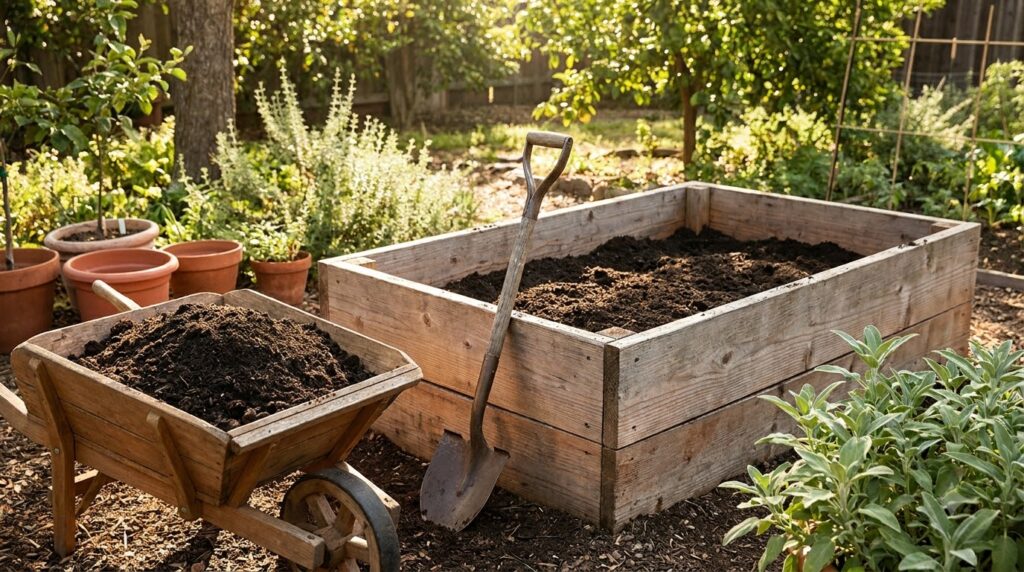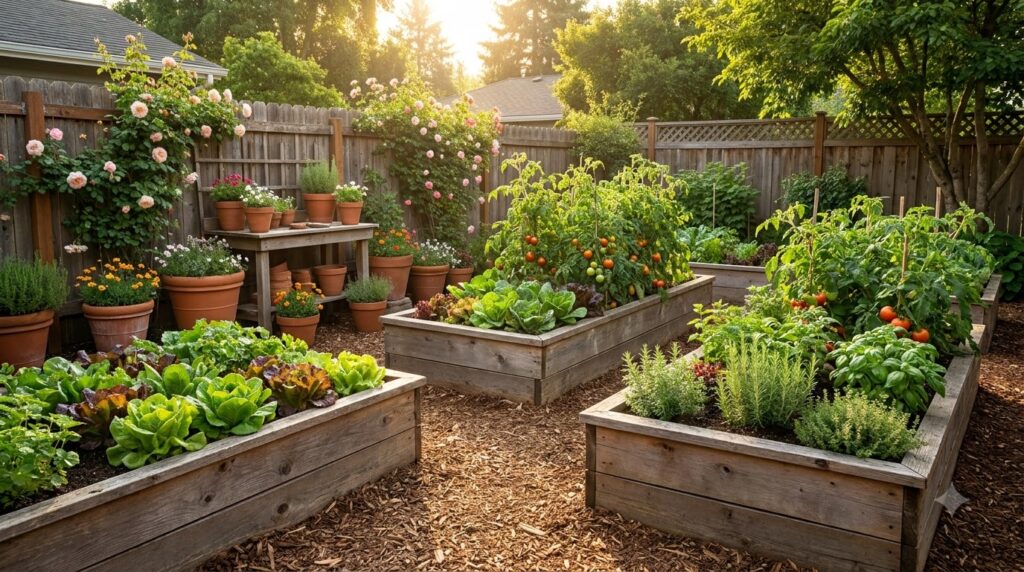
A raised garden bed is a frame of better soil sitting on top of whatever your yard gave you, and the standard one is 4 feet wide, 8 feet long, and about 12 inches deep. That one move fixes drainage, sidesteps bad native dirt, warms up earlier in spring, and brings the work closer to your hands.
Five decisions determine whether yours works: size, depth, frame material, what goes in it, and where it sits. Below are all five, with the numbers and a deep-dive link for each.
Key takeaways
- The beginner blueprint: one 4×8 ft bed, 11–12 inches deep, built from three 2×12 boards, filled with ½–⅔ topsoil + ⅓–½ compost.
- Never wider than 4 ft, the maximum Oregon State University Extension suggests for adult gardeners: you must reach the middle without stepping in. Length is flexible; width is not.
- What is under the bed decides the depth: 6–8 in over open soil, 12+ in over concrete.
- Modern treated lumber, cedar, and metal are all sound frames — railroad ties and mystery old wood are not.
- Soil is the real cost. The frame is a one-time buy; a 4×8 bed at 12 inches swallows 32 cubic feet (1.2 cubic yards) of mix, and on a 24-inch bed a layering trick halves that order.
Why raised beds win (and their honest downsides)
The case for: you control the soil completely (heavy clay and rocky fill stop mattering), drainage is automatic (water can’t pool in a box that drains out the bottom), spring comes earlier (raised soil warms faster), edges define the garden so weeds and lawn stay out, and a taller frame brings the garden to a more comfortable working level.
The honest case against: the frame and first fill cost real money (in-ground is free), raised soil dries out faster so you water more often, and beds on pavement run hot at the edges in high summer. None of these are dealbreakers; all of them are manageable with the choices below.
Raised bed, container, or straight in the ground?
Quick orientation before committing lumber:
- In-ground rows win when your native soil is genuinely good and budget is zero. Free, holds moisture longest, unlimited root run — but you inherit whatever soil and drainage you have.
- Containers and grow bags win on balconies and rentals. Total control, totally portable — but they dry out daily in summer and cap out at herb-and-tomato scale.
- The raised garden bed is the middle path: chosen soil like a container, root room and moisture buffer approaching in-ground, plus the ergonomic win neither offers. That balance is why it has become the default for home vegetables.
Size: the 4-foot rule and the standard bed
Width is the only dimension with a hard rule: you must reach the center from outside, because stepping into a bed compacts the loose soil you paid for. Oregon State University Extension puts the maximum at 4 feet for adults, and Clemson Extension recommends 3 to 4 feet.
If the bed sits against a fence and you can reach from one side only, keep it near 2.5 feet, the one-sided limit University of Minnesota Extension gives for ground beds. Length is whatever your space and lumber allow.
That is why the 4×8 ft bed is the default answer: comfortable reach from both sides, cuts cleanly from 8-foot boards, and big enough (32 sq ft) to feed a family salad habit all season.
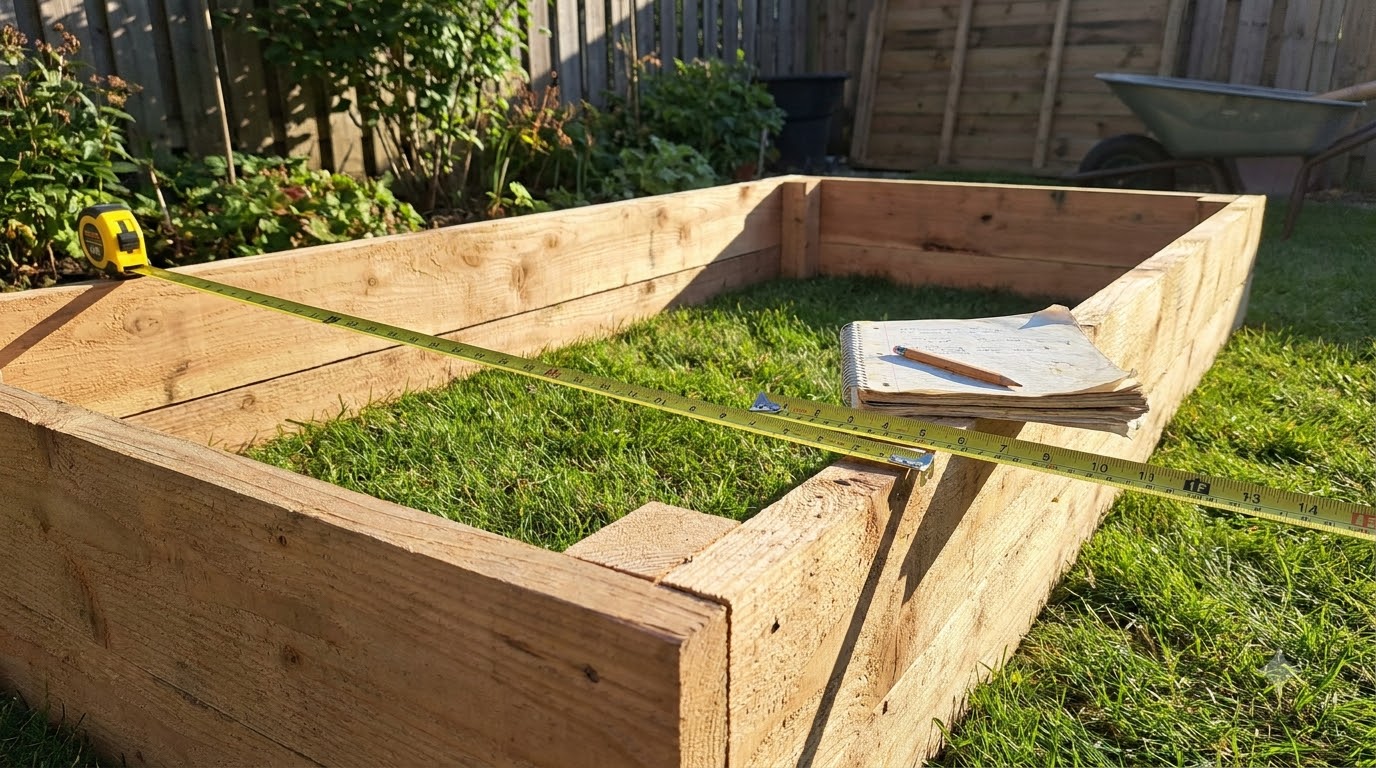
Depth: what’s underneath decides
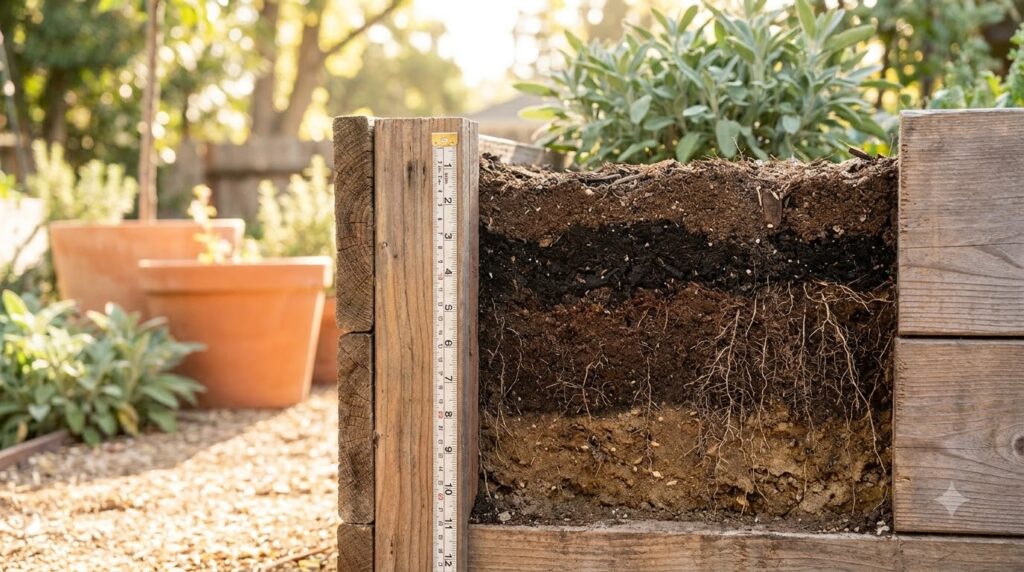
The short version: on open soil, 6–8 inches is enough for most crops, because roots keep growing down into the ground below; Oregon State Extension calls about 8 inches of soil mix sufficient for most vegetables. On concrete, a patio, or gravel, 12 inches is the minimum, because the bed is the entire root zone.
Root crops on a hard surface want 18. One 2×12 board (11¼ inches actual) lands you in the sweet spot with a single course of lumber.
Depth is also the biggest cost lever you control, since soil is bought by volume. The full breakdown — depth by crop, by surface, and what each inch costs — is in how deep should a raised garden bed be.
Frame material: wood, metal, or masonry
Any of these builds a good bed; they differ in lifespan, price, and looks:
| Frame | Durability | Cost | Best for |
|---|---|---|---|
| Ground-contact treated pine | Mostly intact after 6 seasons in an Oregon State trial | $ | Cheapest per year — and yes, modern treated wood is garden-safe |
| Cedar or redwood | Resists decay far longer than pine or fir | $$$ | The classic look, zero preservatives |
| Untreated pine/fir | Needed replacing after about 6 seasons in the same trial | $ | Starter beds you expect to rebuild |
| Galvanized metal | Rust-resistant for upwards of 50 years, per UMN | $$ | Longest life, quick assembly |
| Stone / block | Permanent | $$–$$$$ | Permanent landscaping (bricks can raise soil pH) |
What not to build from: railroad ties and utility poles, whose industrial preservatives are not meant for gardens, and salvaged lumber more than 20 years old, which may be arsenic-based CCA stock, per Oregon State Extension. University of Minnesota Extension also warns that some prefabricated metal beds sold online have been found to contain lead.
The treated-wood safety breakdown has the full list and the end-tag codes to check at the store.
Placement: sun, water, and what’s below
- Sun first. Tomatoes, peppers, and eggplant want at least 6–8 hours of direct sun a day, per University of Minnesota Extension; lettuce, radishes, and scallions cope with less. Put the bed where the sun already is, not where the bed looks best.
- Near the hose. Raised beds dry faster than ground soil — every extra step to the spigot is a bed that gets watered less.
- Level ground, or level the frame with a shovel before filling; water runs off the low side of a tilted bed.
- Check what’s underneath — open lawn, compacted clay, concrete, or tree roots each change the depth math, per the raised bed depth breakdown.
Building the raised garden bed: boards to box
- Cut list for a 4×8: two 8-ft boards for the sides, one 8-ft board cut in half for the ends, plus 4×4 offcuts for corner posts and a stake at the middle of each long side. Oregon State Extension advises reinforcing beds longer than 6 feet so the weight of wet soil cannot bow the boards outward.
- Screw, don’t nail — three exterior screws per corner into the end grain, or into the corner post. Nails walk out as wood swells.
- Set and level the frame in its final spot.
- Critter insurance if you need it: staple galvanized hardware cloth across the bottom now, which University of Minnesota Extension recommends against tunneling mice and chipmunks — it is the one cover that can’t be added later.
- Deal with the grass. University of Minnesota Extension advises killing it and loosening the soil before the frame goes on. Plain cardboard, overlapped and soaked, is the free smothering layer that replaces sod-stripping, though it slows water until it starts to break down.
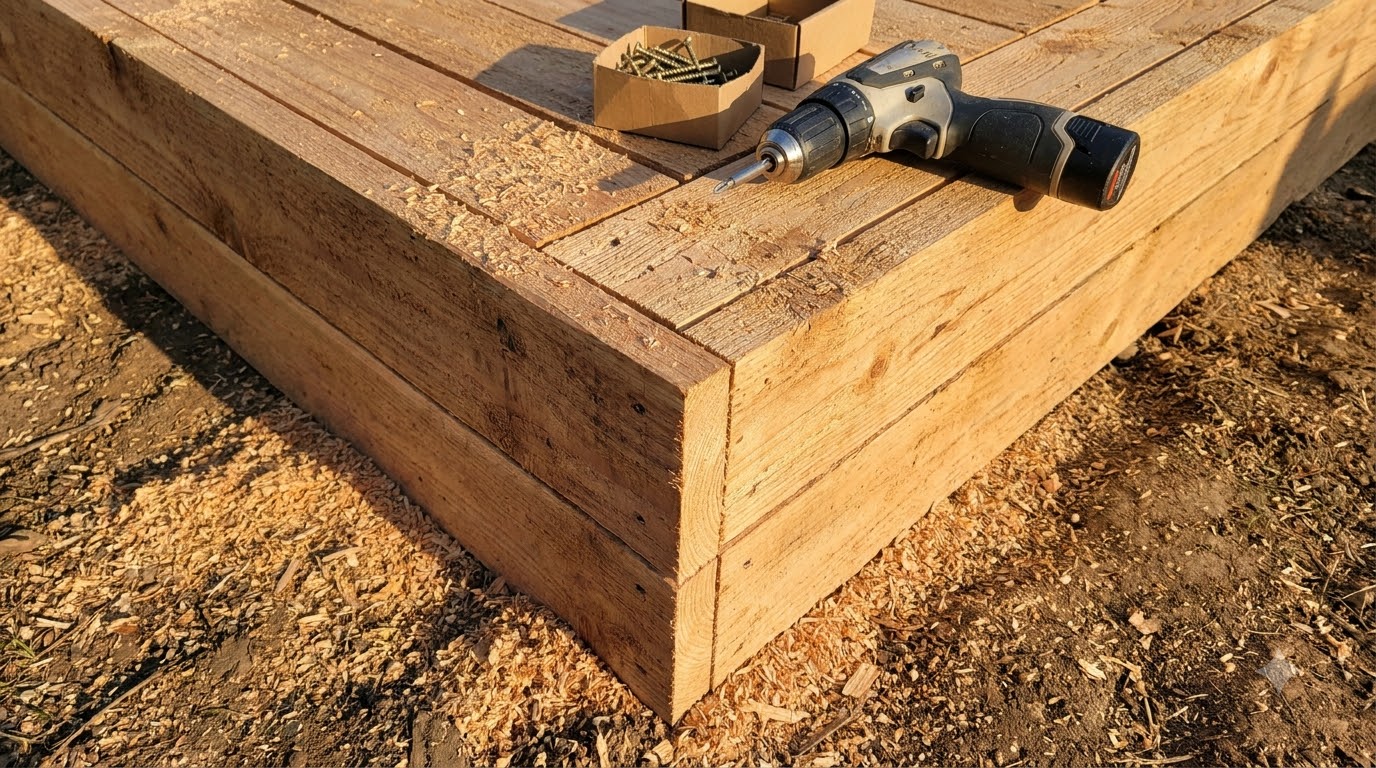
Filling it: the two-layer rule
Only the top 12 inches needs real soil: a blend of one-half to two-thirds topsoil with one-third to one-half compost (the University of Minnesota Extension ratio). Anything deeper can be logs, branches, and leaves, which UMN notes is how some gardeners fill beds taller than 2 feet to cut costs.
A 4×8 at 12 inches wants 32 cubic feet, or 1.2 cubic yards (about 22 bags of 1.5 cubic feet), and UMN adds that buying by the cubic yard is generally much cheaper than buying bags.
The complete walkthrough — volumes by bed size, the layered method, what never goes in the bottom — is in how to fill a raised garden bed.
What to plant the first year
Stack the deck with crops that forgive beginners and love loose bed soil:
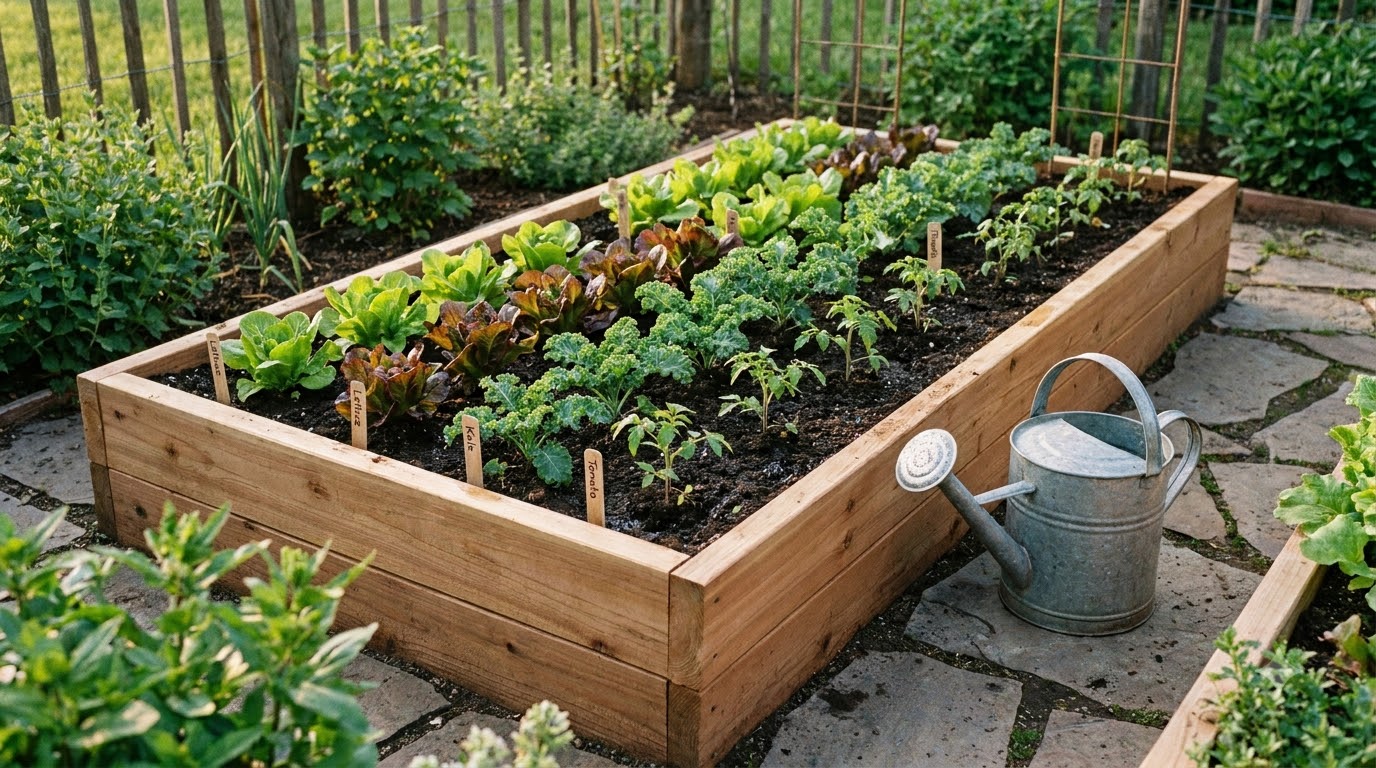
- Can’t-miss: lettuce and salad greens, radishes, bush beans, zucchini (one plant is plenty), and herbs: basil, parsley, thyme.
- Easy second tier: cherry tomatoes (deep roots — give them the middle), peppers, kale, beets, cucumbers on a trellis at the north end.
- Plant intensively. Bed spacing is closer than seed-packet row spacing — you never walk here, so rows don’t need walking room. Clemson Extension recommends planting in blocks, not rows.
Watering and season care
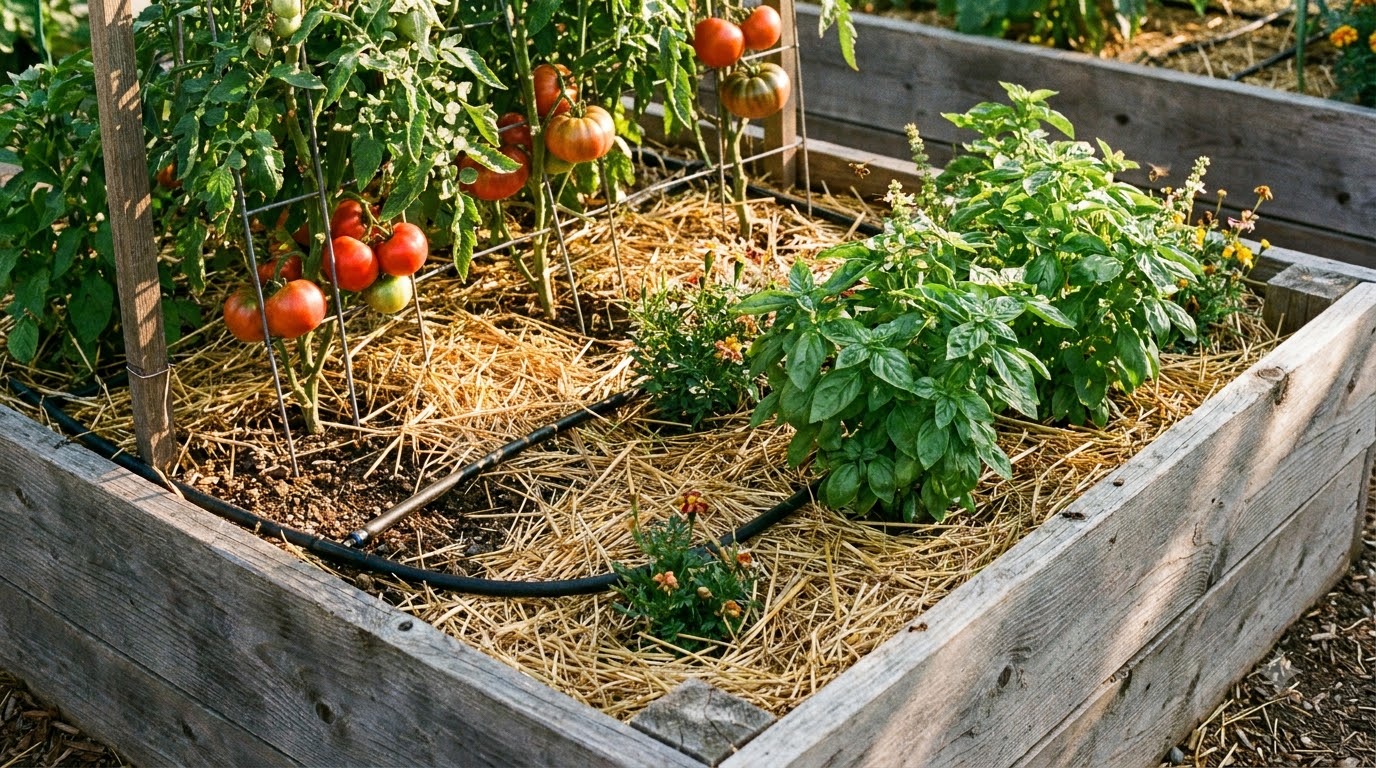
The rhythm that keeps a bed thriving: water deeply and less often rather than daily sprinkles, close to the soil so leaves stay dry, and mulch the surface with straw or chips once seedlings are up, which Colorado State Extension notes reduces evaporation. A simple drip line on a timer turns the whole chore into a checkbox.
Expect the soil level to drop as organic matter breaks down. Clemson Extension advises replenishing beds with compost regularly, and an inch or two of compost each spring doubles as the annual feeding.
Through the seasons, one cheap hoop frame carries every protection the bed will need — frost cloth in the shoulder seasons, insect netting after transplanting, shade cloth in heat waves: the cover guide has the full calendar.
What it actually costs
Honest math for the standard 4×8, 12-inch bed: the frame is three boards and screws, and ground-contact treated pine is the cheapest lumber run in the store. Cedar and redwood cost more but resist decay, per Oregon State Extension. The soil is the bigger line: 1.2 cubic yards of topsoil-compost blend, cheapest bought in bulk.
The discount: on a bed taller than 12 inches, fill everything below the top foot with yard debris via the layered method. On a 24-inch bed that halves the soil order, from 64 to 32 cubic feet. Metal frames cost more than wood up front, UMN notes, but last longer.
The five mistakes that waste a first season
- Building wider than 4 feet — then stepping in it all summer.
- 6 inches of depth on a concrete pad. Fine on lawn, fatal on slab.
- Filling with bagged potting soil — wrong product at bed volume: dries fast, costs most.
- Ignoring what’s underneath — tree roots and buried slabs turn a bed into a container without telling you.
- Siting for looks instead of sun. A gorgeous bed in 4 hours of sun grows gorgeous disappointment.
Frequently asked questions
Are raised beds better than planting in the ground?
Better for drainage, soil control, earlier spring planting, and your back — that is why they dominate home vegetable gardens. In-ground wins on cost and watering frequency. If your native soil is decent and your knees are happy, in-ground is not wrong; raised beds simply remove the most common failure points.
What do I put on the bottom of a raised garden bed?
On grass: plain cardboard, overlapped and soaked — it smothers the lawn and disappears in a season. On open soil: nothing. Where digging animals are a problem: galvanized hardware cloth stapled across the frame before filling. Never plastic sheeting or gravel.
How long does a raised garden bed last?
It depends on the frame. In an Oregon State University trial, untreated Douglas-fir 2×12 beds needed replacing after about six growing seasons, while ground-contact treated beds were still mostly intact. Cedar and redwood resist decay longer than pine or fir, and UMN rates galvanized steel as rust-resistant for upwards of 50 years. The soil inside lasts; you only top it up.
Does a raised garden bed need drainage holes?
No — a proper raised bed has an open bottom and drains into the ground below. Only fully enclosed planters on balconies or sealed surfaces need drainage holes. If your bed sits on concrete, keep the bottom open and add depth instead.
What size raised bed should a beginner build?
One 4×8 ft bed, about 11–12 inches deep. It is wide enough to matter, narrow enough to reach the middle without stepping in (Oregon State Extension suggests 4 feet as the maximum width for adults), and matches standard lumber lengths, so the build is three boards, a few stakes, and a box of screws.
Is it cheaper to build a raised bed or buy a kit?
Building with treated pine is usually the cheapest per year of service. Metal kits cost more up front but last longest and go together quickly. Cedar builds sit in between on cost and win on looks. In every case, soil — not the frame — is the bigger long-term expense.
Sources
- University of Minnesota Extension, Raised bed gardens (reviewed 2026). Checked October 16, 2026.
- Oregon State University Extension, Raised bed gardening, FS 270 (reviewed 2024). Checked October 16, 2026.
- Oregon State University Extension, Pressure-treated wood for raised bed construction in Oregon, EM 9879 (revised 2026). Checked October 16, 2026.
- Clemson Cooperative Extension HGIC, Raised Beds, HGIC 1257 (2017). Checked October 16, 2026.
- Colorado State University Extension, Mulching (reviewed 2023). Checked October 16, 2026.