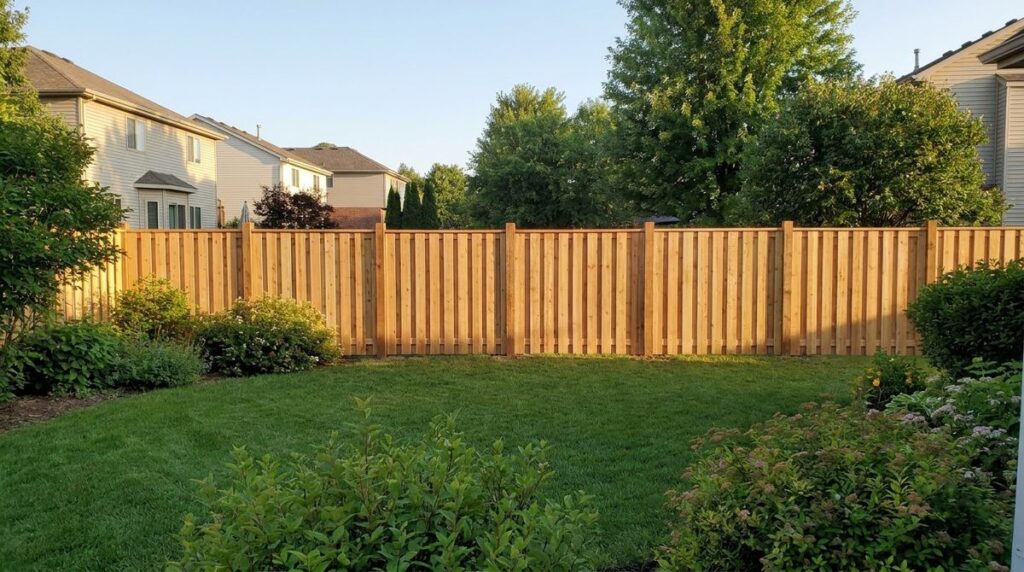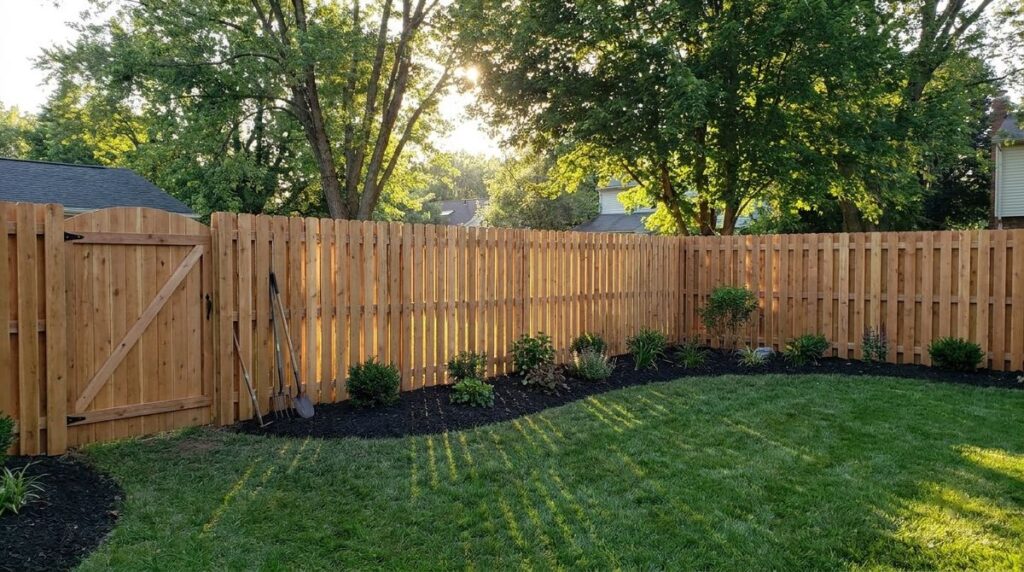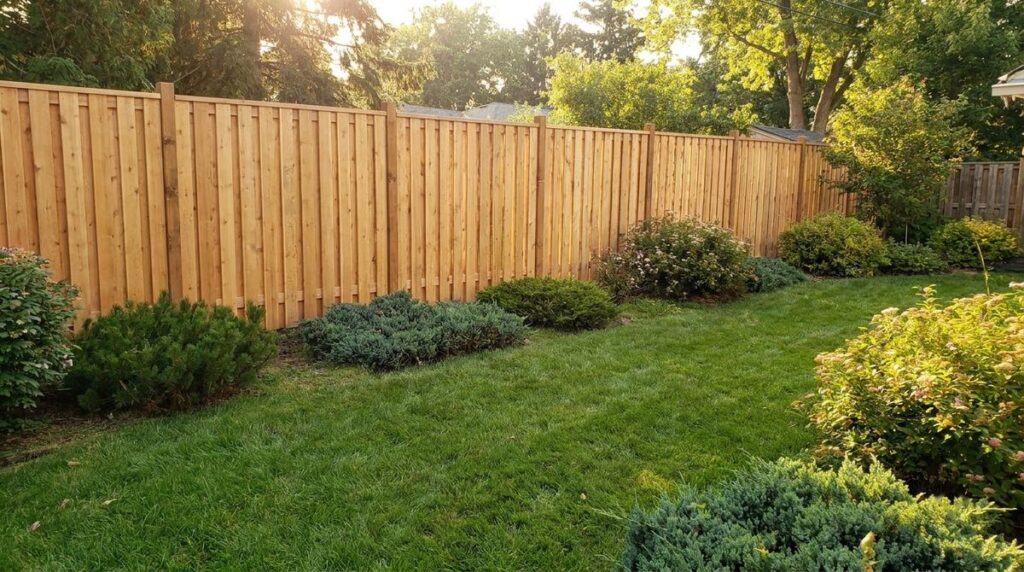
A board on board privacy fence is two layers of boards on the same rails, with the second layer covering every gap in the first by about 1 inch per side, so it stays private after the wood shrinks. It takes about 21 boards per 8-foot bay against 17–18 for stockade, and Fixr prices it at about $21–$45 per linear foot installed versus $15–$27.
Key takeaways
- Overlap is what you pay for. A 1-inch overlap per edge still leaves about 2/3 inch of cover after a fresh board dries, by the shrinkage figures in Oregon State Extension’s Table 2.
- Board-on-board uses about 20% more boards than stockade at the common 3½-inch gap, and about 35% more at a 2½-inch gap.
- Fixr prices board-on-board at $3,150–$6,750 for 150 feet installed, roughly 1.4–1.7 times its stockade range.
- “Board-on-board” and “shadowbox” are not used consistently. Ask whether both layers sit on the same face of the rails; only that layout blocks the view from every angle.
- A solid fence is a solid windbreak. The Nebraska Forest Service says barriers above 80% density cause excess turbulence on the leeward side.
| Style | View blocked | Boards per 8-ft bay (5½-in boards) | Installed cost per linear ft (Fixr) | Best for |
|---|---|---|---|---|
| Board-on-board, one face | From every angle, even after shrinkage | About 21 | $21–$45 | Close neighbors, pools, second-story views |
| Shadowbox, both faces | Straight on; see-through at an angle | 17–21, set by overlap | $17–$35 | Windy lots, a good face on both sides |
| Stockade | Solid when new; thin gaps as boards dry | 17–18 | $15–$27 | Long runs on a tight budget |
| Horizontal | Set by the gap you leave | Depends on board width and gap | $15–$22 | Modern houses, short runs |
Board counts are arithmetic for an 8-foot bay with 5½-inch-wide boards (see below). Costs: Fixr privacy fence guide (150 ft styles table, divided by 150) for board-on-board and stockade; Fixr wood fence guide for shadowbox and horizontal. Both updated January 2025.
What a board on board privacy fence is
A board on board privacy fence starts like a spaced picket fence: one row of boards goes up with gaps narrower than a board. A second row is then centered over those gaps, so each board in it laps onto its two neighbors. The overlap, not a tight butt joint, blocks the view.
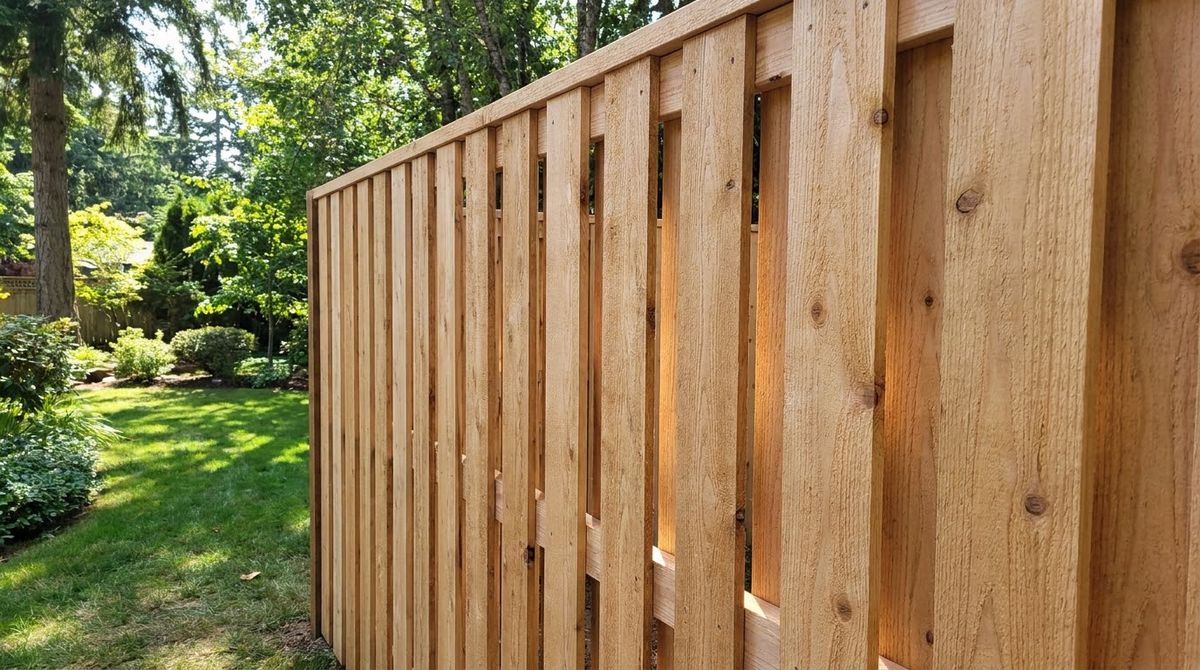
The names are a mess: HomeGuide lists “board-on-board with overlapping slats” and a “shadowbox fence with staggered pickets to permit airflow” as two designs. Fixr says shadowbox is “sometimes called a board-on-board fence” and prices them as one style.
- One-face board-on-board: both layers on the same side of the rails, back layer touching the front layer. No straight path for light or sight.
- Two-face (shadowbox) layout: one layer on each side of the rails, so the rail depth separates the layers. Overlap blocks the view head-on only.
Ask a contractor which one the quote means, and get it in writing with the gap and overlap. The step-by-step install, including how to space the first layer, is in the guide to building a wood privacy fence.
How much overlap keeps privacy as boards shrink
How much overlap you need depends on how much a board narrows as it dries. Oregon State University Extension’s Table 2 gives width (tangential) shrinkage from the green size: western redcedar 1.7% dried to 20% moisture and 4.0% dried to 6%; coast Douglas-fir 2.5% and 6.1%; ponderosa pine 2.1% and 5.0%.
| Wood (5½-in flatsawn board) | Width lost, green to 20% MC | Width lost, green to 6% MC | 1-in overlap left (worst case) |
|---|---|---|---|
| Western redcedar | 0.09 in | 0.22 in | About 3/4 in |
| Ponderosa pine | 0.12 in | 0.28 in | About 3/4 in |
| Douglas-fir (coast) | 0.14 in | 0.34 in | About 2/3 in |
Arithmetic: 5.5 in × Oregon State EM8600 Table 2 tangential shrinkage. Each board’s edges pull in by half its loss, and an overlap joint has one front and one back board, so the joint loses about one full board’s shrinkage. Southern pine is not in that table. Kiln-dried boards start smaller and move less.
The same numbers explain stockade gaps. Butted boards have no overlap, so each joint opens by about the width one board loses: roughly 1/10 inch to 1/3 inch on a green 5½-inch board. That is the daylight a stockade fence can show after its first dry season.
- 1-inch overlap per edge (3½-inch gap with 5½-inch boards): about 2/3 inch or more left in the table’s worst case.
- ½-inch overlap (4½-inch gap): about 1/6 inch left with Douglas-fir dried to 6%. Tight, and boards also twist.
- No overlap: that is a spaced fence, not a privacy fence.
Shadowbox vs board-on-board: the angle problem
Shadowbox vs board-on-board comes down to the space between the layers. When layers sit on opposite faces of the rails, a ray of light can slip through a front gap, travel across the rail depth and clear the back board’s edge. Fixr says some shadowbox designs let more light through than others, and that is the reason.
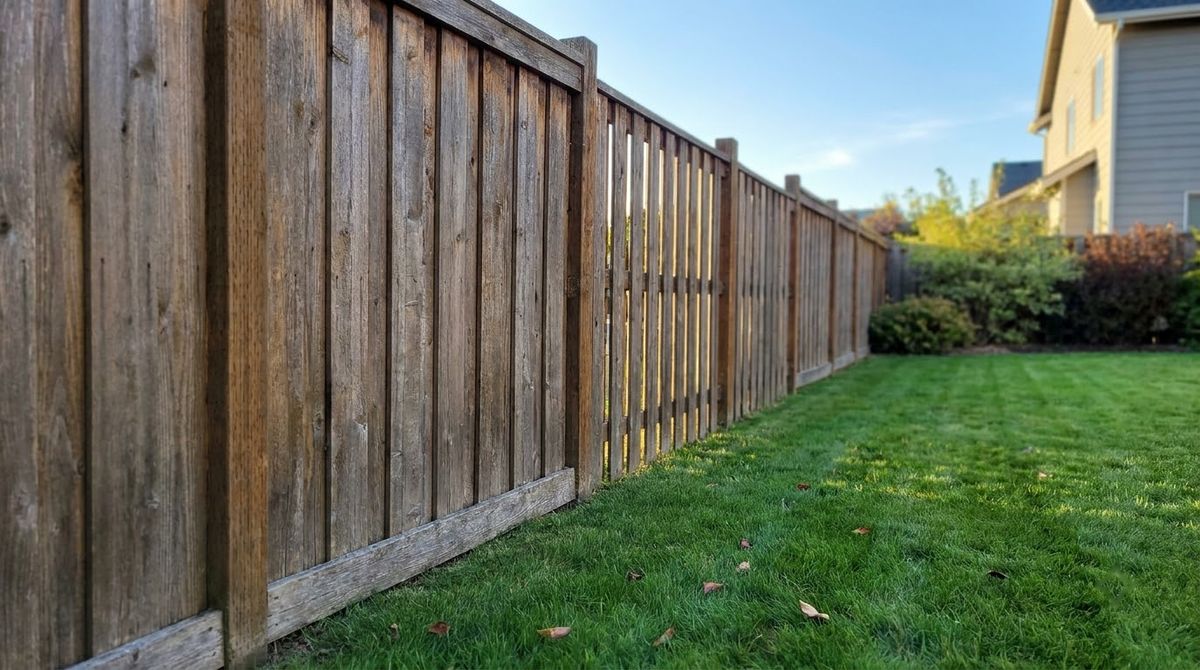
The angle is simple geometry. With a 1-inch overlap and layers 1½ inches apart (2×4 rail laid flat), you can see through at about 34 degrees off straight-on. With layers 3½ inches apart (rail on edge), it opens at about 16 degrees. A one-face board-on-board has no gap between layers, so there is no angle that sees through.
Arithmetic: see-through angle = arctan(overlap ÷ layer spacing). Rail sizes are standard 2×4 actual dimensions; your rails and overlap will change the result.
That is why shadowbox suits a fence where airflow and a finished look on both sides matter more than total screening. HomeGuide calls shadowbox one of the few privacy fences that still allows airflow.
Lumber use vs a stockade fence
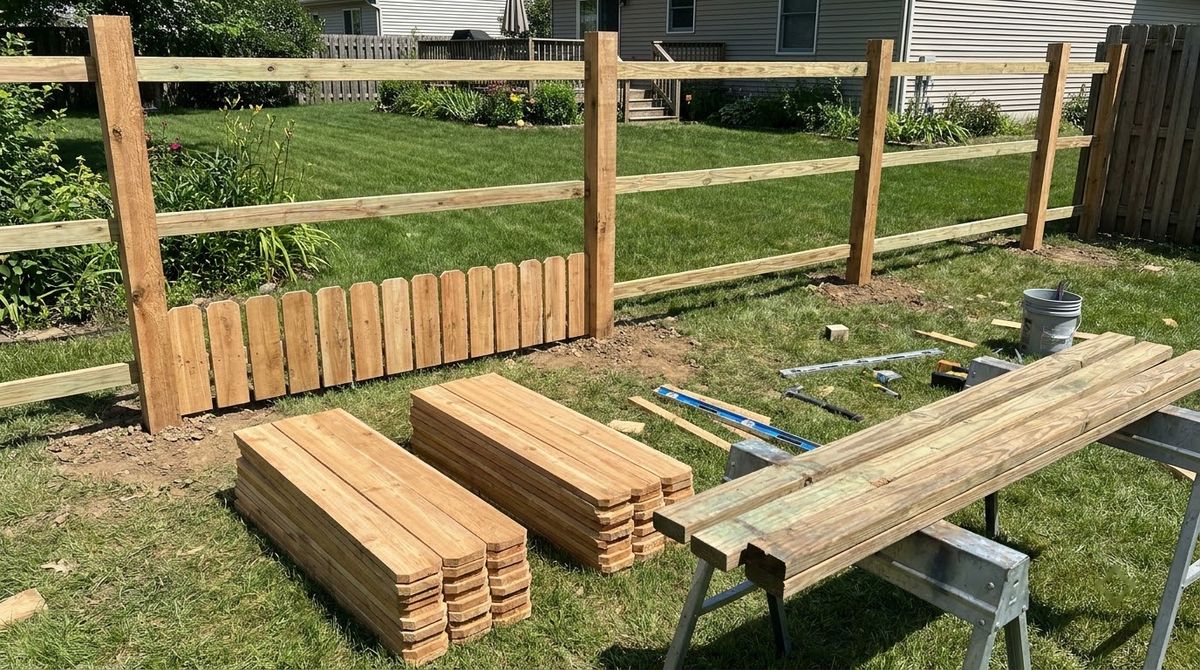
Lumber use is the main cost difference between board-on-board and a stockade fence, because posts and rails stay about the same. The counts below assume about 96 inches of board run per 8-foot bay and 5½-inch-wide boards, the picket width in a redwood privacy fence installation sheet.
| Layout | Board pitch | Boards per 8-ft bay | vs stockade |
|---|---|---|---|
| Stockade, butted | 5½ in | 17–18 | Baseline |
| Board-on-board, 4½-in gap (½-in overlap) | 10 in per layer | About 20 | About 15% more |
| Board-on-board, 3½-in gap (1-in overlap) | 9 in per layer | About 21 | About 20% more |
| Board-on-board, 2½-in gap (1½-in overlap) | 8 in per layer | About 24 | About 35% more |
Arithmetic: 96 ÷ pitch per layer, two layers, rounded; stockade = 96 ÷ 5.5. Add a few boards for cuts and culls. The 3½-inch gap is the spacing one fence company gives in its board-on-board how-to.
More boards also means more weight on the posts and rails. The same redwood sheet caps post spacing at 8 feet center to center and recommends 6 feet for maximum strength, which is the safer choice under two layers of boards.
Board-on-board cost relative to other styles
Board-on-board cost lands between stockade and premium panels. Fixr’s privacy fence guide prices 150 linear feet installed at $2,250–$4,000 for stockade and $3,150–$6,750 for board-on-board (shadow box). That is about $900 more at the low end and $2,750 more at the high end for the same run.
- Per foot, from those totals: stockade about $15–$27, board-on-board about $21–$45 installed.
- Materials only (Fixr wood fence guide): stockade $5–$10 per linear foot, shadowbox $7–$15.
- HomeGuide prices a 6-foot wood privacy fence, a group that includes board-on-board, at $25–$50 per linear foot installed and $50–$75 at 8 feet (2026 prices).
Lumber grade and height move the number more than style does. Material-by-material and height-by-height tables are in the privacy fence cost per foot breakdown. If budget wins over overlap, the cheap privacy fence ideas list ranks stockade and dog-ear first.
Wind: what a solid fence does
Wind matters with a board on board fence because it is effectively solid. The Nebraska Forest Service defines windbreak density as the solid part of a barrier divided by its total area. It says density of 40–60% gives the largest sheltered area downwind, and that above 80% “excessive leeward turbulence” may reduce protection farther downwind.
- For your patio: a one-face board-on-board will not shelter the yard better than a shadowbox; past 80% density, wind tumbles over the top.
- For the fence itself: no ranking guide or source opened for this post gives a wind load figure by fence style, so none is quoted here.
- What the install sheet does say: 6-foot post spacing for maximum strength, and holes at least 2 feet deep or one-third of the post’s height, and below the frost line in frost zones.
In a high-wind or hurricane zone, ask your local building department whether a solid fence over a set height needs engineered posts or footings.
Which to build: verdict by situation
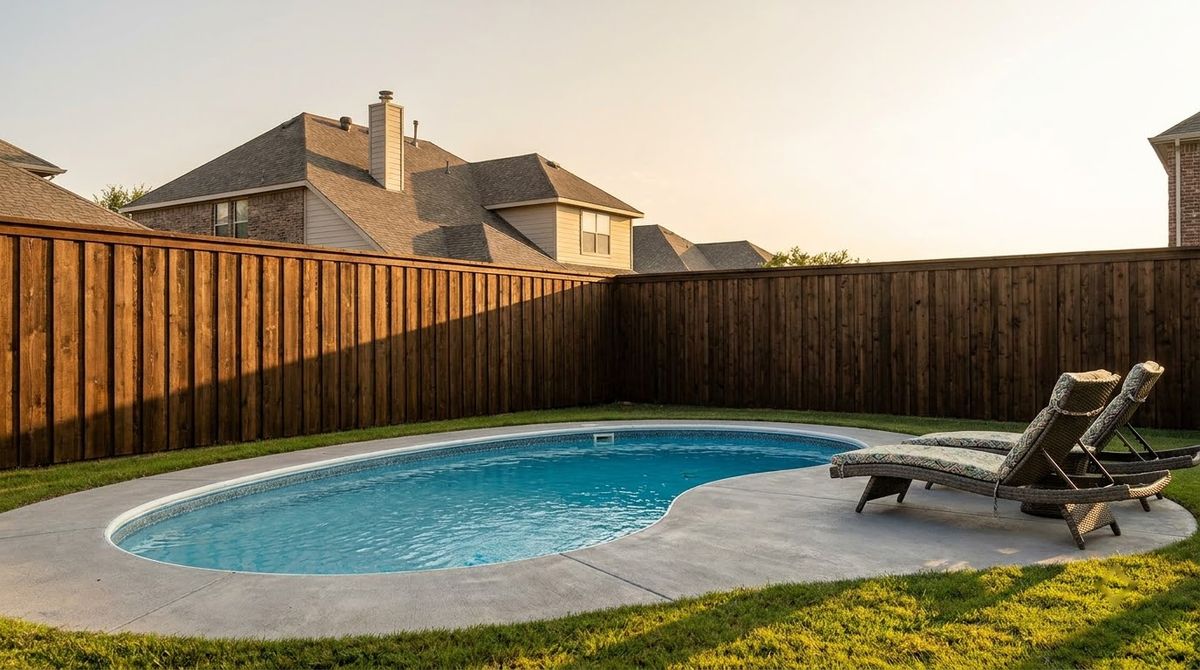
- Pick board-on-board if a neighbor’s deck, window or pool looks into your yard and you want no line of sight from any angle, now and after the boards dry.
- Pick shadowbox if your lot is windy, the neighbor shares the cost and wants a finished side, or a little light at an angle is fine.
- Pick stockade if the run is long and the budget is fixed; plan on thin gaps after the first dry season.
- Pick horizontal if the house is modern and the run is short; privacy is set by the gap you choose, and Fixr notes it takes more material to reach the same height.
Style trade-offs for lumber species and lattice tops are covered in the wood privacy fence styles and lumber comparison.
Mistakes to avoid: when board-on-board is the wrong choice
- The overlap is under ½ inch. Shrinkage and twist can open gaps anyway, so you pay the extra lumber for little gain.
- The quote is really a two-face shadowbox. Fine for looks and airflow, not for full privacy from a second-story window.
- Posts are spaced at 8 feet with light posts. Two layers add weight; use 6-foot spacing.
- You want the yard less windy. A near-solid barrier creates turbulence behind it.
- You have not checked which side faces out. A one-face fence shows rails on one side; ask your town and HOA which face goes toward the neighbor before you build.
Frequently asked questions
What is a board on board fence?
It is a wood privacy fence built in two layers on the same rails. The first row of boards is spaced with gaps narrower than a board, and the second row is centered over those gaps so each board overlaps its neighbors. Because the overlap blocks the view, the fence stays private after the boards shrink.
Is board-on-board the same as shadowbox?
Not always. HomeGuide treats them as different designs, while Fixr calls shadowbox “sometimes called a board-on-board fence.” In practice, a fence with both layers on one face of the rails blocks the view from every angle, and a fence with layers on opposite faces is see-through at an angle. Ask which layout a quote means.
How much should board on board pickets overlap?
About 1 inch per edge is a common choice: with 5½-inch boards that means a 3½-inch gap in the first layer. Using Oregon State Extension shrinkage figures, a 1-inch overlap still leaves about 2/3 inch of cover after a green board dries. Overlaps under ½ inch can open gaps once boards dry and twist.
How much more does a board on board fence cost?
Fixr prices 150 linear feet installed at $3,150 to $6,750 for board-on-board and $2,250 to $4,000 for stockade, about $21 to $45 per foot against $15 to $27. That is roughly 1.4 to 1.7 times the stockade price. The overlap adds about 20% more boards at a 3½-inch gap.
Is a board on board fence good in wind?
It blocks wind like a solid wall, which is not always what you want. The Nebraska Forest Service says barriers above 80% density cause excess turbulence downwind. For a windy lot, a shadowbox lets air through. If you build board-on-board, use 6-foot post spacing and check local requirements for tall solid fences.
Sources
- Oregon State University Extension Service, Wood and Moisture Relationships (EM 8600), Table 2 (checked October 2026).
- Fixr, Privacy Fence Cost (updated January 2025).
- Fixr, Wood Fence Cost (updated January 2025).
- HomeGuide, Wood Fence Cost (2026 prices, updated December 2025).
- Nebraska Forest Service, How Windbreaks Work (checked October 2026).
- Redwood fence installation sheet, Step-by-Step Instructions: Building a 6-Foot Redwood Privacy Fence (product PDF, checked October 2026).