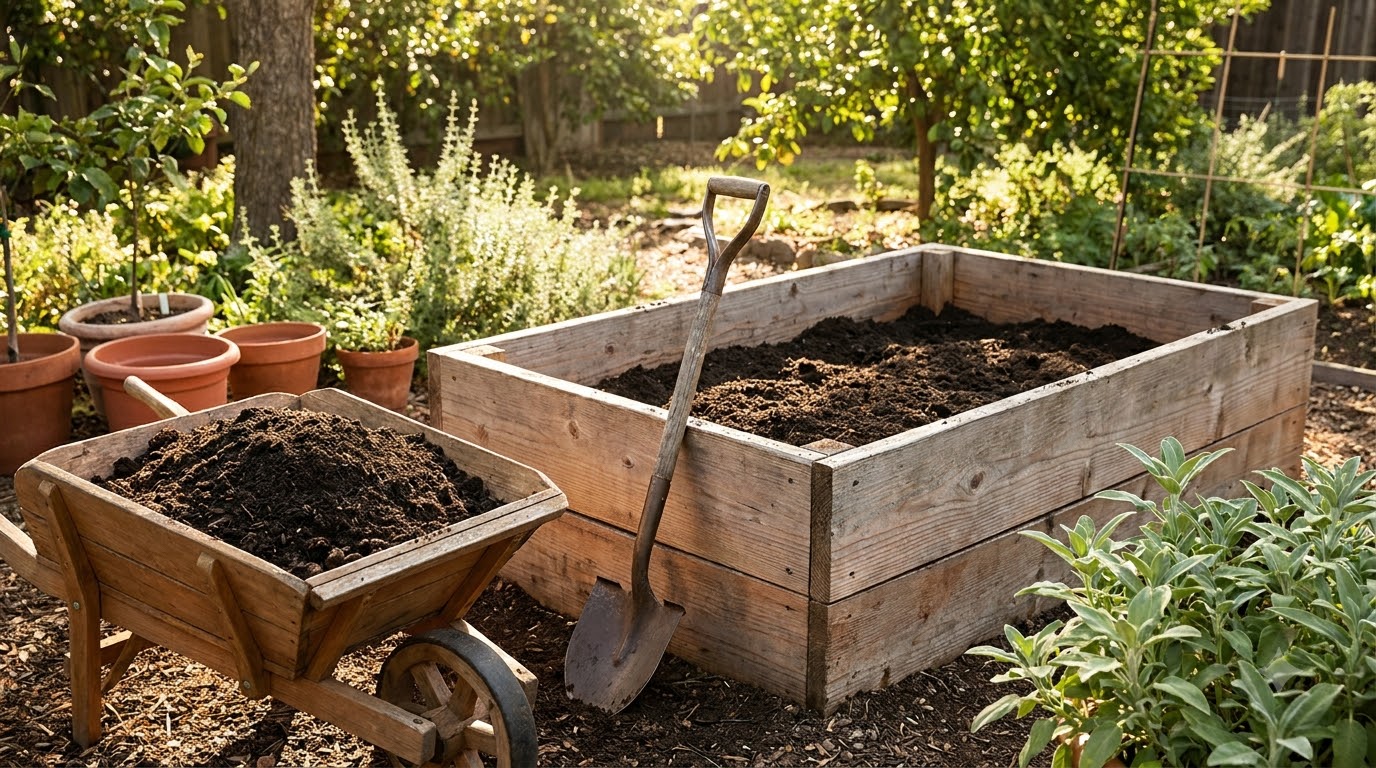
To fill a raised garden bed, you only need quality soil in the top 12 inches — a blend of one-half to two-thirds topsoil with one-third to one-half compost, per the University of Minnesota Extension. Anything deeper than 12 inches can be coarse organic material: logs, branches, leaves. That two-layer approach fills a deep bed for roughly half the cost of soil alone, and it is exactly how experienced gardeners fill tall beds.
Key takeaways
- The mix that works: ½–⅔ topsoil + ⅓–½ plant-based compost (UMN Extension). Not bagged potting soil, and not 100% compost.
- Only the top 12 inches needs good soil. Below that, roots are sparse — fill deep beds with coarse organic material first.
- A 4×8 ft bed at 12 inches needs 1.2 cubic yards (about 22 bags at 1.5 cu ft). Past ~1 cubic yard, bulk delivery beats bags on price.
- Skip the gravel layer. Rocks in the bottom make drainage worse, not better.
- Fill to the rim, water it down, top up. A new bed settles noticeably in its first season.
What to fill a raised garden bed with
The filling is a two-layer job, and each layer has a different job to do:
| Layer | What goes in | Why |
|---|---|---|
| Top 12 in (30 cm) | ½–⅔ topsoil mixed with ⅓–½ plant-based compost | This is the root zone. The topsoil provides structure and minerals; the compost provides nutrients and water-holding. |
| Everything below | Logs, branches, twigs, dry leaves, grass clippings, plain cardboard | Fills volume for free, feeds soil life as it slowly breaks down, and improves moisture retention over time. |
Two fillers to avoid, both covered in our guide to how deep a raised bed should be: bagged potting soil (formulated for containers — it dries out far too fast at bed volume, and costs the most per cubic foot) and pure compost (holds water badly on its own and can start repelling water once it dries out). Both mistakes look fine in week one and cost you the season by July.
How much soil you actually need
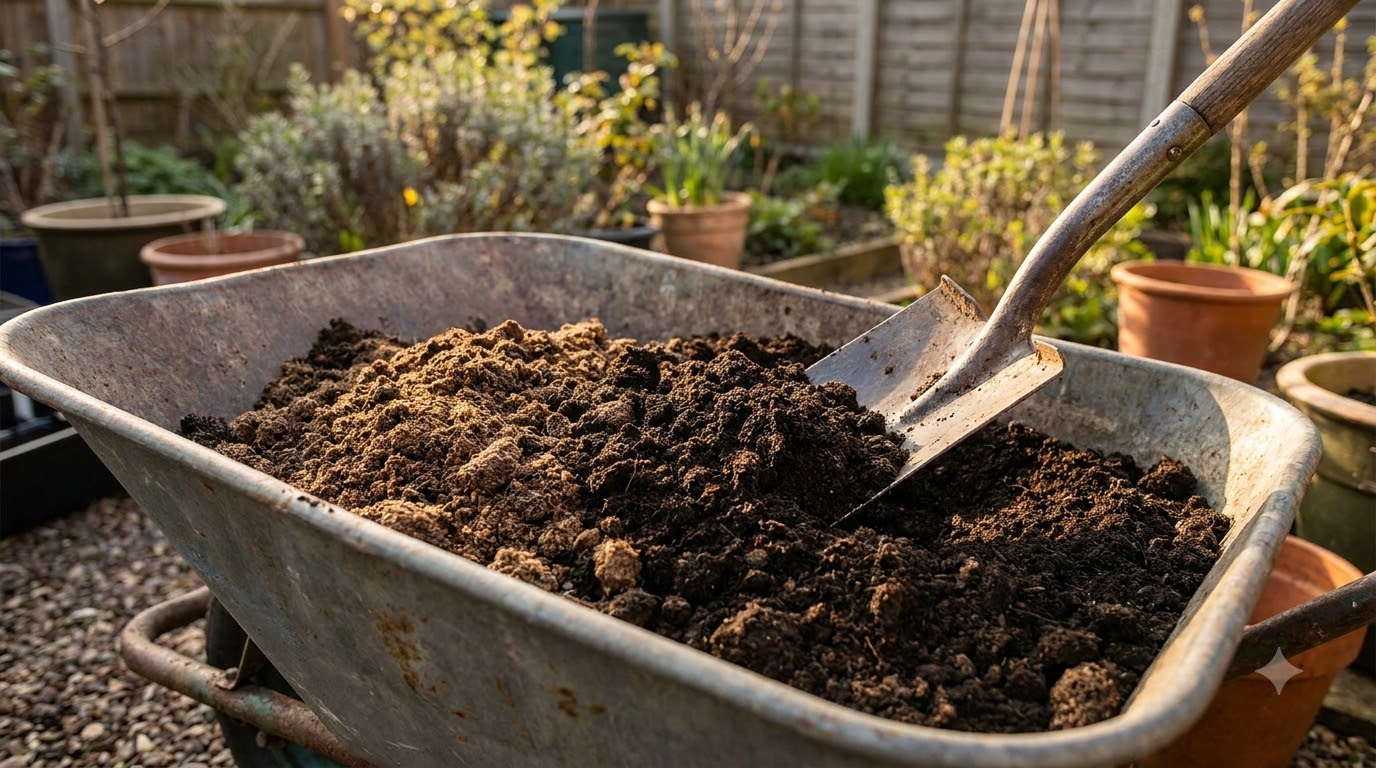
Soil is sold by volume, and volume is simple math: length × width × depth. Here is the shopping list for common bed sizes filled entirely with soil mix at 12 inches deep:
| Bed size | Volume at 12 in deep | Bags (1.5 cu ft) | Bulk order |
|---|---|---|---|
| 4×4 ft | 16 cu ft | 11 bags | 0.6 cu yd |
| 2×8 ft | 16 cu ft | 11 bags | 0.6 cu yd |
| 4×8 ft | 32 cu ft | 22 bags | 1.2 cu yd |
| 4×8 ft, 18 in deep | 48 cu ft | 32 bags | 1.8 cu yd |
| 4×8 ft, 24 in deep | 64 cu ft | 43 bags | 2.4 cu yd |
To convert any bed: cubic feet ÷ 27 = cubic yards. And before you order, check the depth you actually need — if your bed sits on open soil, you may need far less depth than you think, because roots continue into the ground below.
The layered method: fill a deep bed for half the price
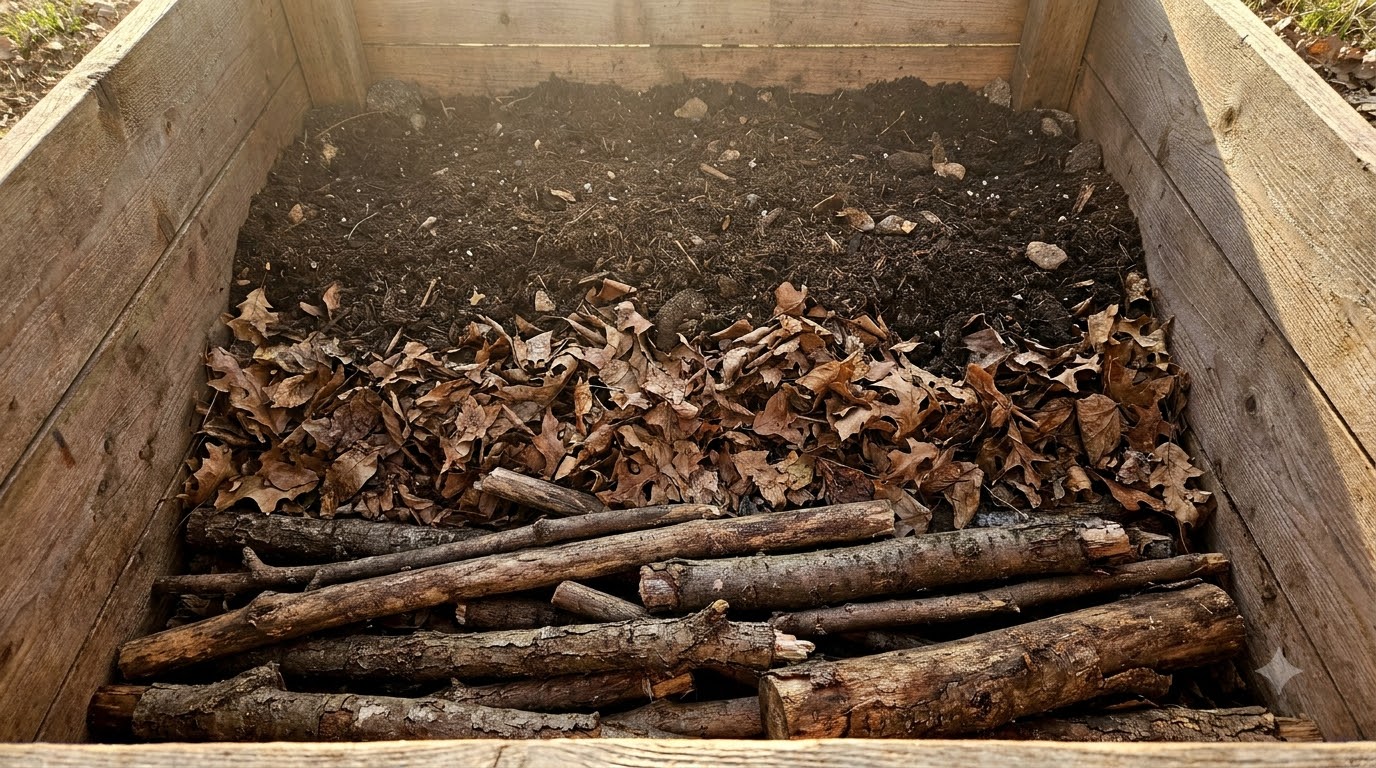
Those 18- and 24-inch numbers above are why tall beds intimidate people. The layered method — a simplified version of hügelkultur — solves it. The University of Minnesota Extension notes that gardeners building beds taller than two feet routinely fill the bottom with layered organic material specifically to avoid buying that much soil.
- Bottom third: woody material. Logs, branches, and twigs, packed reasonably tight. The bigger the pieces, the slower they break down and the longer the volume lasts.
- Middle layer: fine organic matter. Dry leaves, straw, grass clippings, or rough compost. This fills the gaps between the woody pieces so the bed settles less.
- Top 12 inches: the real soil mix. Topsoil and compost at the UMN ratio. Roots live here; nothing below this layer needs to be plant-ready on day one.
On a 4×8 ft bed at 24 inches deep, layering replaces roughly half of the 64 cubic feet with material most yards produce for free — that is 20+ bags of soil you are not buying. The trade-off: an organic-filled bed settles more in year one, so expect to top up with a few inches of soil or compost the following spring.
What NOT to put in the bottom
- Gravel or rocks “for drainage.” The oldest myth in gardening. Water does not move easily from fine soil into a coarse layer below — it perches above the gravel until the soil is fully saturated, so the root zone stays wetter, not drier. Raised beds drain fine on their own; that is half the reason to build one.
- Plastic sheeting. It blocks drainage entirely and turns the bed into a bathtub. If you need a barrier over concrete, use a permeable landscape fabric instead.
- Scraps of treated or painted lumber. Fine as a frame, not as fill that decomposes directly in your root zone.
- Anything with seeds or live roots. Weedy hay, fresh weeds, or invasive grasses will resurface right through two feet of fill.
- Food scraps in quantity. A bed is not a compost pile — large amounts of fresh scraps attract rodents and sink unevenly. Compost them first, then add the compost.
Filling day: step by step
- Level the ground and remove obstacles. The frame should sit flat with no gaps under the walls.
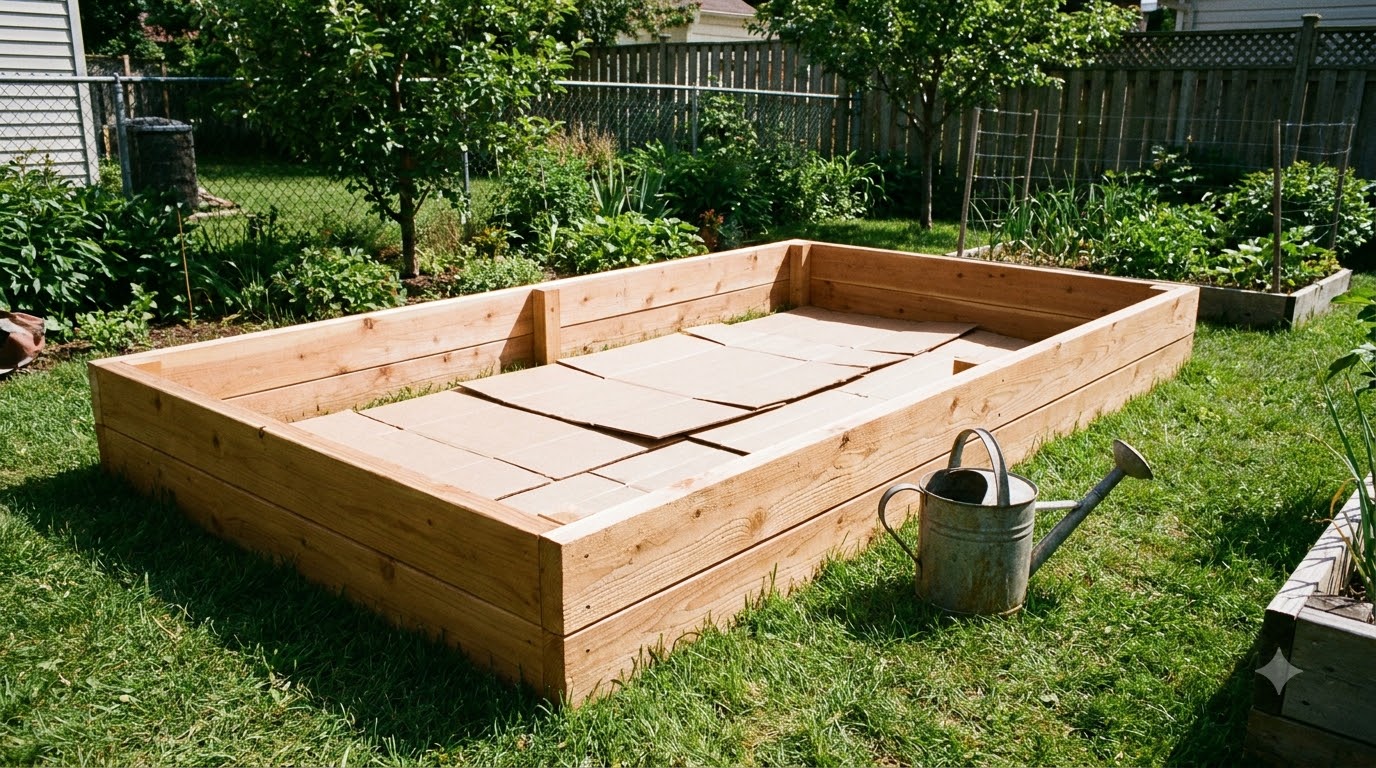
- Lay plain cardboard over grass. Overlap the seams and wet it down — it smothers the lawn and breaks down within a season. Skip landscape fabric on open soil: you want roots and worms crossing that boundary.
- Add the coarse layers (deep beds only): wood at the bottom, fine organic matter over it, watering each layer as you go.
- Mix your soil before it goes in. Combining topsoil and compost on a tarp or in a wheelbarrow beats mixing inside the bed — the blend ends up even instead of striped.
- Fill to the very rim and water deeply. The level will drop an inch or two immediately. Top it back up.
- Plant right away if you used finished compost. A bed built on raw materials (fresh manure, mostly-green layers) benefits from a few weeks of rest first.
Bagged or bulk: where the money goes
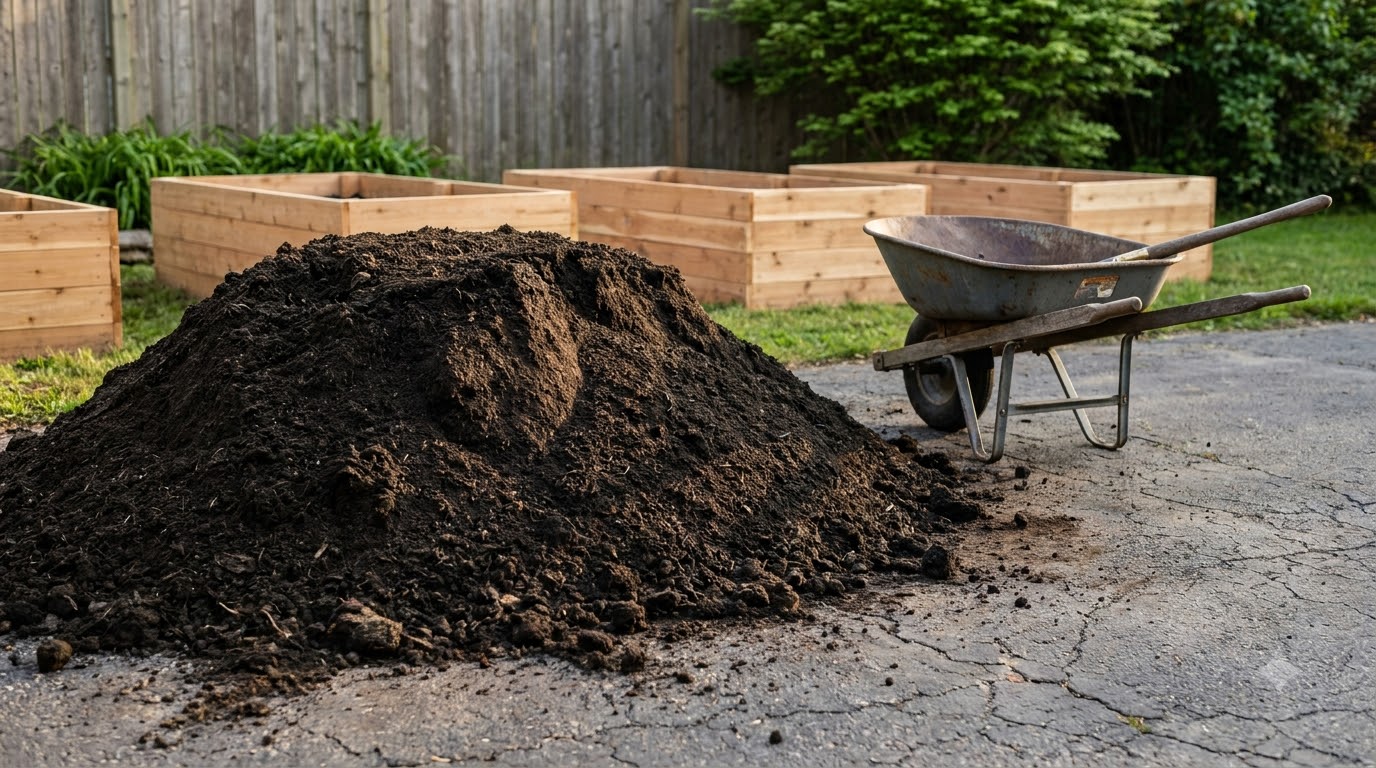
Bagged soil wins on convenience for small beds; bulk wins on price for everything else. The crossover sits at roughly one cubic yard — below it, bags are simpler; above it, a bulk delivery is usually cheaper per cubic foot even after the delivery fee. One 4×8 bed at 12 inches (1.2 cu yd) is already past that line.
Ordering bulk? Ask the yard for a 50/50 topsoil-compost blend (many sell it pre-mixed as “garden mix” or “raised bed mix”) — it lands inside the UMN ratio and saves you the mixing step entirely.
Free fill most yards already produce
Before buying anything for the lower layers, look around — the layered method runs mostly on materials that usually get hauled away:
- Storm branches and pruning waste. The bottom-third woody layer, solved. Cut pieces to fit; no need for neat stacking.
- Fall leaves — yours and your neighbors’. Bagged leaves at the curb in October are exactly the middle layer a new bed wants. Dry leaves pack down to a fraction of their raked volume, so collect more than looks reasonable.
- Arborist wood chips. Many tree services give chips away free rather than pay to dump them; some cities run chip-drop programs. Use them in the lower layers only — fresh chips mixed into the top layer tie up nitrogen where roots feed.
- Municipal compost. A lot of US cities sell or give away finished compost from yard-waste programs for a fraction of bagged prices. Quality varies by batch — ask if it is screened, and let a strong-smelling load rest a couple of weeks before planting into it.
- Untreated grass clippings. Thin layers only, mixed with leaves — a thick mat of fresh clippings turns slimy and airless. Skip clippings from lawns treated with herbicide.
Expect settling — and plan for it
A freshly filled bed is mostly air. As organic matter decomposes and particles pack, the level drops noticeably over the first season — more if you used the layered method. This is normal and free to fix: fill higher than you think, water deeply at fill time, and top up with an inch or two of compost every spring. The annual top-up doubles as the bed’s yearly feeding.
New to raised beds? Start with the complete raised garden bed guide — size, wood, soil, and cost in one place.
Frequently asked questions
What is the cheapest way to fill a raised garden bed?
The layered method: fill the bottom two-thirds with logs, branches, and leaves from your own yard, then buy quality soil mix only for the top 12 inches. On a deep bed this cuts the soil bill roughly in half.
Can I fill a raised bed with only compost?
No. Pure compost holds water badly — it dries out fast and can start repelling water once dry. Blend it: one-half to two-thirds topsoil with one-third to one-half compost, per University of Minnesota Extension guidance.
Should I put rocks in the bottom of a raised bed for drainage?
No. A gravel layer makes drainage worse: water perches above the coarse layer until the soil is saturated, keeping the root zone wetter. Raised beds drain well by design — no drainage layer needed.
Do I need cardboard or landscape fabric under a raised bed?
Plain cardboard over grass, yes — it smothers the lawn and decomposes within a season. Landscape fabric on open soil, no: it blocks the root and worm traffic that makes an open-bottom bed work.
How many bags of soil do I need for a 4×8 raised bed?
About 22 bags of 1.5 cu ft at 12 inches deep (32 cubic feet total, or 1.2 cubic yards). At that volume, a bulk delivery is usually cheaper than bags.
Can I use soil dug from my yard to fill a raised bed?
Partly. Native soil can replace some of the topsoil share if it is decent loam, blended with compost at the usual ratio. Skip it if it is heavy clay or full of weed roots — you would be importing the problems a raised bed is meant to escape.
Should I fill a raised bed in fall or spring?
Fall is ideal, especially for the layered method: leaves are free and everywhere, and the fill gets a whole winter to settle and start breaking down before planting. Filling in spring works too — just water everything down hard, top up after the first settle, and plant the same week if your top layer is finished compost and topsoil.
Sources
- University of Minnesota Extension — Raised bed gardens (soil mix ratios, layered filling for tall beds)