A patio paver base is 4 to 12 inches of compacted, angular crushed gravel, topped with a 1-inch layer of coarse concrete sand, sloped 1 to 2 percent away from the house. Use the thin end on sandy, well-drained ground and the thick end on clay, wet soil or cold climates, and compact the gravel in thin lifts.
Key takeaways
- Base depth depends on soil. CMHA sets a 4-inch minimum for patios on well-drained soil; Unilock’s chart goes to 10 inches on clay.
- Gravel goes in lifts. Guides range from 3 to 6 inches per lift, thinner with a lighter plate compactor.
- Bedding sand is 1 inch, not more. Use concrete sand; CMHA rules out masonry sand, limestone screenings and stone dust.
- Sand never fixes a low spot. Fill dips with base gravel and recompact, or the dip shows through the pavers.
- Edges hold the whole patio. Spike restraints into the gravel base, never into soil.
Here is what goes into a patio paver base, layer by layer, from the top down.
| Layer | What to use | Thickness | Notes |
|---|---|---|---|
| Pavers | Concrete pavers for foot traffic | 2⅓ in (60 mm) typical | CMHA’s standard for pedestrian areas and driveways |
| Bedding | Coarse concrete sand (ASTM C33), or ⅛-in chip over clear stone | 1 in, screeded loose | Never masonry sand, screenings or stone dust |
| Base | ¾-in minus crushed road base (ASTM D2940), or ¾-in clear stone | 4–12 in compacted | Thicker on clay, wet or disturbed soil |
| Geotextile | Woven or non-woven separation fabric | One layer, 12-in overlaps | Optional; CMHA lists wet, clay, silty and freeze-thaw soils |
| Subgrade | Native soil, organics removed | Compacted in place | CMHA: at least 98% standard Proctor density |
| Edge restraint | Paver edging (plastic or aluminum) or concrete | At least 1 in of paver contact | Spiked into the base, not the soil |
Patio paver base depth by soil and use
Patio paver base depth is where the guides disagree most, because each one assumes different soil. The ranges below are compacted gravel only; add the sand bed and the paver on top to get your digging depth.
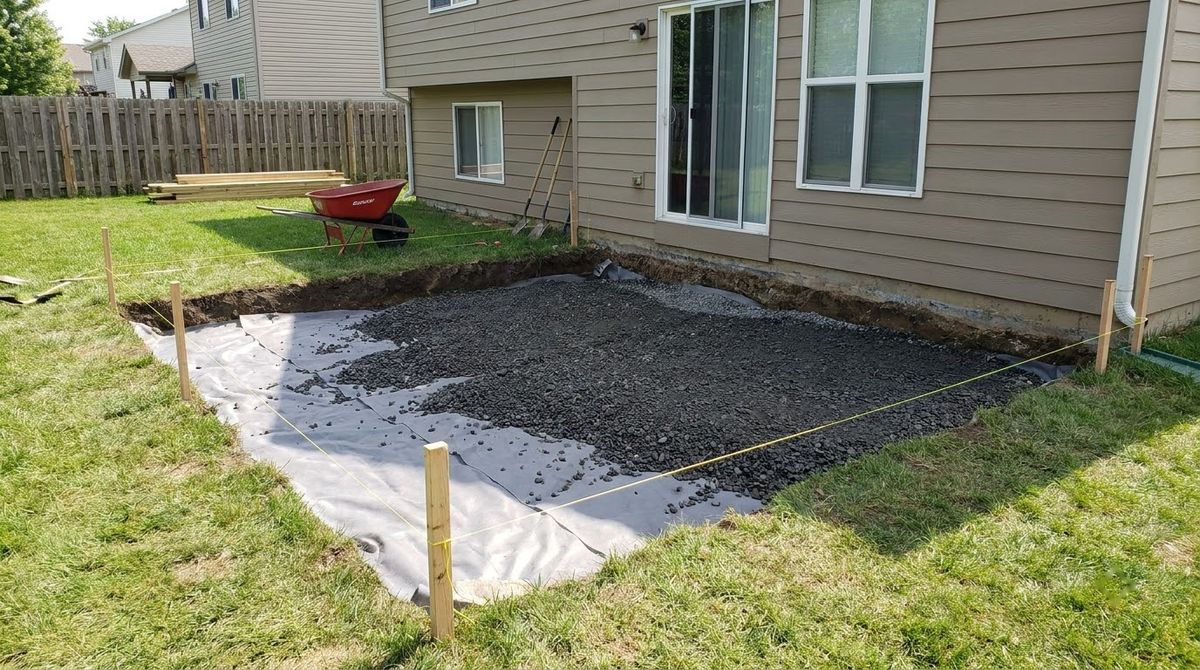
- CMHA (formerly ICPI), PAV-TEC-002: at least 4 inches after compaction for sidewalks and patios over well-drained soil, and thicker in colder climates or on wet or weak soil.
- Rochester Concrete Products: 4 to 6 inches for foot traffic; the minimum on well-drained or undisturbed soil, the maximum on poorly drained or disturbed soil.
- Unilock, by subsoil: 6 inches on sandy soil, 8 on silty soil and 10 on clay for patios and walkways. Its contractor guide gives 6 to 8 inches on well-draining subsoil and 10 to 12 on poor-draining subsoil.
To turn that into a dig depth, stack the layers. A 4-inch base, 1 inch of sand and a 2⅓-inch paver come to about 7⅓ inches, close to Rochester’s 7 to 9 inches. Unilock’s clay column, with a 3-inch paver, comes to 14 inches, plus any loose soil you have to remove.
Dig wider as well as deeper. Unilock says to excavate at least 6 inches past the paver edge, and CMHA’s edge-restraint note says the base should extend beyond the restraint by at least its own thickness: 6 inches of base, 6 inches past the spikes.
What gravel to use for a paver base
The gravel for a paver base is crushed stone, compacted in place. CMHA says the aggregate base your city or state specifies under asphalt is adequate under pavers; Unilock’s contractor guide names ASTM D2940 road base gravel. Unilock’s guides describe two kinds:
- Dense-graded base (with fines). Unilock describes ¾-inch stone mixed with sand, sold as three-quarter minus or road base. Unilock calls it time-tested but slower to drain, and it needs more compaction. Pair it with a sand bed.
- Open-graded base (no fines). ¾-inch clear stone, ASTM No. 57, drains freely and needs less compaction. Unilock pairs it with a 1-inch bed of ⅛-inch chip (ASTM No. 8 or 9) instead of sand.
Can you install pavers over dirt? Unilock’s answer is no: soil alone lacks the stability and drainage of a gravel base. What you can and should do is strip the topsoil and organics, then compact the firm subsoil underneath. CMHA says to remove roots, debris and large rocks and replace them with compacted aggregate.
Geotextile, clay soil and frost
Geotextile, clay and frost all push the same way: a thicker base and more care at the bottom of the hole. A separation fabric between soil and gravel stops soil from working up into the base, which CMHA says reduces rutting and keeps the base carrying load longer.
- When to use fabric. CMHA calls it optional and lists soils that stay saturated part of the year, freeze-thaw areas, and clay or moist silty subgrades. Rochester adds fabric and extra base when soil is saturated more than half the time.
- How to lay it. Overlap seams at least 12 inches, run it up the sides of the excavation, and keep it free of wrinkles (CMHA). Unilock also puts fabric on any vertical edge that touches soil.
- Where not to put it. CMHA’s edge-restraint note uses a 12-inch strip along the edges to stop sand loss, and says fabric should never go on top of the bedding sand.
Cold climates add two rules. CMHA notes greater base thicknesses where there are many freeze-thaw cycles or expansive soils, and says never to place base on frozen soil or use frozen base material. On clay or soil that stays wet, start at the deep end of the ranges above, as Unilock and Rochester do.
Installing paver base: compacting in lifts and leveling
Installing paver base means spreading gravel in layers and compacting each one before the next goes down. Compaction, not depth alone, is what stops sinking; CMHA calls subgrade and base compaction critical to minimizing settlement.
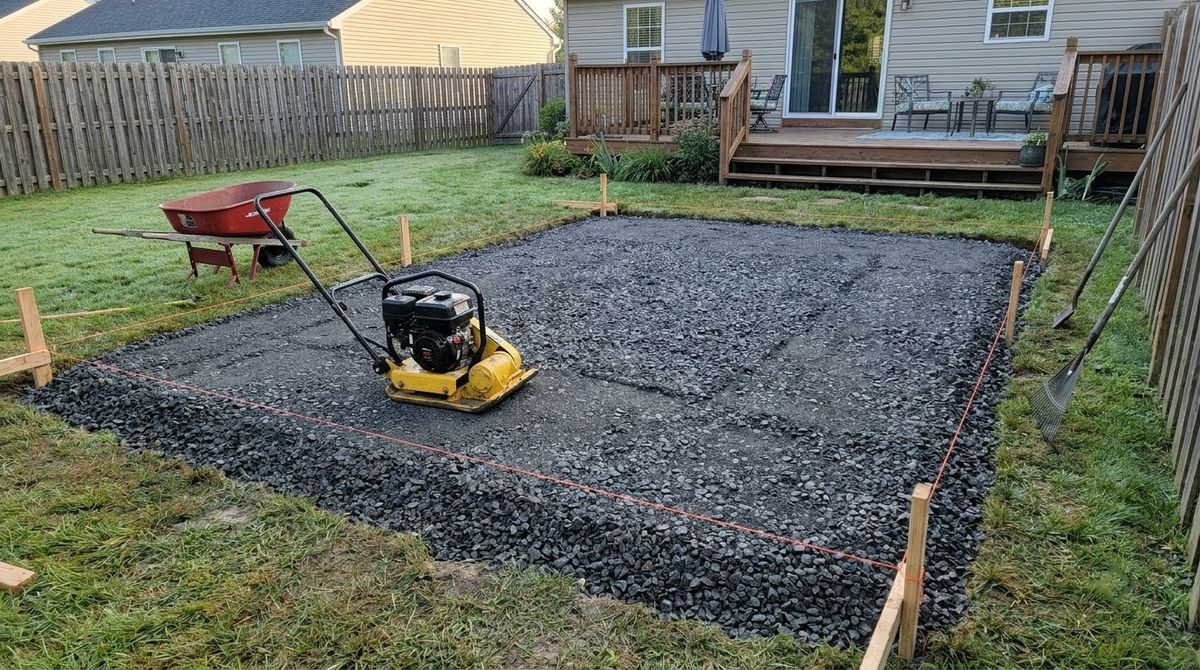
- Compact the soil first. CMHA calls for at least 98% standard Proctor density on the subgrade and on the base for patios and residential driveways.
- Match lift thickness to your machine. CMHA uses 4- to 6-inch lifts with a 7,000 lbf reversible plate and thinner lifts with a 5,000 lbf plate. Rochester caps lifts at 4 inches, and Unilock’s guides call for 3-inch layers.
- Get the moisture right. Rochester says to wet the gravel but not soak it. For soil, CMHA’s field test is a handful that holds together as a ball and breaks into a few pieces when dropped from 6 to 12 inches.
- Make passes count. Unilock’s contractor guide calls for at least three passes per 3-inch layer.
How to level paver base: set string lines at the finished paver height and slope, then measure down to the gravel as you rake and compact.
Rochester levels the compacted base about 3 inches below the finished surface. CMHA gives the same 3 inches for a 2⅓-inch paver on 1 inch of sand, which allows about ¼ inch of settling when the pavers are compacted and ⅛ inch over time.
Check the finished base with a 10-foot straightedge. CMHA allows no more than ±⅜ inch of variation. Anything outside that gets more gravel and another pass of the compactor, not extra sand.
Patio paver sand: bedding depth and type
Patio paver sand under the pavers is a thin leveling layer, not structure. CMHA specifies bedding sand meeting ASTM C33, sold as concrete sand, screeded to a loose nominal 1-inch thickness; Unilock and Rochester also use 1 inch.
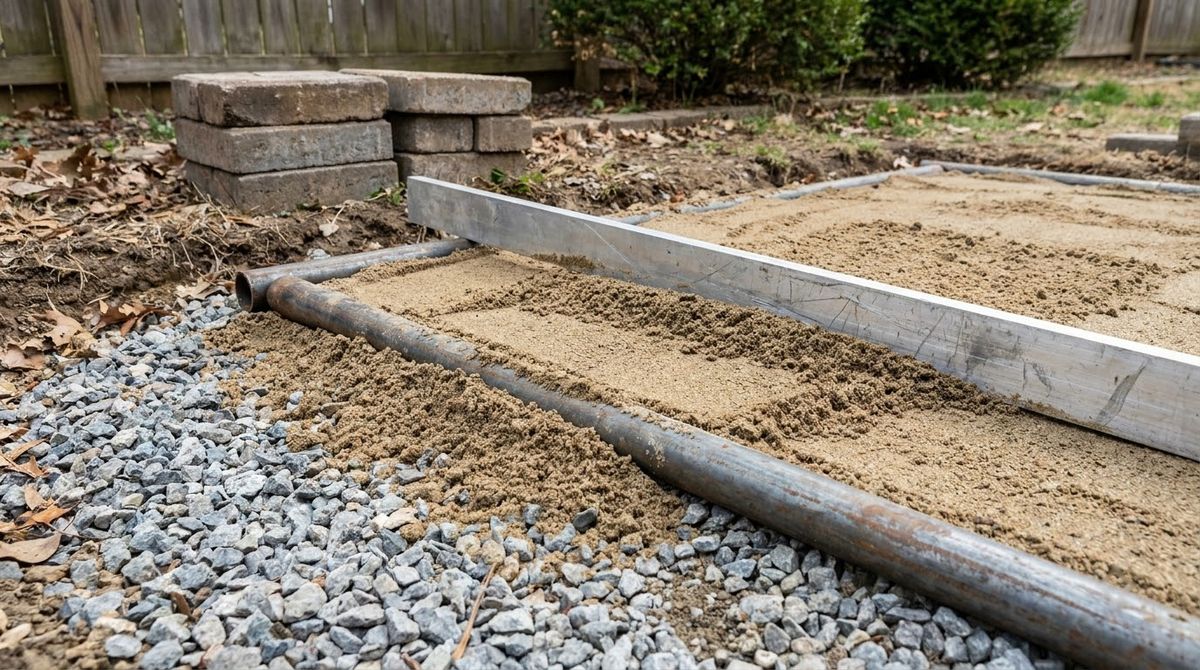
- Use sharp, washed sand. CMHA says never use masonry sand, limestone screenings or stone dust; they do not compact evenly and slow drainage through the bed. Unilock warns that wet fines cause ruts.
- Screed on 1-inch pipes. Lay pipes on the base, fill, pull a straight board across, then remove the pipes and fill the grooves.
- Stay off it. Do not walk on screeded sand; lay pavers from the pavers already set.
- Keep it dry. CMHA says frozen or saturated sand should not be installed.
Too much sand is a common reason pavers sink. CMHA’s maintenance guide lists excessive bedding sand thickness among the causes of depressions, alongside washed-out bedding and joint sand.
Slope for drainage
Slope for drainage is built into the base, not added with sand at the end. Rake and compact the gravel to the same fall you want on the finished surface, so the sand bed stays an even inch from one side to the other.
- Rochester: about 1 inch every 8 feet, roughly 1%.
- Unilock: 1 to 2% on its homeowner pages, 1.5 to 2% in its contractor guide.
- CMHA: a minimum of 1.5%, a little under 3/16 inch per foot.
On a patio that runs 12 feet out from the house, that is about 1½ inches of fall at Rochester’s rate and 2 to 3 inches at 1.5 to 2%. Always slope away from the house, and hold one rate across the whole base.
Edge restraint: what keeps a paver base from spreading
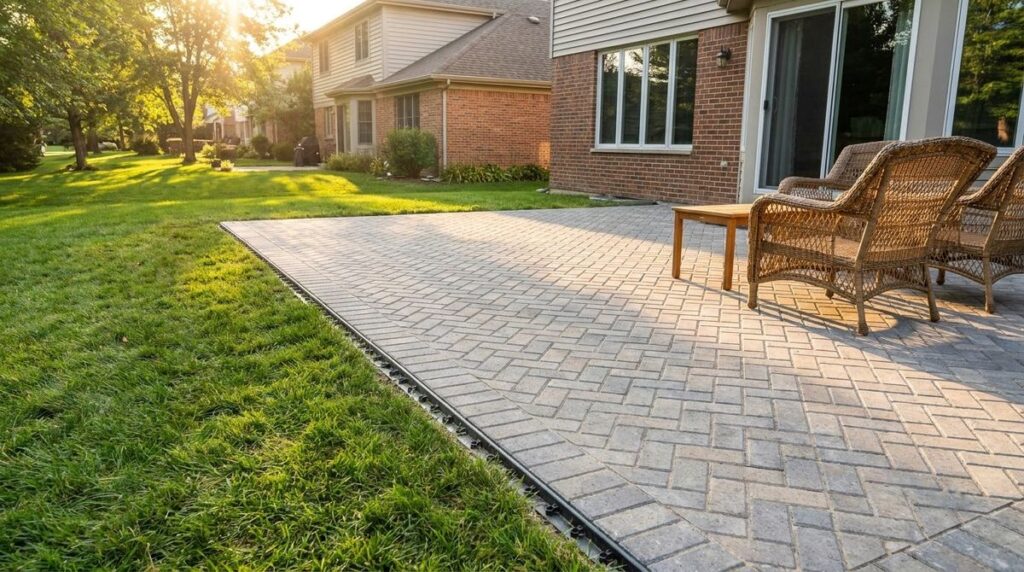
Edge restraint is what keeps pavers interlocked; without it the outer rows creep outward, joints open and the edge drops. Unilock calls restraints critical to durability, and its contractor guide says every edge of a paver patio must be restrained; buildings and other rigid structures act as their own restraint.
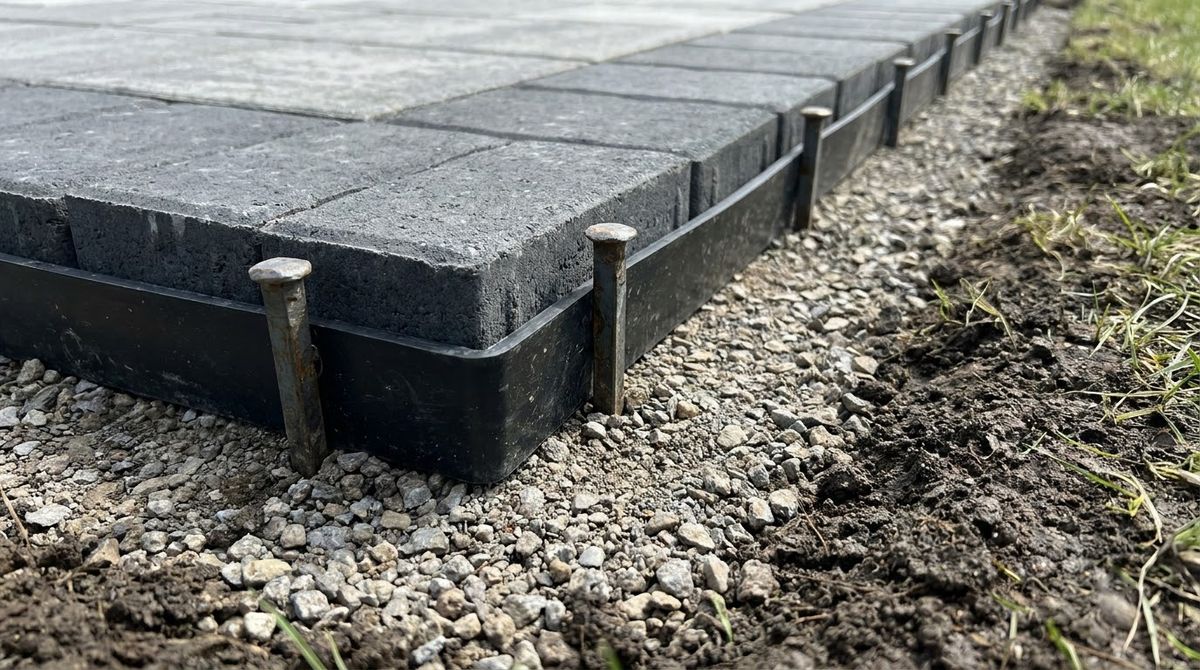
- Set restraints on the base, not the sand. Unilock, Rochester and CMHA all set edging on the compacted gravel.
- Spike into gravel. Unilock’s contractor guide shows 12-inch spikes; CMHA says spikes for plastic and aluminum edging should never go into soil. Follow the edging maker for spacing.
- Use real paver edging. CMHA says flat landscape edging is not an acceptable restraint, timber eventually rots, and soil backfill is never a restraint.
- Touch at least 1 inch of paver. CMHA’s minimum vertical contact between the restraint and the paver side.
Why pavers sink or heave, and how to check an existing base
Pavers sink or heave because something under them moved. CMHA’s maintenance guide traces depressions to settlement of the soil or gravel base, often from poor compaction, plus a saturated base, too much bedding sand, or sand washed out through gaps. Heaves are usually frost lifting the soil below.
- Low spot in the field: base or subgrade settled. Lift the pavers, add and compact base, rescreed, relay.
- Sinking along the edge: lost edge restraint. CMHA says it shows within 1 to 2 feet of the edge as widening joints and rotating pavers.
- Raised hump after winter: frost heave. CMHA’s fix is a frost-resistant subbase, and a geotechnical engineer if frost is not the cause.
- Standing water: a dip in the base reflecting through, or a surface sloped too flat.
To check an existing patio, CMHA suggests looking twice a year, once during or right after rain, when puddles show settlement. Lay a 10-foot straightedge across suspect areas and measure the gap; trust that over your eye, because shadows exaggerate depth. Lift one paver at a low spot to see whether the sand is thick, wet or washed out.
Small fixes are routine. CMHA says to top up joint sand once it has dropped more than ½ inch and to repair lifted pavers with more than ⅛ inch of lippage before winter.
Paver base mistakes to avoid
Most failed paver patios trace back to a few base mistakes, all avoidable with the numbers above:
- One thick dump of gravel compacted once from the top, instead of lifts matched to the compactor.
- Building on topsoil or loose fill instead of firm, compacted subsoil.
- Leveling with sand rather than fixing the base; CMHA says unevenness in the bedding reflects through to the surface.
- Stone dust or masonry sand as bedding, which holds water and ruts.
- Edging spiked into dirt, or no base past the edge to spike into.
- A 4-inch base on wet clay in a frost area; the minimums assume well-drained soil.
Hire a hardscape contractor when the patio sits on wet or expansive clay, will carry vehicles, or needs drain pipe. CMHA recommends perimeter drain pipe in clay or slow-draining soils under vehicles. Call 811 a few days before any digging, as Rochester advises.
For bids, see what a paver patio costs per square foot; for layouts, paver patio ideas by pattern and size; for stone, flagstone patio bases and setting options.
Frequently asked questions
How deep should a paver base be for a patio?
Plan on 4 to 12 inches of compacted gravel. CMHA sets 4 inches as the minimum on well-drained soil, Rochester Concrete Products uses 4 to 6 inches for foot traffic, and Unilock goes from 6 inches on sand to 10 on clay. Add the 1-inch sand bed and the paver thickness to find how deep to dig.
Can you install pavers directly over dirt?
No. Unilock says soil alone does not give pavers the stability or drainage of a gravel base, and pavers laid on dirt shift and sink. Strip the topsoil and organic material, compact the firm subsoil, add separation fabric if the soil is wet clay, then build the compacted gravel base and sand bed on top.
How thick should the sand be under pavers?
About 1 inch, screeded loose. CMHA, Unilock and Rochester Concrete Products all use 1 inch of coarse concrete sand, with no thicker layer to make up for a rough base. More is worse: CMHA lists excessive bedding thickness as a cause of depressions. Never use stone dust, limestone screenings or masonry sand as bedding.
How do you level a paver base?
Level and slope the gravel, not the sand. Run string lines at finished height and slope, measure down as you rake each lift, and compact. CMHA allows no more than plus or minus 3/8 inch under a 10-foot straightedge. Fill low spots with base gravel and recompact, then screed an even 1-inch sand bed on pipes.
Do you need landscape fabric under a paver base?
Not always. CMHA treats geotextile as optional and recommends it where soil stays wet part of the year, over clay or moist silty soil, and in freeze-thaw areas. Lay it on the compacted soil under the gravel, overlap seams at least 12 inches and turn it up the sides. Never put fabric on top of the bedding sand.
Why are my patio pavers sinking?
The soil or gravel under them settled. CMHA’s maintenance guide names poor compaction, a saturated base, too much bedding sand and sand washing out through gaps; sinking at the edges points to failed edge restraint. Check with a 10-foot straightedge, then lift the pavers, rebuild and compact the base, rescreed and relay them.
Sources
- Concrete Masonry & Hardscapes Association (formerly ICPI), Construction of Interlocking Concrete Pavements, PAV-TEC-002 (revised 2022).
- Concrete Masonry & Hardscapes Association, Edge Restraints for Interlocking Concrete Pavements, PAV-TEC-003 (revised 2022).
- Concrete Masonry & Hardscapes Association, Operation and Maintenance Guide for Interlocking Concrete Pavement, PAV-TEC-006 (checked October 2026).
- Unilock, How To Install a Paver Patio Base (checked October 2026).
- Unilock, How-To Build: Patio on Grade (contractor guide, checked October 2026).
- Rochester Concrete Products, Paver Installation Guide (2018).