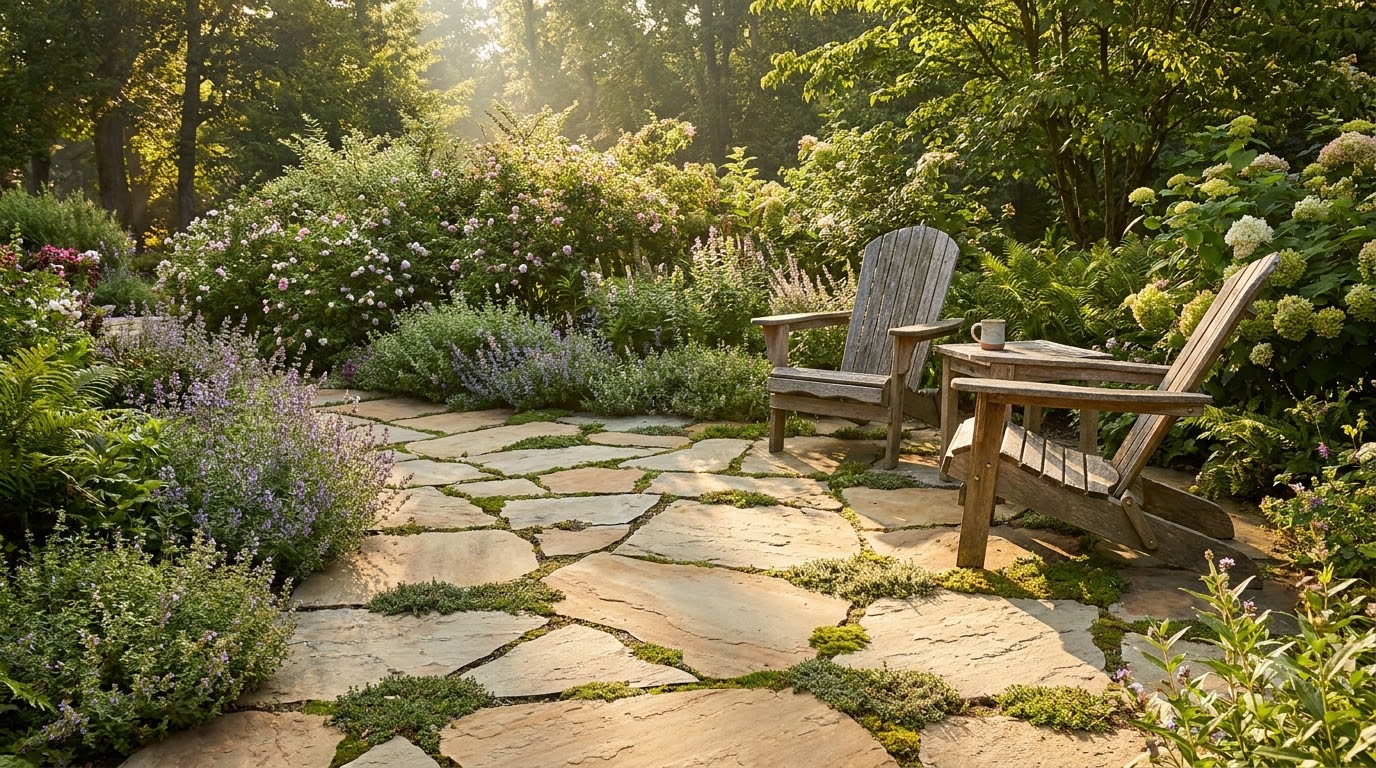
Flagstone patio ideas all hinge on one early decision: dry-laid or mortared. Dry-laid stone sits on a compacted base, tolerates frost heave, can be lifted and reset, and lets you plant the joints. Mortared stone sits on a concrete slab, gives tight formal joints and a rigid surface — and cracks if the slab beneath ever moves. Choose that first; pattern, joint filler and stone type all follow from it.
Key takeaways
- Dry-laid = forgiving and DIY-able. Mortared = formal and rigid, and only as good as the slab under it.
- Buy thick stone for dry-laid work — roughly 1½ to 2 inches; thin flagstone is for mortaring.
- Joints set the character: polymeric sand for tidy, gravel for informal, planted thyme for a garden look.
- The base does the work — excavate, compact, and screed properly, or the prettiest stone still rocks underfoot.
- Match stone to climate: dense stone survives freeze-thaw; soft porous stone spalls in hard winters.
Dry-laid vs mortared
| Dry-laid | Mortared | |
|---|---|---|
| Sits on | Compacted gravel plus setting bed | Concrete slab |
| Frost movement | Flexes and settles; resettable | Cracks if the slab moves |
| Joints | Sand, gravel or planting | Mortar, tight and uniform |
| DIY difficulty | Manageable — heavy but forgiving | Harder; masonry skills required |
| Repairs | Lift the stone, re-screed, replace | Cut out and re-mortar |
| Look | Natural, garden, informal | Formal, architectural |
| Drainage | Permeable through the joints | Runs off the surface |
For most backyards, dry-laid wins: cheaper, more forgiving, kinder to trees and drainage, and mistakes are reversible. Mortared belongs where you already have a sound slab or want a crisp formal terrace.
Choosing the stone
- Sandstone — the warm buff and rust tones most people picture; easy to work, moderately durable, and it wants a decent freeze-thaw rating in cold regions.
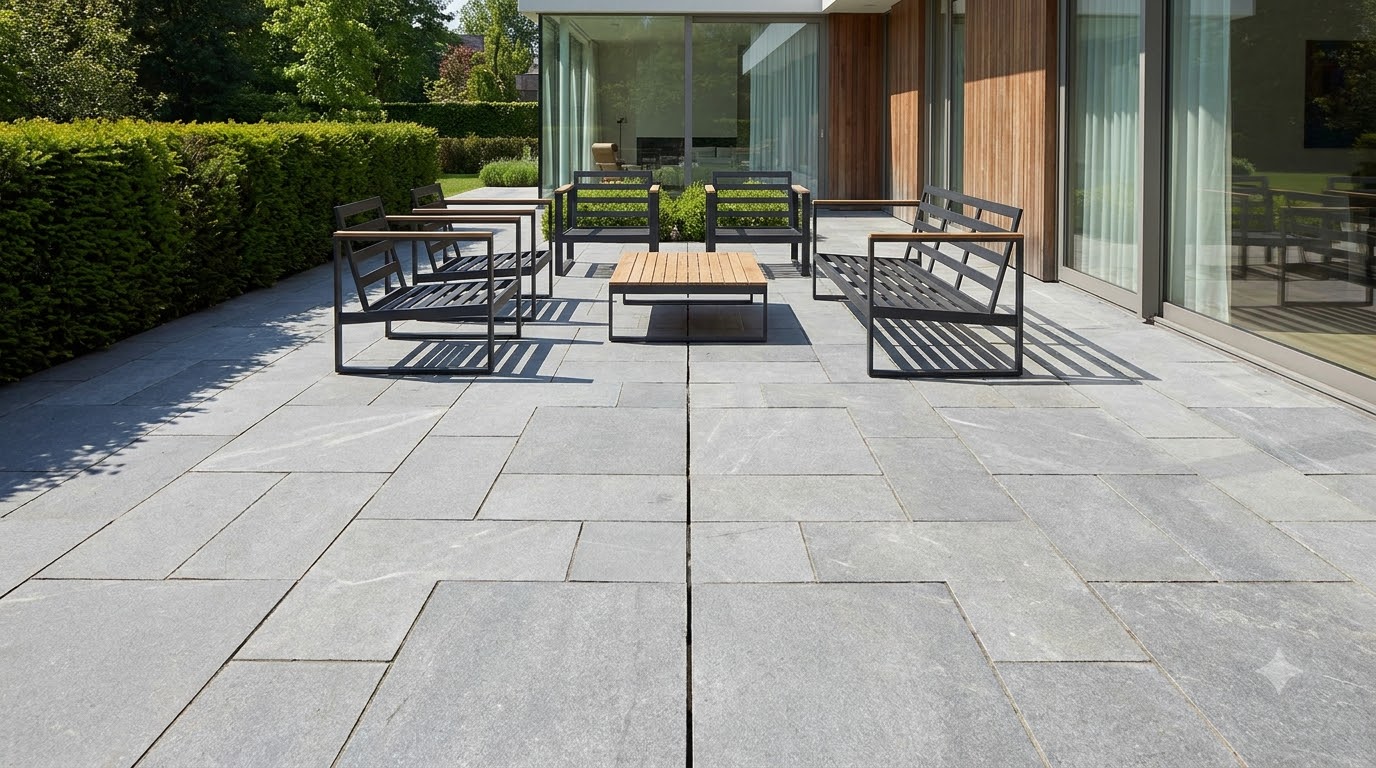
- Bluestone — dense, uniform and hard-wearing; the classic choice for formal patios, available cut square or irregular.
- Limestone — pale and elegant, stays cooler underfoot; softer, so check suitability for freeze-thaw and de-icing salts.
- Quartzite — very hard and slip-resistant with a sparkle in the cleft; the premium option.
- Local stone — almost always the best value and the best fit visually, since it matches the geology your house sits in. A permeable dry-laid patio also counts toward the kind of runoff reduction the US EPA green infrastructure guidance recommends for residential lots.
Two practical rules: buy thicker stone for dry-laid patios so pieces do not crack or rock, and buy the whole patio in one delivery — stone color varies noticeably between quarry runs.
Flagstone patio ideas by pattern
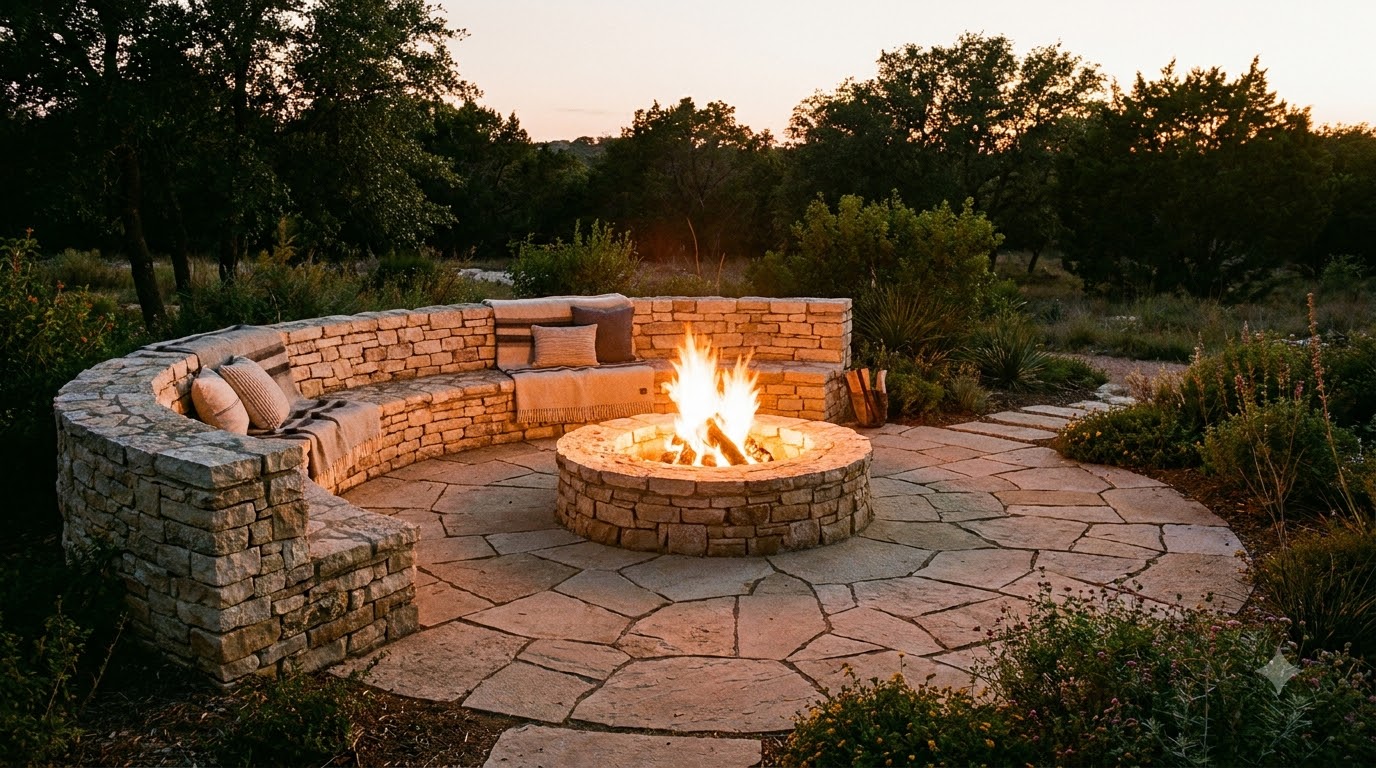
- Irregular natural cleft. Jigsaw-fitted random shapes with modest joints — the quintessential garden patio, and the most forgiving of imperfect cuts.
- Cut ashlar rectangles. Sawn stone in a repeating pattern with tight joints — formal, architectural, and the most expensive to buy and lay.
- Random rectangular. Mixed sizes of squared stone fitted into a running pattern — the middle ground, tidy but not rigid.
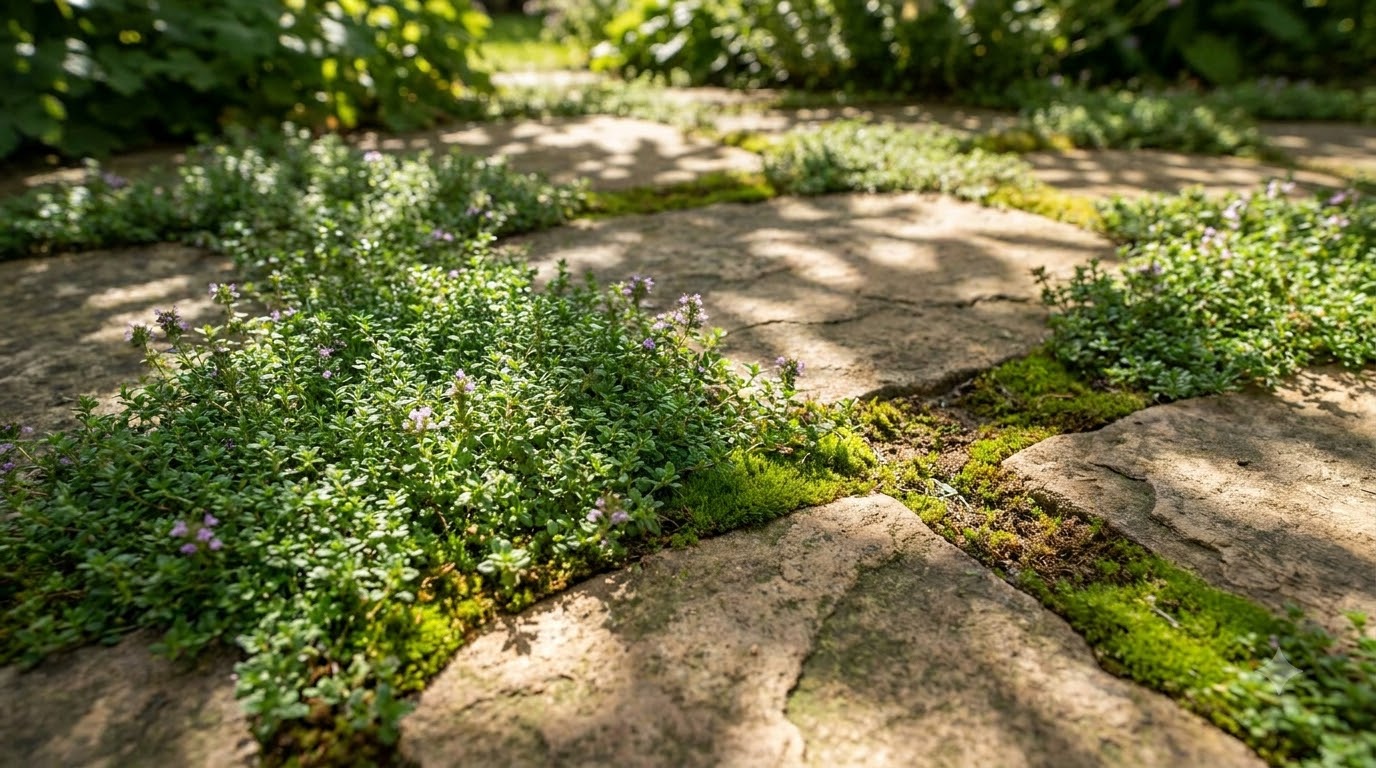
- Wide planted joints. Stones spaced deliberately apart with creeping herbs between — softens hardscape and drains beautifully.
- Stepping stones into lawn. Flagstone that dissolves into grass at the edges, blurring where the patio ends.
- Flagstone with a gravel field. Large stones set in compacted gravel — cheapest way to cover area, and very much in style.
Joints: the detail that sets the mood
- Polymeric sand — hardens after wetting, resists weeds and washout; the tidy default for tight joints.
- Stone dust or coarse sand — traditional and cheap; expect to top up and weed occasionally.
- Fine gravel — suits wide informal joints and drains freely.
- Planted joints — creeping thyme, Irish moss, sedum. Choose tough, low, foot-tolerant species and keep them out of the main walking line.
- Mortar — only for stone on a slab. Mortaring joints on a dry-laid patio cracks within a season.
Laying a dry-laid patio, in order
- Excavate to allow for base plus setting bed plus stone thickness, sloping away from the house at about a quarter inch per foot.
- Compact a gravel base in layers — this is the step that decides whether the patio stays flat.
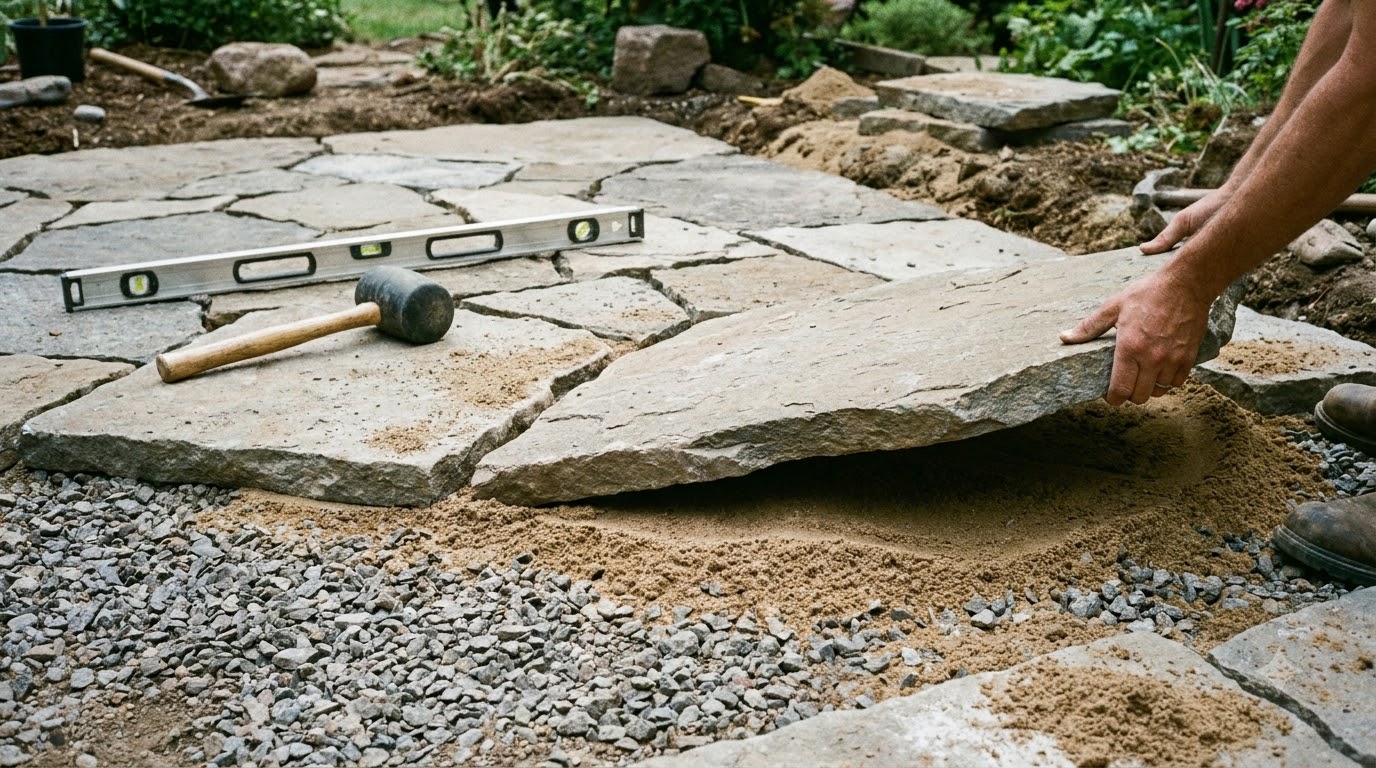
- Screed a setting bed of sand or stone dust to a consistent thickness.
- Dry-fit the stones first, shuffling shapes until the joints look even. Take a photo before you commit.
- Set each stone with a rubber mallet, checking level and slope constantly; add or remove bedding rather than forcing stones down.
- Fill the joints, sweep, wet, and top up as they settle.
Budget-wise, stone is the material cost and labor is the rest — which is why doing the excavation and laying yourself changes the total more than the choice of stone does. If the numbers still look steep, a budget concrete patio with a stone border gets a similar effect for less.
Maintenance and common mistakes
- Wash off algae and moss film in damp shade — that film, not the stone, is what makes a patio slippery.
- Seal only if you want the wet-look color, and use a matte outdoor sealer with a non-slip additive.
- Top up joints each spring; washout is normal on dry-laid work.
- Do not mortar a dry-laid patio to stop weeds — it cracks and traps water.
- Do not skimp on base depth in freeze-thaw climates; rocking stones almost always trace back to a thin base.
- Avoid de-icing salts on softer stone; they accelerate spalling.
Frequently asked questions
Is a flagstone patio cheaper than pavers?
Usually not. Natural flagstone costs more per square foot than concrete pavers and takes longer to lay because every stone is a different shape. Dry-laying it yourself closes much of the gap, since labor is the larger share of an installed stone patio.
Should flagstone be dry-laid or set in mortar?
Dry-laid on a compacted base is the DIY-friendly, frost-tolerant choice: stones can be lifted and reset, and joints can be planted. Mortared flagstone on a slab gives a rigid, formal surface but cracks if the slab beneath moves.
What goes between flagstone joints?
Polymeric sand for tight joints that resist weeds, ordinary sand or stone dust for a traditional look, gravel for wide informal gaps, or soil planted with creeping thyme and moss. Mortar is only for stones set on a slab.
How thick should flagstone be for a patio?
For dry-laid patios choose thicker stone — roughly one and a half to two inches — so pieces do not crack underfoot or shift. Thin flagstone is intended for mortaring onto a solid base.
Do flagstone patios get slippery?
Natural cleft stone grips well when clean. Slipperiness comes from algae and moss film in damp shade, and from glossy sealers. Wash periodically and choose a matte non-slip sealer if you seal at all.
Can you lay flagstone over an existing concrete patio?
Yes, if the slab is sound, level and drains properly — that is the classic mortared installation. If the slab is cracked or heaving, fix the underlying problem first or dry-lay on a fresh base instead.