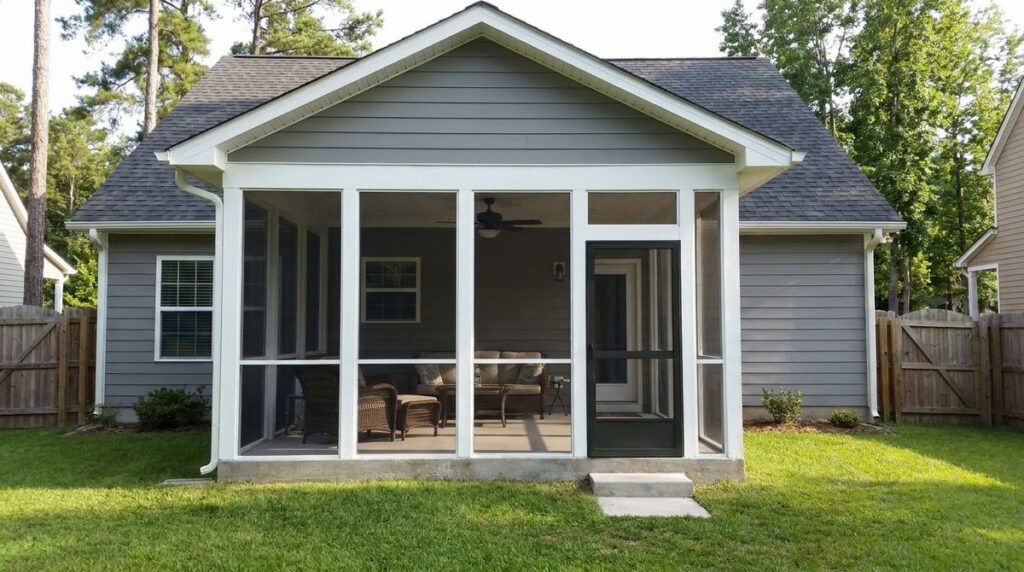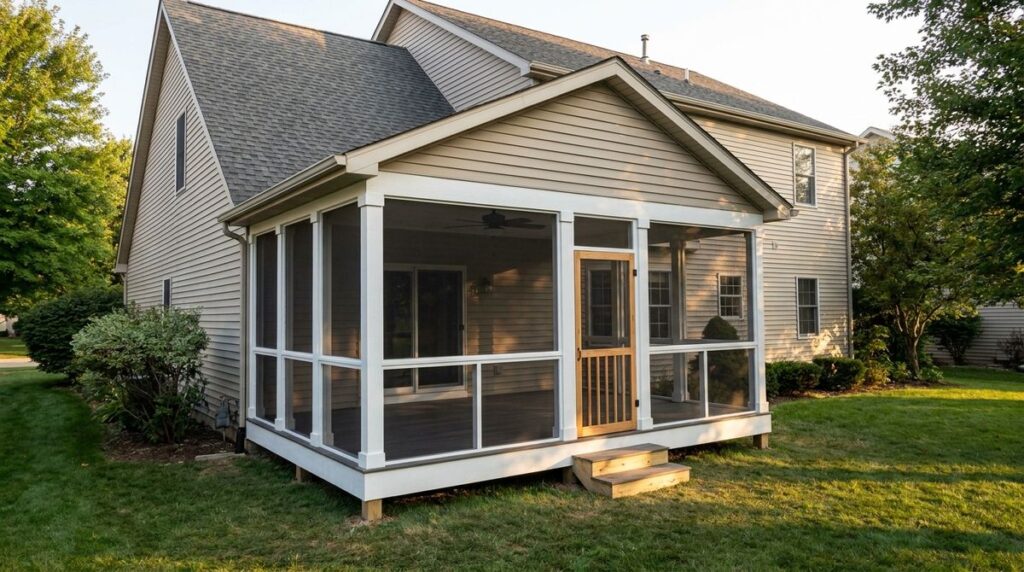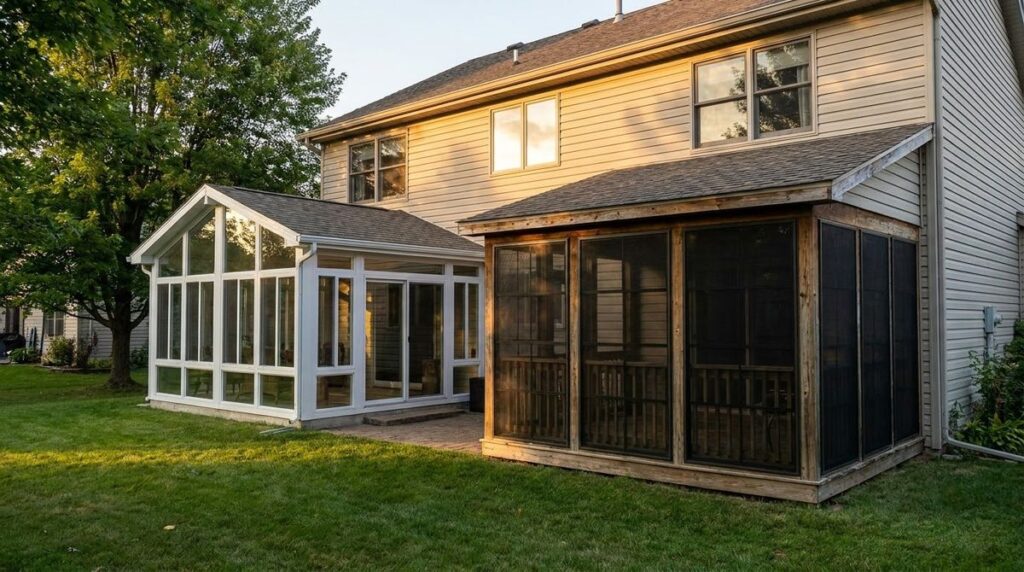
In the sunroom vs screened porch choice, a sunroom costs about $100 to $350 per square foot and is built as a glass-walled room, while a screened porch costs $10 to $25 per square foot to screen an existing roofed porch, or $50 to $175 to build new, and stays outdoor space. Those figures come from HomeGuide’s 2025 and 2026 cost guides.
The bigger difference is legal, not visual. Once a sunroom is heated or cooled, the energy code treats it as conditioned space, with insulation, window and permit rules a screen room never faces. That one decision, heat or no heat, sets most of the cost gap.
Key takeaways
- A screened porch is the cheapest way to get a bug-free roofed space: $2,000–$5,000 to screen a 200 sq ft existing porch, per HomeGuide.
- A heated 4-season sunroom of the same 200 sq ft (10×20) runs $40,000–$66,000 in HomeGuide’s size table.
- The model code defines a sunroom as a one-story structure attached to a dwelling with glazing over 40 percent of its exterior walls and roof (IRC and IECC 2021).
- Heat changes the rules. A heated porch must meet the energy code; an unheated, thermally isolated one gets lighter insulation and window limits.
- Only a conditioned room usually adds square footage; HomeGuide says a screened porch does not.
| Option | Walls | Heated or cooled | Typical cost per sq ft | Counts as living space | Best for |
|---|---|---|---|---|---|
| Screened porch | Insect screen | No | $10–$25 (existing roof) / $50–$175 (new) | No | Warm evenings, bug-heavy summers, tight budgets |
| 3-season room | Glass or plastic windows | No | $80–$230 | Usually not | Stretching spring and fall, rain and pollen protection |
| 4-season sunroom | Insulated glass, insulated walls and roof | Yes | $200–$400 | Usually yes | Year-round use, a true extra room |
| Prefab sunroom kit | Factory panels, 3- or 4-season | Either | $20–$150 | Only if built as conditioned | An existing level slab or deck |
Costs: HomeGuide sunroom guide (Aug 2025) and screened-in porch guide (Feb 2026), installed national averages. Living-space column reflects HomeGuide’s square-footage and tax notes; your assessor decides.
Sunroom vs screened porch: what actually separates them
Sunroom vs screened porch is not just glass versus mesh. The 2021 International Residential Code (IRC) defines a sunroom as a one-story structure attached to a dwelling with a glazing area over 40 percent of the gross area of its exterior walls and roof. A screened porch has a roof and screen walls, and nothing that holds heat in.
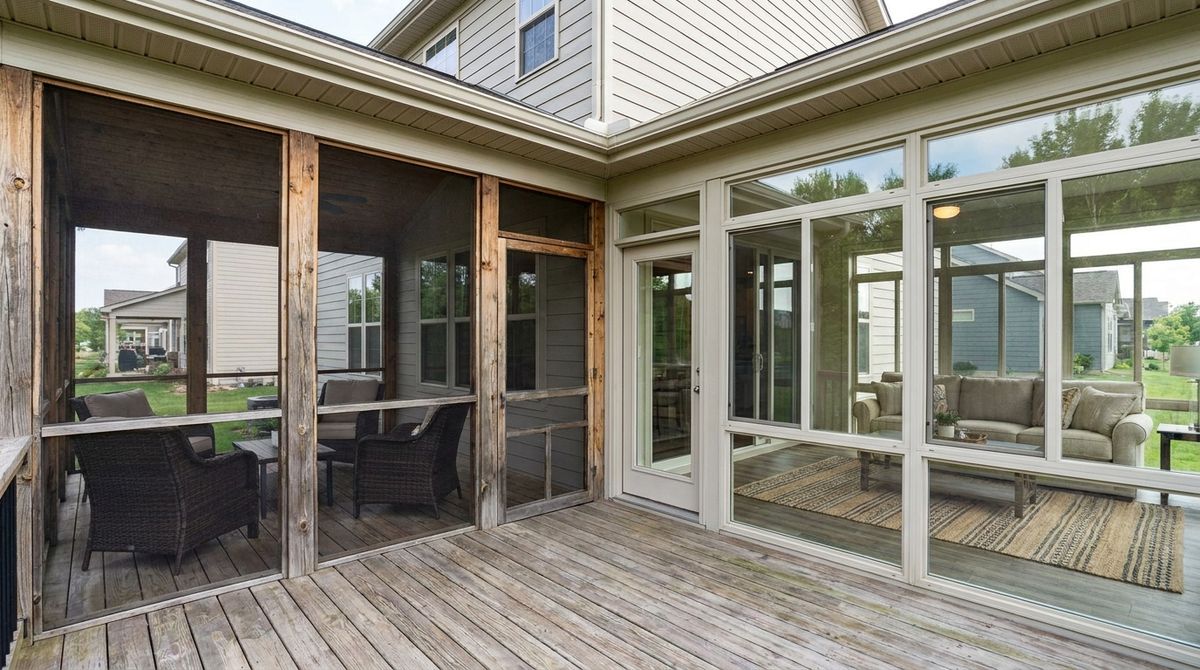
The IRC goes further. Section R301.2.1.1.1 sorts sunrooms into five categories that the permit applicant names on the plans:
- Category I: walls open or enclosed with insect screening or thin plastic film. Nonhabitable and unconditioned. This is the code’s view of a screen room.
- Categories II and III: walls enclosed with glass or plastic, still nonhabitable and unconditioned; Category III windows meet extra air and water tests. This is the typical 3-season room.
- Category IV: heated or cooled by a separate control or system and thermally isolated from the house. Nonhabitable but conditioned.
- Category V: heated or cooled and open to the main house. Habitable and conditioned, which is the 4-season sunroom most people picture.
So the real question is which category you are building. A screened porch with its own roof sits under the patio cover rules covered in the guide on how to build a screened in porch; a Category V room is built and inspected like an addition.
Cost compared at the same size
Cost comparisons only mean something at the same size, so the table below lines up 200 square feet, about a 10×20 room, from HomeGuide’s two guides. It shows the jump at each step: screens, then glass, then heat. For screen materials, roof and line-item prices, see the full screened in porch cost breakdown.
| Project, about 200 sq ft | Installed cost | What drives it |
|---|---|---|
| Screen in an existing roofed porch | $2,000–$5,000 | Screen framing, mesh, door |
| New screened porch | $10,000–$35,000 | Foundation, floor, roof |
| 3-season room, 10×20 | $16,000–$46,000 | Windows, foundation, finish |
| 4-season sunroom, 10×20 | $40,000–$66,000 | Insulation, insulated glass, HVAC, electrical |
Assumptions: HomeGuide screened-in porch cost (updated Feb 2026) and sunroom cost by size (Aug 2025), national averages, installed. Permits, HVAC extension and interior finishes can be extra.
Fixr’s sunroom guide (updated November 2022) lands in the same range: a custom-built 12×20 sunroom at $31,200–$72,000 and a prefab one at $12,000–$18,000, with additions averaging $130–$300 per square foot and conversions of an existing porch, patio or deck $80–$200.
The 4-season add-ons are where budgets move. HomeGuide lists $300–$5,000 to add or extend HVAC, $2,500–$15,000+ for a ductless mini-split, $1,000–$6,000 for a sunroom foundation, and $3,500–$12,000 for about 10 windows. A screened porch carries none of those lines.
Permits and energy code: conditioned space vs not
Permits and energy code rules split on one word: conditioned. The 2021 International Energy Conservation Code (IECC) calls a space conditioned when it sits inside the building thermal envelope and is directly or indirectly heated or cooled, including a room that opens to heated space or has uninsulated ducts in it.
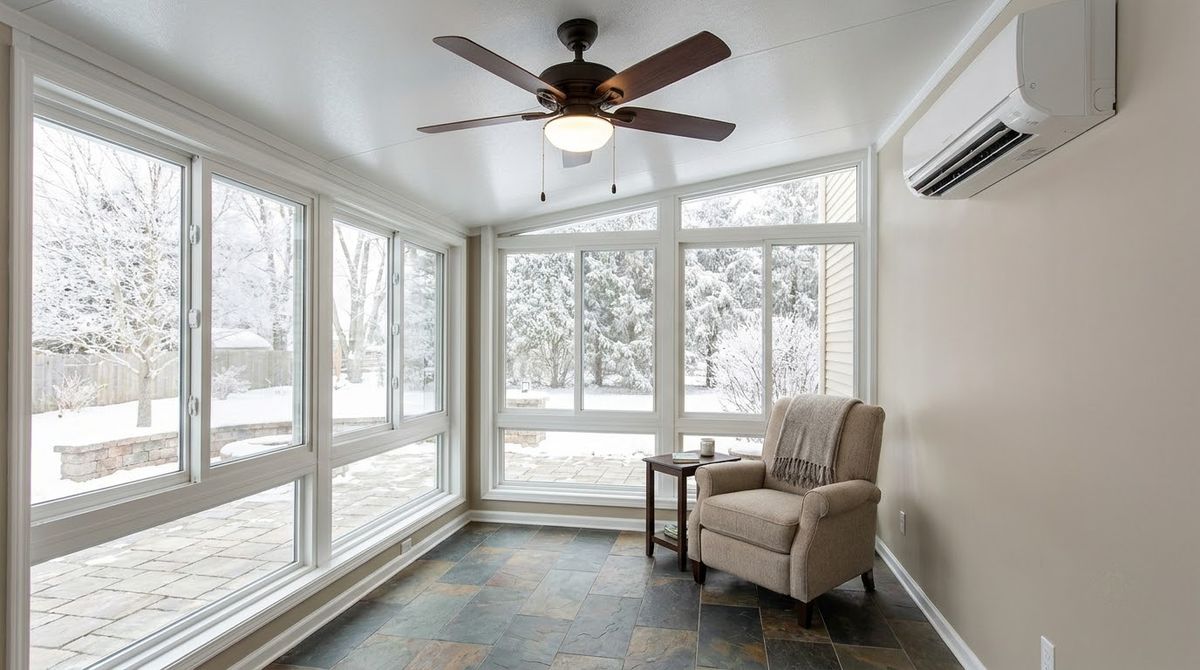
A 4-season sunroom that opens to your kitchen is conditioned space and must meet the full insulation and window rules for the house. The IECC gives a lighter path only to a sunroom with thermal isolation: a physical separation from the house plus its own heating and cooling zone or equipment.
- Insulation (IECC R402.2.12): a thermally isolated sunroom needs at least R-19 ceiling insulation in Climate Zones 0–4, R-24 in Zones 5–8, and R-13 walls everywhere.
- Windows (IECC R402.3.5): in Climate Zones 2–8, its windows may not exceed a U-factor of 0.45, and skylights 0.70.
- The wall between: walls and new windows separating that sunroom from the house must meet the full envelope rules.
- Habitable rooms (IRC R303.10): where the winter design temperature is below 60°F, habitable rooms need heat that holds 68°F, and portable space heaters do not count.
City handouts show how this plays out. Delano, Minnesota, requires a building permit for every new three- or four-season porch and for converting a three-season porch to four-season. Heated porches must comply with the state energy code, submit an energy calculation worksheet, use 2×6 wall studs instead of 2×4, and pass an insulation inspection.
Permit fees run about $200–$500 for a sunroom building permit in HomeGuide’s guide and $400–$600 in Fixr’s, and HomeGuide notes zoning, electrical and heating-cooling permits may be added. Your state may amend the IECC, so check with your local building department before you sign a contract.
Year-round use: what each one handles
Year-round use is what you buy with the extra money. A screened porch keeps out insects and, under a solid roof, most rain, but it holds no heat. HomeGuide lists “unusable during the winter when unheated” among sunroom drawbacks, and that applies to an unheated 3-season room too.
- Screened porch: best in mild and warm months; open to humidity, pollen, wind-driven rain and cold.
- 3-season room: blocks wind, rain and pollen, so spring and fall stretch longer; no insulation, so it follows outdoor temperatures.
- 4-season sunroom: insulated and heated or cooled, so it works like any other room. HomeGuide lists higher heating and cooling bills for 4-season rooms as a drawback.
Climate decides how much each step is worth. In a cold-winter area, only a heated room is usable in January. In a hot one, HomeGuide notes that uninsulated lanais suit the climate, so a screened space can cover most of the year.
Square footage, appraisal and taxes
Square footage is where a sunroom and a screened porch part ways on paper. HomeGuide says a screened porch does not add to a home’s total square footage, because added square footage needs heating, cooling and insulation like the rest of the home. It can still raise the property’s appraised value.
For sunrooms, HomeGuide says most three-season rooms are appraised as low as 25 percent of living space value per square foot, while four-season rooms with livable space are valued at the home’s normal price per square foot. The same guide notes a 4-season room raises property taxes, while many screen rooms and 3-season rooms are taxed as non-habitable patio space. Ask your county assessor how your county counts each one.
Lanai vs screened porch
Lanai vs screened porch is mostly a question of regional wording. Merriam-Webster defines a lanai as a roofed porch or veranda, from the Hawaiian word lānai. In Florida and Hawaii, the word often covers a covered patio or porch that may or may not be screened.
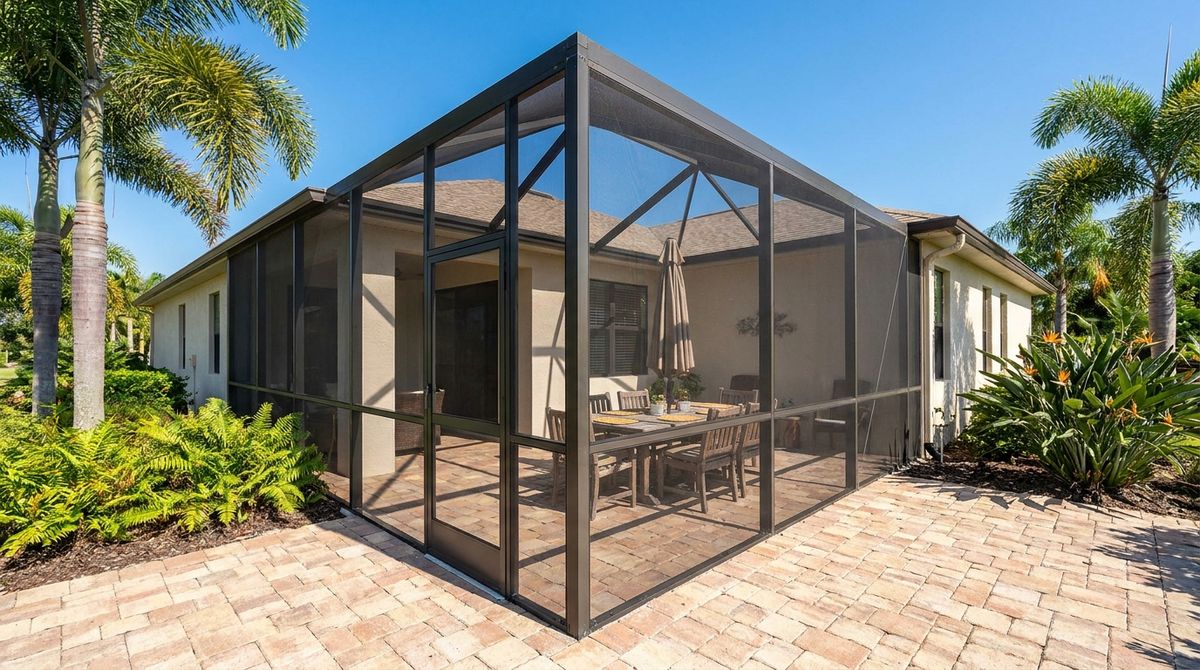
HomeGuide prices a lanai at $50–$175 per square foot, the same band as a new screened porch, and notes lanais suit hot climates because they usually have no insulation. Code-wise, a screened lanai is a Category I sunroom or a patio cover, not a habitable room.
Converting a screened porch to a sunroom later
Converting a screened porch to a sunroom later is common, but rarely a simple window swap. HomeGuide prices the conversion at $4,000–$20,000, plus a slab foundation and code upgrades where needed; Fixr puts converting a porch to a sunroom at $8,000–$50,000.
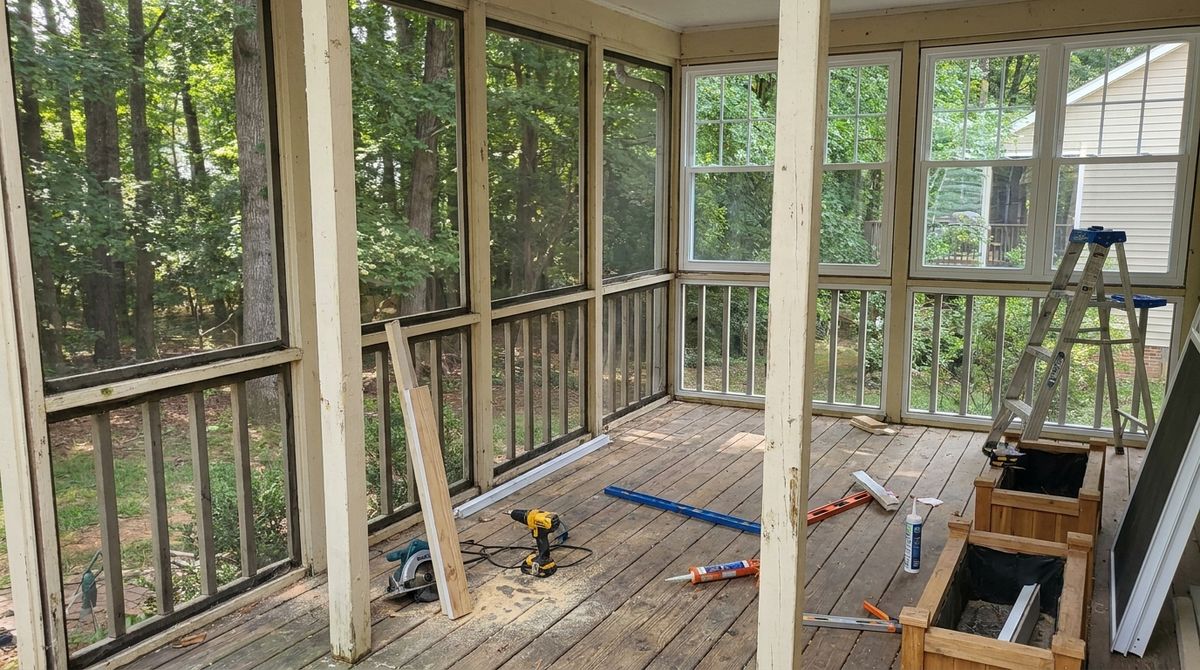
Fixr explains why: a screened porch must be brought up to the standards of an interior room, which may mean a new slab, insulation and extended heating and cooling. In Delano’s handout, a four-season porch also needs 2×6 walls where a three-season one can use 2×4. If you might glass it in, size footings, headers and wall framing for the room now, and keep the screen-porch budget separate from the room budget.
Which to build: verdict by situation
- Pick a screened porch if you already have a roofed porch, deck or patio, your main problem is bugs, and you use the space from late spring to early fall.
- Pick a 3-season room if wind, pollen or rain shorten your porch season and you do not need it in midwinter.
- Pick a 4-season sunroom if you want a room you can use every month, counted as living space, and can fund insulation, insulated glass and HVAC.
- Pick a screened lanai if you live in a hot climate where a glass room would overheat more months than it would stay comfortable.
- Pick a screened porch now, built heavy, if the budget only covers screens today but a sunroom is the long-term plan.
Mistakes to avoid when choosing
- Pricing a “sunroom” without naming the category. A 3-season quote and a 4-season quote are different buildings.
- Adding a space heater to a 3-season room and calling it a 4-season room. The IRC does not accept portable heaters for habitable rooms.
- Leaving the patio door open to an unheated room. An opening to heated space can make the room conditioned under the IECC definition.
- Counting on square footage from a screened porch. Without heat, cooling and insulation it usually does not count.
- Skipping the permit check. Delano requires a permit for every three- or four-season porch, and HomeGuide says screened porches typically need a building permit too.
- Building light now and enclosing later. Undersized footings and 2×4 walls can force a teardown when you upgrade.
Frequently asked questions
Is a sunroom or a screened porch cheaper?
A screened porch is much cheaper. HomeGuide puts screening an existing 200 sq ft porch at $2,000 to $5,000 and a new screened porch at $10,000 to $35,000. A 10×20 sunroom runs $16,000 to $46,000 as a 3-season room and $40,000 to $66,000 as a 4-season room, before permits and finishes.
Does a sunroom count as square footage?
A 4-season sunroom that is heated, cooled and insulated usually counts as living space and is valued at the home’s normal price per square foot, according to HomeGuide. Three-season rooms and screened porches usually do not count, because added square footage needs heating, cooling and insulation. Your county assessor makes the final call.
Do I need a permit for a sunroom?
Yes, in most places. HomeGuide says a sunroom needs a building permit costing about $200 to $500, and zoning, electrical and heating-cooling permits may be added. Delano, Minnesota, requires a permit for every new three- or four-season porch and an energy worksheet for heated ones. Check with your local building department first.
Can you turn a screened porch into a sunroom?
Yes, but it is often close to building a new room. HomeGuide prices the conversion at $4,000 to $20,000 plus any slab and code upgrades, and Fixr says a screened porch must be brought up to interior room standards, which may mean a new foundation, insulation and extended heating and cooling.
What is the difference between a lanai and a screened porch?
Merriam-Webster defines a lanai as a roofed porch or veranda, a word from Hawaiian. A screened porch is any roofed porch enclosed with insect screen. A lanai can be screened or open, and HomeGuide notes lanais usually have no insulation, which suits hot climates such as Florida and Hawaii.
Sources
- HomeGuide, How Much Does a Sunroom Cost? (Aug 22, 2025).
- HomeGuide, How Much Does a Screened-In Porch Cost? (Feb 11, 2026).
- Fixr, How Much Does It Cost to Build a Sunroom? (updated Nov 10, 2022).
- International Code Council, 2021 IECC Chapter 4 [RE], Sections R402.2.12 and R402.3.5; definitions from Chapter 2 [RE] (2021).
- International Code Council, 2021 IRC Chapter 3, Sections R301.2.1.1.1 and R303.10; sunroom definition from Section R202 (2021).
- City of Delano, Minnesota, Department of Building Inspections, Three and Four Season Porch Requirements (checked October 2026).
- Also cited by name: Merriam-Webster, “lanai” (checked October 2026).