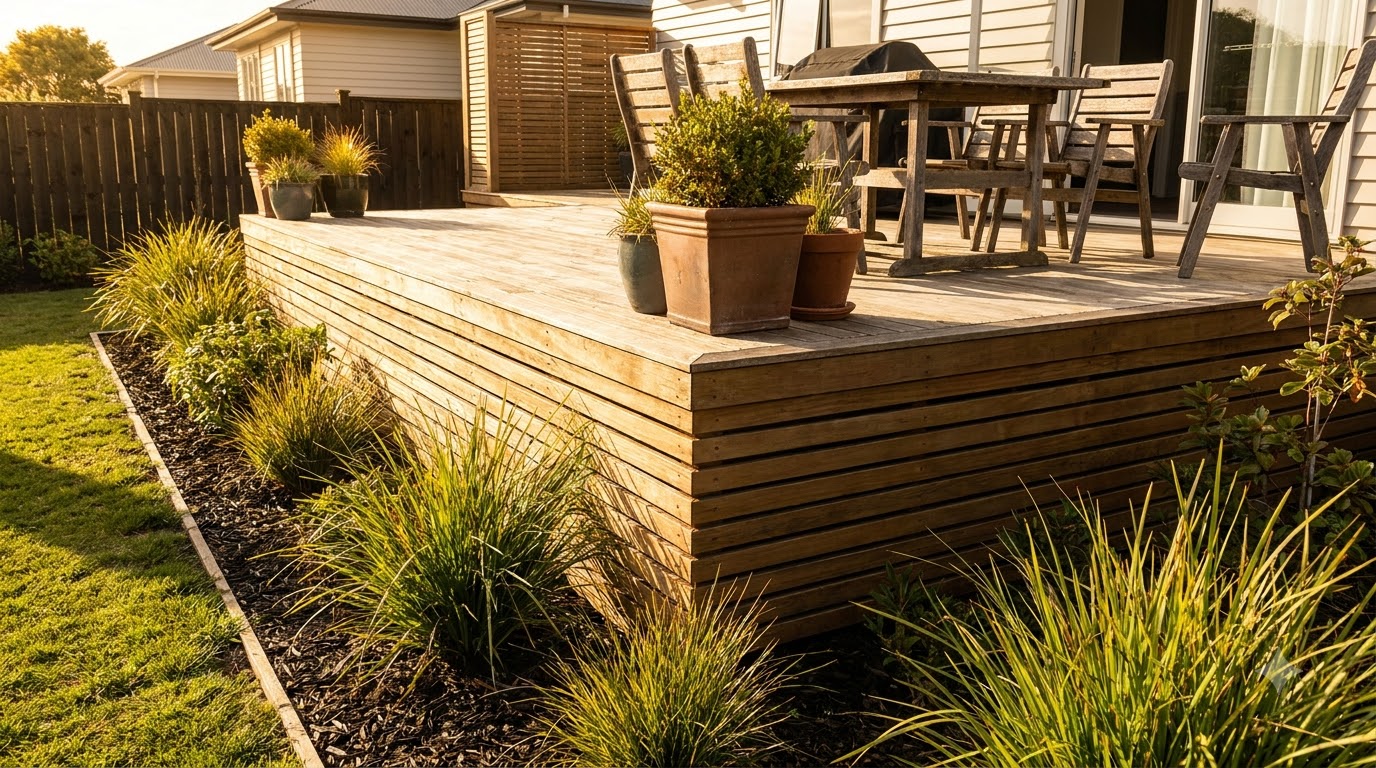
The best deck skirting ideas share one rule: never seal the underside airtight. Skirting hides framing, blocks animals, and finishes a raised deck — but a solid, unventilated skirt traps moisture against the joists and quietly rots the deck it was meant to smarten up. Below: 12 skirting options from cheap lattice to stone veneer, plus the airflow, access and animal-proofing details that decide whether skirting helps or hurts.
Key takeaways
- Airflow is the whole ballgame — lattice, spaced slats, or solid panels with deliberate vent gaps.
- Build in an access door. Shutoffs, cleanouts and stored things all live under there eventually.
- Hardware cloth buried in an L-shape is what actually stops digging animals; skirting alone does not.
- Keep the bottom edge off the dirt — a gap plus gravel beats mulch piled against the panels.
- Low decks may not need skirting at all — planting often looks better and costs less.
Ventilation first: why sealed skirting kills decks
The space under a deck is damp by nature: rain gets through the boards, ground moisture rises, and shade keeps it cool. Moving air carries that moisture away. Wrap the perimeter in solid panels with no gaps and the air stops moving — so the moisture stays, sitting against the joists, beams and ledger. Rot starts where nobody looks.
Practical targets when planning any of the ideas below:
- Keep openings continuous around the perimeter, not just on one side — air needs a route in and out.
- Leave a gap at the bottom (a couple of inches above grade or gravel) and vent near the top of the skirt.
- Solid materials need designed vents — louvered panels, vent grilles, or gaps between boards.
- Do not backfill soil or mulch against the skirt; it bridges moisture straight into the wood.
- Grade the ground to drain away from the deck before closing anything in — the American Wood Council deck guide covers the framing and clearance details a skirt has to work around.
Budget-friendly deck skirting ideas (1–4)
1. Lattice panels. The classic and the cheapest: pre-made treated or vinyl panels drop into a simple frame in an afternoon. Ventilates by default; paint it the trim color and it disappears.
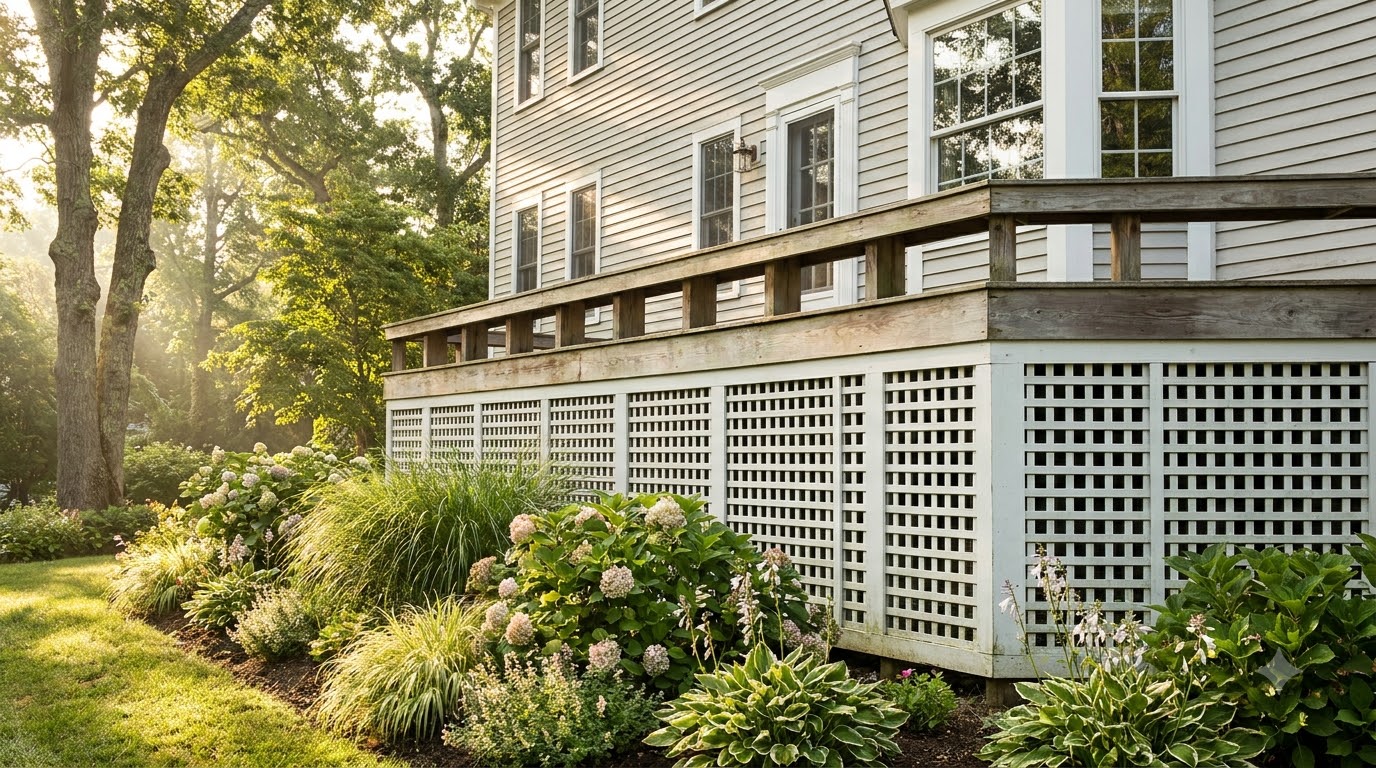
2. Spaced vertical boards. Deck boards run vertically with a consistent gap — costs a little more than lattice and looks a decade more modern.
3. Horizontal slats. The current favorite: wide boards laid horizontally with even reveals. Reads as designed cladding rather than a screen, and the gaps do the venting.
4. Corrugated metal panels. Framed sheets of galvanized or corten-look metal — farmhouse-industrial, extremely durable, cheap per square foot. Vent above and below.
Upscale skirting (5–8)
5. Stone or brick veneer. Makes a raised deck read as a solid extension of the house. The most expensive option here, and the one that most needs deliberate vents built in.
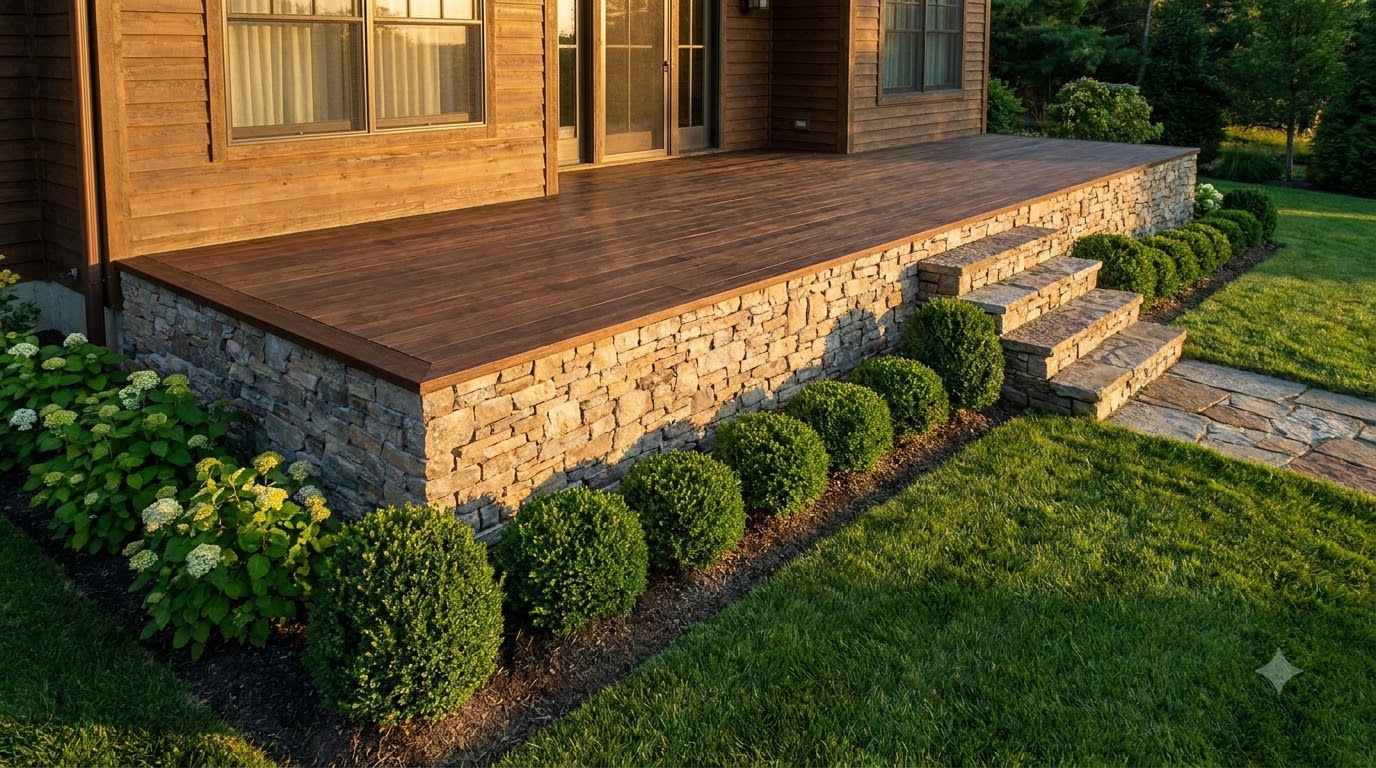
6. Composite panels matched to the decking. Color-matched, rot-proof, no repainting — the tidy answer when the deck surface is composite.
7. Board-and-batten. Vertical boards with battens over the seams; a traditional facade detail that suits cottage and farmhouse homes.
8. Framed trellis with climbers. A structural trellis skirt planted with climbing greenery — excellent airflow, and it improves every season.
Clever and practical (9–12)
9. Skirting with a hidden access door. A hinged or removable panel keyed to the slat pattern, invisible until you need it. Do this whichever style you choose.
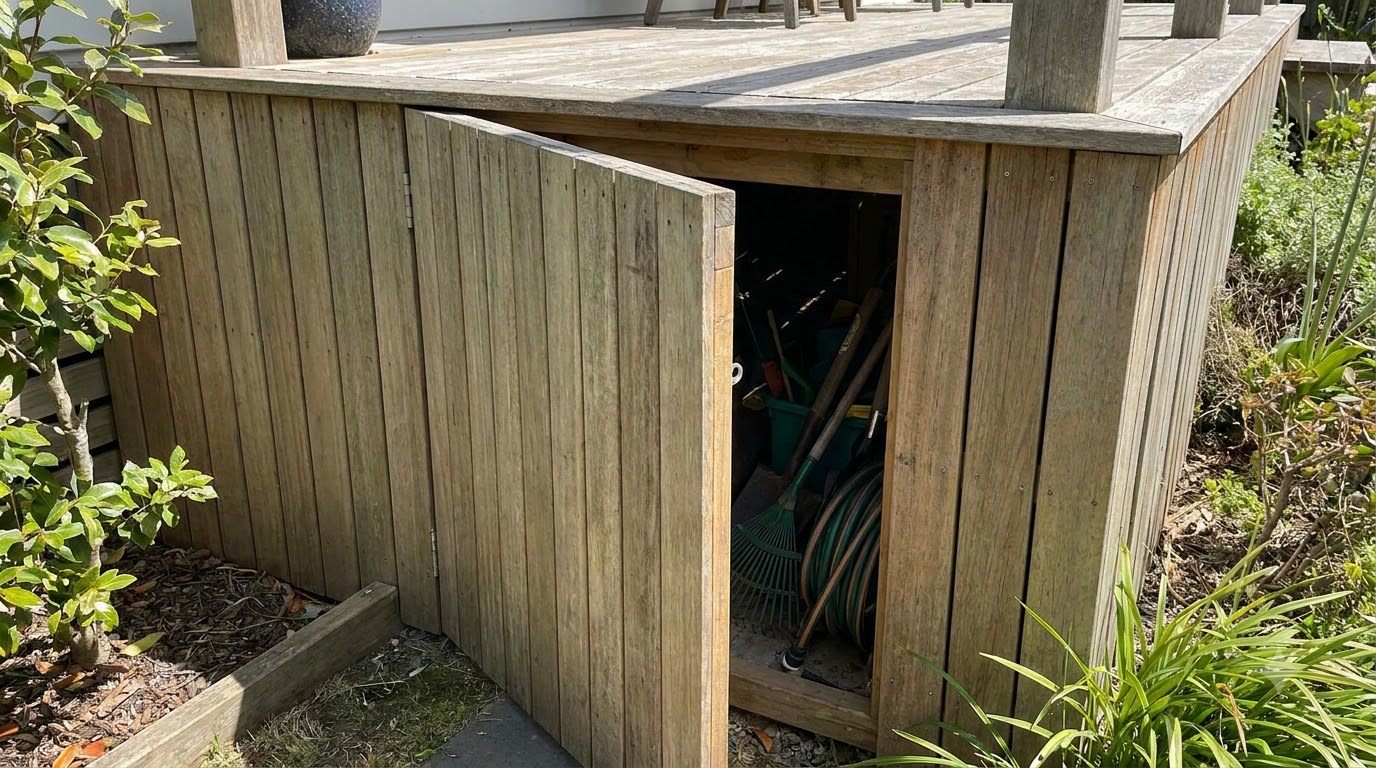
10. Built-in under-deck storage. Frame the space inside for bins and garden tools, with the access door sized to what you actually store. Keep everything off the ground on pavers.
11. Living skirt. Ornamental grasses, ferns and low shrubs planted along the base — the cheapest option of all on a low deck, and the only one that gets better with time.

12. Lit skirting. A recessed strip or spaced downlights washing the skirt at night turns a purely functional panel into a design feature — the same layering logic as outdoor lighting elsewhere.
Materials compared
| Material | Cost | Ventilates | Lifespan near soil | Best for |
|---|---|---|---|---|
| Vinyl lattice | $ | Yes, by design | Long | Cheapest fast fix |
| Treated wood slats | $ | Yes, via gaps | Medium — use ground-contact rated | Modern look on a budget |
| Composite panels | $$$ | Needs planned gaps | Long | Matching composite decks |
| Metal panels | $$ | Needs planned gaps | Long | Industrial and farmhouse styles |
| Stone veneer | $$$$ | Needs built-in vents | Indefinite | High raised decks, formal homes |
| Planting | $ | Completely | n/a | Low decks near grade |
Measuring and fitting
- Measure at several points. Ground rarely runs level — the gap between deck frame and grade usually varies by inches along one side.
- Scribe the bottom edge to follow the ground rather than cutting one straight line and leaving wedge-shaped gaps.
- Build a sub-frame of treated battens on the outside of the deck framing; panels attach to that instead of to the joists directly.
- Keep panels removable — screws rather than nails, so a section can come off without demolition.
- Set the base on gravel, not soil, so the bottom edge dries after rain.
Keeping animals out
Skunks, groundhogs and cats do not care how nice the lattice looks — they dig under it. The fix is a buried barrier: fasten galvanized hardware cloth behind the skirting, run it down to grade, then bend it outward in an L-shape and bury it a few inches under soil or gravel. Diggers hit the horizontal leg and give up. Do this at build time; retrofitting means removing everything you just installed.
Mistakes worth avoiding
- Sealing the perimeter solid. The single most damaging thing you can do to deck framing.
- No access panel. Sooner or later something under there needs reaching — usually urgently.
- Untreated wood at ground level. The bottom edge is the wettest spot on the whole deck.
- Mulch piled against the skirt — it holds water right where you least want it.
- Skirting a deck with a drainage problem. Fix the grading first; skirting hides the puddle but not the rot.
Frequently asked questions
Does a deck need skirting?
No — skirting is cosmetic and practical rather than structural. It hides framing and clutter, discourages animals from nesting underneath, and finishes the look. A low deck close to grade often looks better with planting instead.
Should deck skirting have ventilation gaps?
Yes. Sealing the underside of a deck traps moisture against the framing, which is exactly how joists rot. Use lattice, spaced slats, or solid panels with deliberate vent gaps so air keeps moving.
What is the cheapest deck skirting?
Pre-made lattice panels in treated wood or vinyl, up in an afternoon. Spaced vertical or horizontal boards cost a little more and look considerably more modern for the same effort.
How do you keep animals from getting under a deck?
Back the skirting with galvanized hardware cloth and extend it below grade in an L-shape so animals cannot dig under. Skirting alone rarely stops a determined digger — the buried edge does the work.
Can you store things under a deck?
Yes, if you build in an access door and keep drainage in mind. The space stays damp unless it drains well, so keep items off the ground on pavers or shelving.
What material lasts longest for deck skirting?
Composite and vinyl panels, then stone veneer, then metal. All beat untreated wood, which sits close to damp ground. Whatever the material, keep the bottom edge clear of standing soil and mulch.