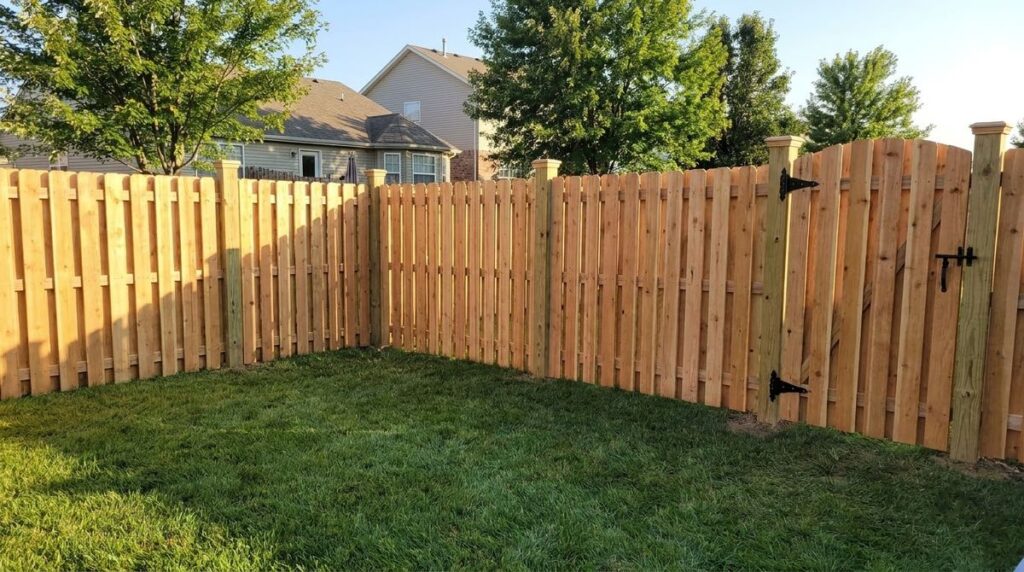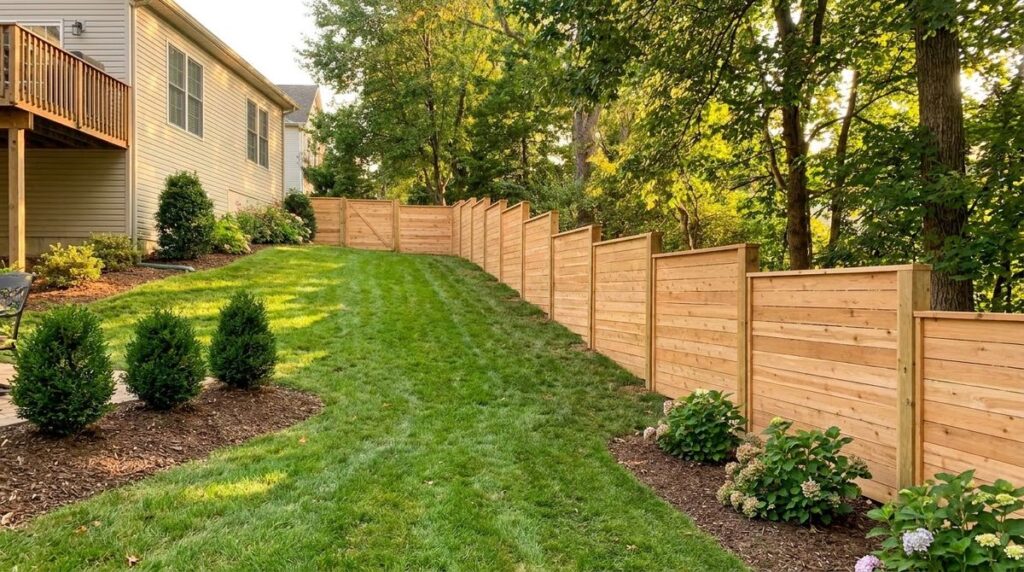
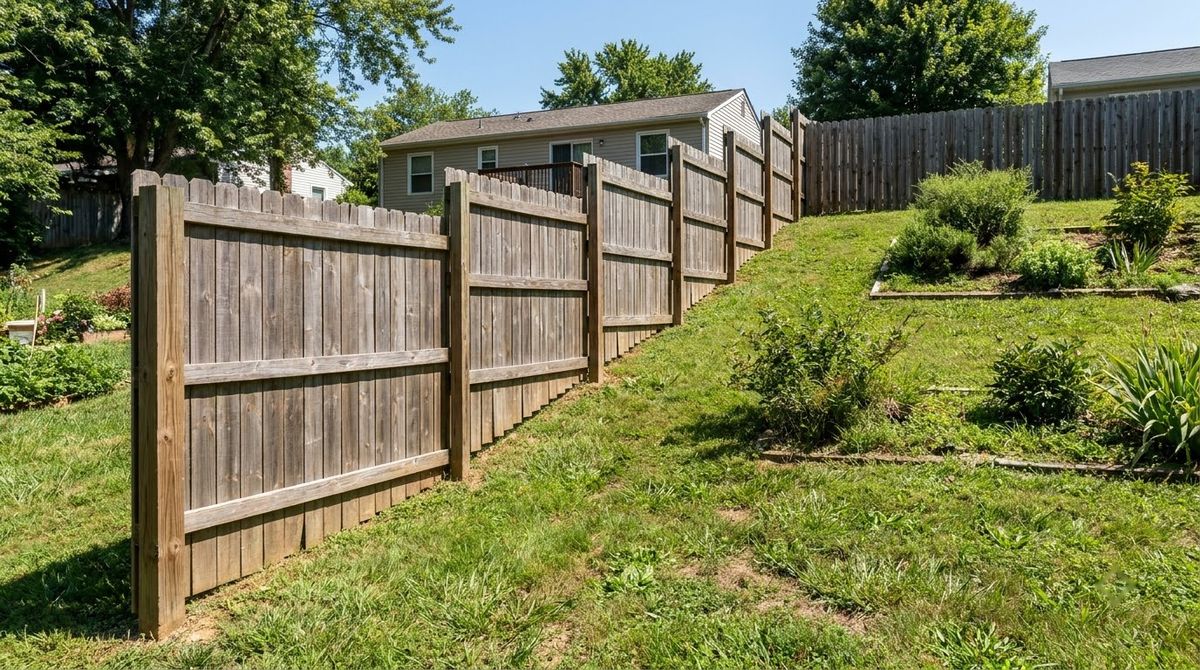
A privacy fence on a slope is built one of two ways: stepped, with level 6-foot-tall sections that drop at each post, or racked, with rails tilted to follow the ground, and vinyl privacy sections rack only 2 to 10 inches per 8-foot section. Steeper ground gets stepped, with longer downhill posts and the gaps closed.
Key takeaways
- Preassembled wood panels can only be stepped. Racking needs loose posts, rails and pickets you cut to the slope.
- Racking has limits. One vinyl maker lists 2 to 10 inches of rack per 8-foot privacy section; its aluminum sections rack up to 20 inches per 6 feet.
- Height is measured from the lower ground in many codes. SeaTac uses the lowest grade on the property line; Berea uses the lowest point within 3 feet of the fence.
- Downhill posts in a stepped fence stand taller, so they need longer stock to keep one-third of the post in the ground.
- Gates do not like slopes. One vinyl gate maker caps racking at 8 degrees, or 1 inch per foot of gate width.
Here is how the two methods compare once the ground starts to fall.
| Item | Stepped fence | Racked (contoured) fence |
|---|---|---|
| Rails | Level, each section set lower than the last | Parallel to the ground, posts stay plumb |
| Works with | Preassembled panels and stick-built fences | Loose components or rackable vinyl and aluminum sections |
| Slope limit | Any slope; steeper ground means bigger steps | Set by the product: 2–10 in per 8-ft vinyl privacy section (DSI) |
| Gap under fence | Triangle at the low end of each section | None, bottom follows the grade |
| Posts | Downhill post taller by the drop per section | Same length; spacing may shrink |
| Height on paper | Tallest at each low end; check averaging rules | Close to the same height all along |
Privacy fence on a slope: stepped vs racked
Stepped vs racked comes down to two things: the kind of fence you buy and how steep the line is. A Home Depot wood fence kit sheet says preassembled panels can only be stepped, with rails kept level. Loose posts, rails and pickets can be built with the parallel method, where rails follow the slope.
Use this as the quick sort:
- Prebuilt wood panels: step them. The kit sheet says the parallel method cannot be done with preassembled panels.
- Stick-built wood (posts, rails, pickets): rack it on gentle and moderate ground. Rails are miter cut and pickets stay plumb.
- Vinyl: check the spec sheet for your style. Weatherables says each style handles a defined slope, stated in inches over feet.
- Aluminum: racks the most. Digger Specialties (DSI) lists up to 20 inches over a 6-foot standard section, 40 inches for double-punch sections.
Many slopes get a mix: racked sections on the gentle stretch and steps where the ground drops hard. A composite fence guide hosted by Home Depot adds a third option, regrading the line flat, and calls it time-consuming and costly.
How to measure the slope along the fence line
To measure the slope along the fence line, stake both ends of each run, tie a mason line between them and level it with a line level, water level or transit. Then measure from the line down to the ground at the low end. That number is the drop for the run.
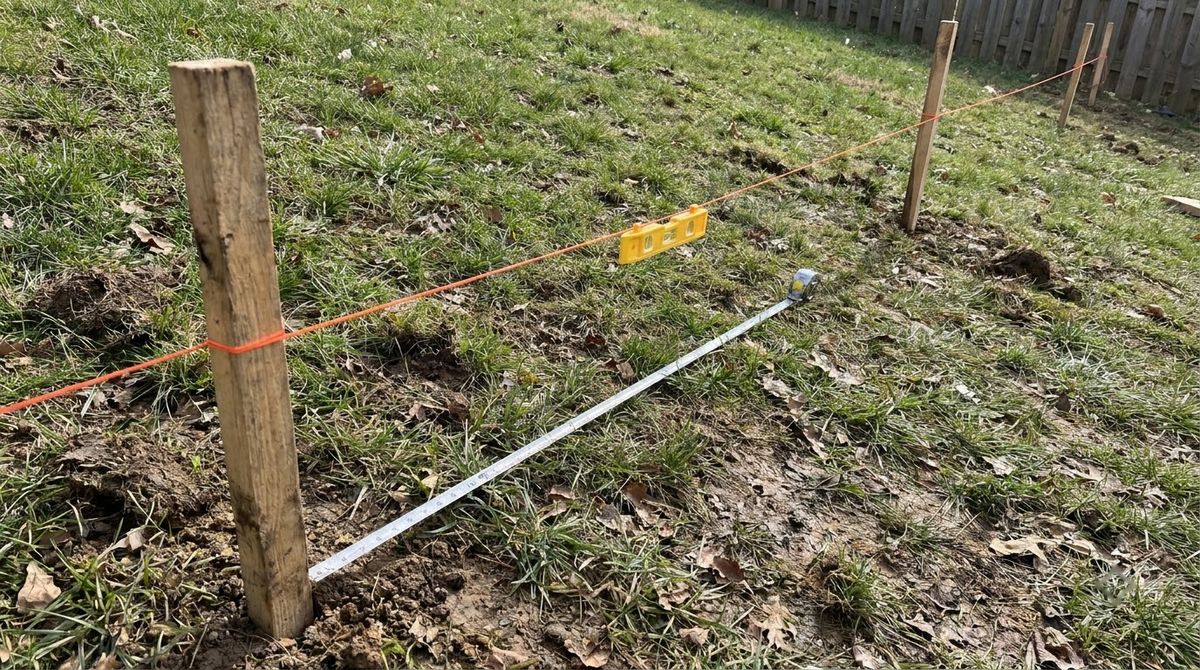
- Divide the run into sections at your post spacing, often 8 feet center to center for wood and vinyl.
- Record the drop for each section, not just the whole run. One steep section decides the method for that stretch.
- Turn it into a percent if you like: drop ÷ run × 100. A 12-inch drop over 8 feet (96 inches) is a 12.5 percent slope.
- Compare the drop to your product’s rack limit. A 12-inch drop per 8-foot section is past the 2-to-10-inch range DSI lists for its vinyl privacy styles, so that section gets stepped.
Run extra lines on very steep or uneven ground; the composite guide suggests more than two points to get an accurate reading. Lay the line out before you buy materials, because the method changes what you order.
How fence height is measured on a slope in real codes
Fence height on a slope is measured from a point your zoning code names, and the codes do not agree. That matters most for a stepped fence, whose low end can stand a foot or more taller than its high end. Three real examples:
- SeaTac, Washington (SMC 15.435): height is measured from existing or finished grade, whichever is lowest on the property boundary. On a sloping side or rear yard, the 6-foot limit may be averaged in stepped segments, but no part of the fence may exceed 8 feet above finished grade. In front yards it is 4 feet averaged, 6 feet at any point.
- Berea, Ohio: on sloping ground, height is measured from the lowest point within 3 feet on either side of the fence. Side yards are capped at 6 feet, front yards at 4 feet, and every fence needs a permit.
- Tempe, Arizona (ZDC 4-706): height is measured from the highest adjacent finished ground, paving or sidewalk within 20 feet, unless otherwise noted.
Here is what averaging means, as arithmetic only. A level section that is 5 feet 6 inches tall at its uphill post and 6 feet 6 inches at its downhill post averages 6 feet and stays under SeaTac’s 8-foot hard cap. Whether your zoning office reads “averaged” the same way is a question to ask before you set posts.
One more line: the model International Residential Code exempts fences not over 7 feet high from a building permit (R105.2). A stepped low end that climbs past 7 feet can pull a fence into permit territory where your city follows that rule.
For yard-by-yard limits, see how tall a privacy fence can be by yard position, and check with your local building department.
Post depth and setting posts on a slope
Post depth on a slope follows the same rule as on flat ground, measured at each post: put about one-third of the post’s length in the ground. The Home Depot wood kit sheet gives that rule of thumb and sets end, corner and gate posts at least 6 inches deeper.
Dig holes 10 to 12 inches wide and 6 inches deeper than needed, then add 6 inches of gravel for drainage.
The difference on a slope is above ground. In a stepped fence, each downhill post has to reach the top rail of the higher section. Trex’s composite fence guide spells out the math: if the ground drops 6 inches over 8 feet, the lower post is set at 6 inches plus its normal 75-inch height, or 81 inches above grade.
- Size the downhill posts by arithmetic. With 81 inches above grade and one-third buried, the post must be at least 81 × 1.5 = 121.5 inches long, just over 10 feet.
- Leave posts long and cut later. The same guide sets posts tall and trims them to height afterward with a saw.
- Measure spacing level, not along the ground. For stepped fences, Trex says post spacing is measured horizontally. For racked fences, horizontal spacing may need to shrink so rails are not too short.
- Reinforce tall vinyl. Weatherables says vinyl fences over 6 feet need concrete or an aluminum insert inside the post to at least 22 inches above grade, with holes 30 to 36 inches deep.
Set every post plumb, even on a racked fence; only the rails tilt. The full post-setting sequence, from gravel to bracing and cure time, is in how to build a wood privacy fence step by step.
Racking a wood privacy fence: rails, pickets and spacing
Racking a wood privacy fence means the rails run parallel to the ground while posts and pickets stay plumb. Trex’s guide says to miter cut the rails to fit the grade and notes that pickets may need cutting on extreme slopes. DSI warns that heavy racking throws the rails out of line across a post.
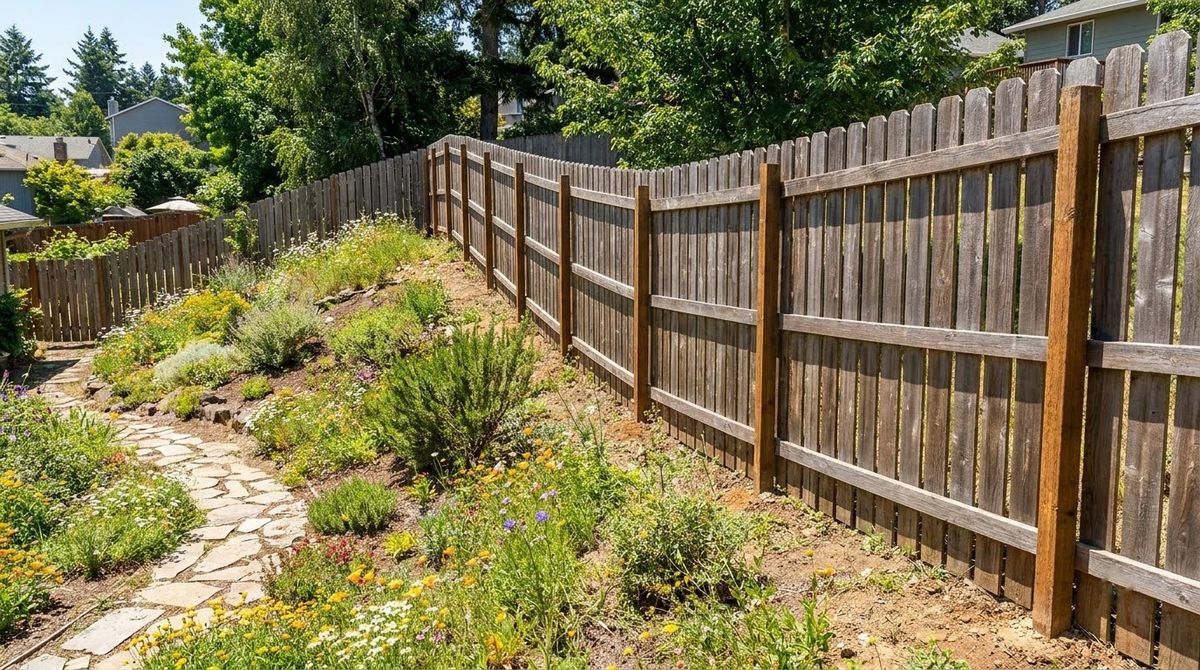
- Hang rails at a consistent height above grade at each post, so the top line follows the ground at an even offset.
- Plumb pickets against a level, not against the rail. The wood kit sheet says to check plumb every three or four pickets.
- Keep three rails on a 6-foot fence and four on an 8-foot fence, attached on edge, as the kit sheet specifies.
- Cut post tops to a string line stretched at the finished height, the method the kit sheet uses for an even top.
Board-on-board and shadowbox styles rack the same way because each board hangs on its own. Style trade-offs are in wood privacy fence styles and lumber.
Gaps under stepped panels and how to close them
Gaps under stepped panels are the price of keeping each section level: the composite guide says stepping leaves gaps between the ground and the bottom of the fence. A section that drops 12 inches leaves a triangle 12 inches tall at its low end, room for a dog or a rabbit and a clear sightline.
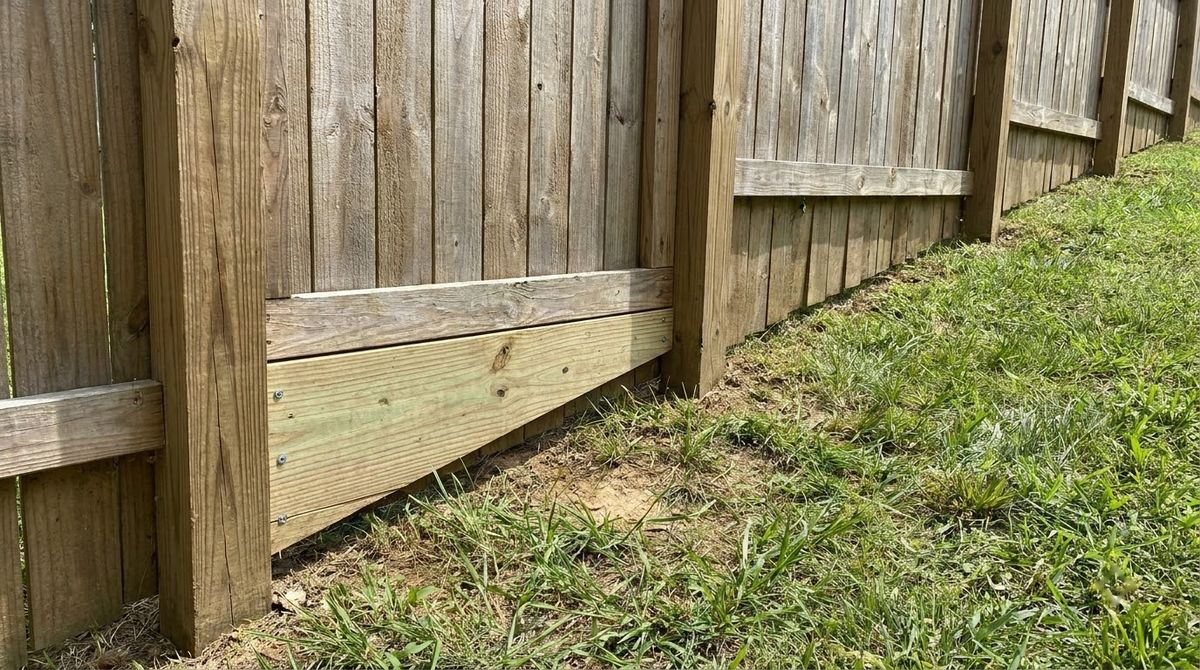
Ways to close the gap, from simplest to most work:
- Fill with soil. Trex’s step method says to fill the gap below the fence with soil. Check first: Darien, Illinois does not allow the ground under a fence to be changed without approval of its Zoning Enforcement Officer.
- Add a gap board (rot board). Cut a board to the triangle and fasten it between posts under the panel. Anything touching soil should be rated for ground contact; the American Wood Preservers’ Association lists Use Category 4A or higher for posts and landscape walls.
- Extend the infill on a stick-built fence. Run longer pickets down to the grade at the low end of each section and scribe-cut their bottoms.
- Build a low wall along the line. For a fence on top of a retaining wall, SeaTac caps the combined height at 9½ feet in side and rear yards and 6 feet in front; the wall itself is covered in building a retaining wall on a slope.
Keep a small air gap between wood pickets and soil. The Home Depot redwood fence sheet sets the bottom of the pickets at least 1 inch above ground so they do not wick moisture.
Gate posts on a slope
Gate posts on a slope set the height for everything around them, so plan the gate first. Weatherables tells installers to assemble the gate before setting posts, because the gate width plus hardware sets the post spacing, and the gate sets the height for the rest of the fence.
The same guide says to leave enough clearance under the gate for it to swing freely.
- Put the gate on the flattest stretch you can find along the line, even if it means moving it a few feet.
- Test the swing arc first. If the ground rises inside the arc, the gate bottom hits it. The wood kit sheet says to check full swing clearance before mounting the latch.
- Swing toward falling ground where you have the choice; the bottom clears more as it opens.
- Rack only a little. Catalyst Fence Solutions limits a racked vinyl privacy gate to 8 degrees, or 1 inch per foot of gate width.
- Set gate posts deeper. The wood kit sheet puts gate posts at least 6 inches deeper than line posts.
Gate frames, hinges and bracing for a wood gate are covered in the gate section of the fence building guide.
Mistakes to avoid, and when to hire a pro
The mistakes that ruin a fence on a slope are usually made before the first post goes in. Watch for these:
- Buying preassembled panels for a slope you meant to rack. They step only.
- Measuring height from your side of a high step when your code uses the lowest grade at the property line.
- Ordering every post the same length for a stepped fence; downhill posts run longer.
- Racking past the product limit, which, per DSI, can mean rail holes elongated in the field.
- Regrading under the line without asking the zoning office first.
Hire a fence contractor when the ground is too steep to step without very tall downhill posts, when the line meets a retaining wall, or when the soil is rock or loose fill. Slope and rock also show up as their own line items in privacy fence cost per foot.
Frequently asked questions
Is it better to step or rack a privacy fence on a slope?
Rack a privacy fence when the drop per section stays within your product’s rack limit, because the bottom follows the ground with no gaps. Step it when you use preassembled wood panels, which can only be stepped, or when the slope is steeper than the limit, such as more than 2 to 10 inches per 8-foot vinyl privacy section.
How is fence height measured on a slope?
Your zoning code decides. SeaTac, Washington measures from the lowest grade on the property boundary and lets the 6-foot limit be averaged in stepped segments, with 8 feet as the cap at any point. Berea, Ohio measures from the lowest point within 3 feet of the fence. Ask your local building department before you build.
How do you fill the gap under a stepped fence?
Fill the gap with soil, fasten a gap board cut to the triangle between the posts, extend pickets down to grade on a stick-built fence, or run a low wall along the line. Use ground-contact lumber, AWPA Use Category 4A or higher, for any board touching soil, and ask the zoning office before regrading.
Can you rack a pre-built wood fence panel?
No. A Home Depot wood fence kit sheet says preassembled panels can only be installed with the step method, rails level. To follow the slope, build the fence from loose posts, rails and pickets so the rails can be miter cut to the grade while the posts and pickets stay plumb.
How deep should fence posts be on a slope?
Bury about one-third of each post, measured from the ground at that post, and set end, corner and gate posts at least 6 inches deeper. Downhill posts in a stepped fence stand taller, so they need longer stock: an 81-inch post above grade needs at least 121.5 inches of total length.
Sources
- City of SeaTac, Washington, SeaTac Municipal Code Chapter 15.435 Fences (checked October 2026).
- City of Berea, Ohio, Fence Design Standards (checked October 2026).
- The Home Depot, Wood Fence Kits Installation Instructions (product sheet, checked October 2026).
- Digger Specialties (DSI), How to Rack Fencing Sections for a Seamless Install (manufacturer guide, checked October 2026).
- Weatherables, Vinyl Fencing Installation Guide (manufacturer guide, checked October 2026).
- Trex, Seclusions Installation Guide (2013, checked October 2026).
- Also used: City of Tempe, Arizona, General Fence and Wall Height Standards (ZDC 4-706); City of Darien, Illinois, Residential Fence Information; International Code Council, 2021 IRC Section R105.2; American Wood Preservers’ Association, residential use category infographic (2021); Catalyst Fence Solutions, Racking a Vinyl Gate for Full Privacy Styles; The Home Depot, Building a 6-Foot Redwood Privacy Fence and Euro Style Composite Fencing install sheets (all checked October 2026).