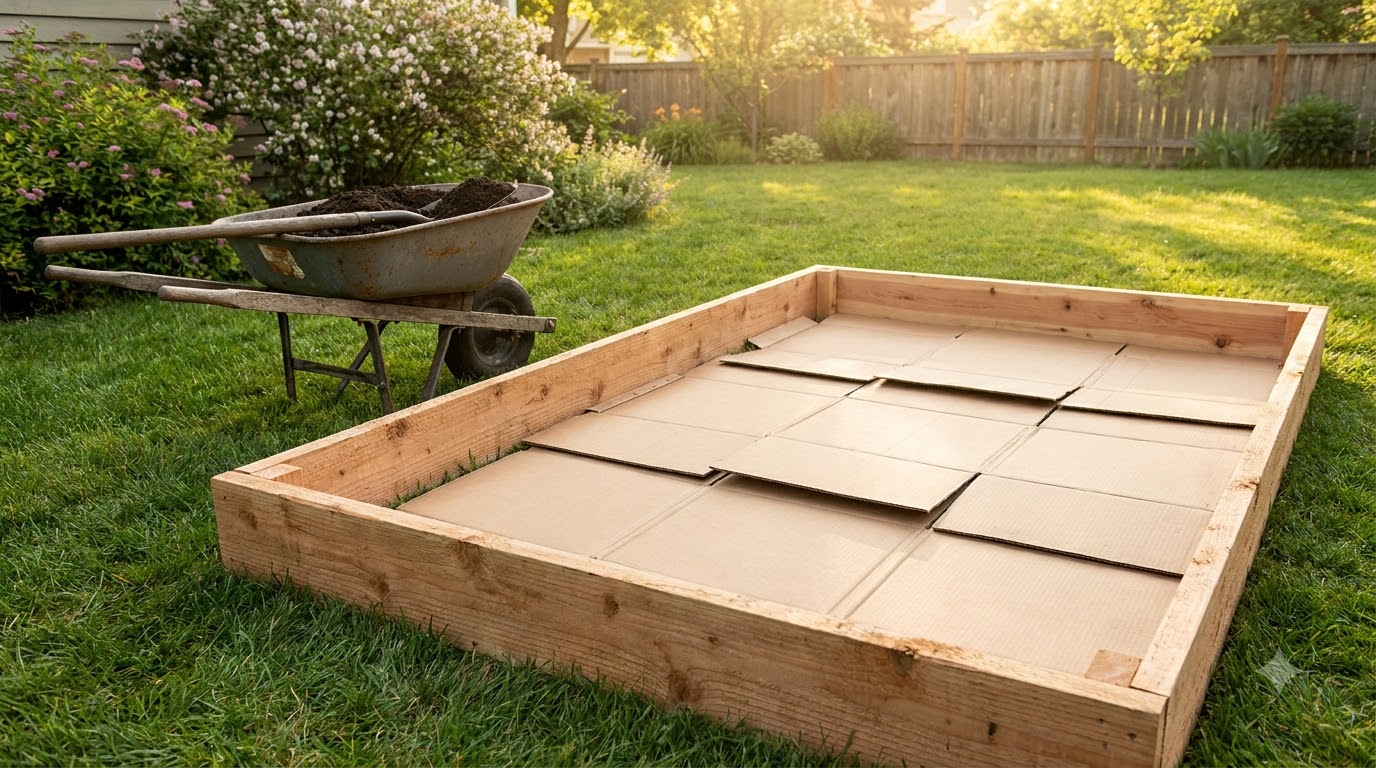
Plain corrugated cardboard is the best free material a raised garden bed will ever get — laid over grass under a new bed, it smothers the lawn, feeds worms, and disappears within a season, leaving an open soil boundary that roots cross freely. The rules are short: plain brown boxes only, tape and staples off, overlap the seams, soak it. And there are a few places cardboard quietly backfires, which almost nobody mentions.
Key takeaways
- Under a new bed over grass is the killer app: overlap 4–6 inches, wet it down, soil on top. The lawn dies in the dark; the cardboard is gone by next season.
- Plain brown corrugated only. Plastic tape, labels, and staples come off; glossy, coated, and waxed boxes stay out of the garden.
- Cardboard beats landscape fabric under open-bottom beds — it does the smothering, then gets out of the way. Fabric stays forever and blocks the soil connection.
- It is also a fill layer, a path base, and a winter smother — one material, four jobs.
- Where it backfires: exposed on the surface it turns slug shelter and rain shield; near house walls, soggy cardboard is termite bait.
Why cardboard for raised garden beds works so well
Three properties line up perfectly for bed-building. It blocks light completely, and grass and most weeds cannot survive weeks of total darkness. It is carbon that soil life loves — worms congregate under moist cardboard, and by eating it they till the boundary between your fill and the native ground. And it is temporary by design: unlike plastic or landscape fabric, it does its job and then leaves, which is exactly what you want under an open-bottom bed where roots and drainage need to cross.
Cardboard vs landscape fabric vs plastic
Three materials get pitched for the same job. Only one of them retires gracefully:
| Cardboard | Landscape fabric | Plastic sheeting | |
|---|---|---|---|
| Cost | Free | $$ | $ |
| Kills existing grass | Yes | Yes | Yes |
| Lets water through | Yes (once wet) | Yes, less over time as it clogs | No |
| Roots & worms can cross later | Yes — it’s gone in a season | Never | Never |
| Long-term legacy | Compost | Shredding fabric in your soil for years | A buried bathtub liner |
Under an open-bottom bed, the temporary material wins precisely because it is temporary. Fabric and plastic solve week one and sabotage year two.
How much cardboard, and where to get big boxes
A 4×8 ft bed with proper 4–6 inch overlaps eats more cardboard than people expect — think three or four large appliance-size boxes, or a dozen ordinary shipping boxes, flattened. Where the big sheets live:
- Appliance and furniture stores — refrigerator and mattress boxes are the single-sheet jackpot; most stores hand them over for the asking.
- Bike shops — bike boxes are huge, plain, and constantly discarded.
- Your own recycling pile, saved for a month before build day.
- Neighborhood recycling morning — one street’s flattened boxes will floor several beds.
Fewer seams beats more cardboard: two big sheets with one overlap outperform ten small boxes with twenty gaps.
Which cardboard is garden-safe
- Yes: plain brown corrugated boxes — shipping boxes, appliance boxes, moving boxes. Standard ink on brown board is fine.
- Strip first: plastic packing tape, shipping labels, and staples. None of them break down; all of them surface in your soil for years.
- No: glossy or coated boxes (the shiny layer is plastic or clay coating), waxed produce boxes, and heavily dyed board. If it doesn’t look like plain cardboard, it isn’t.
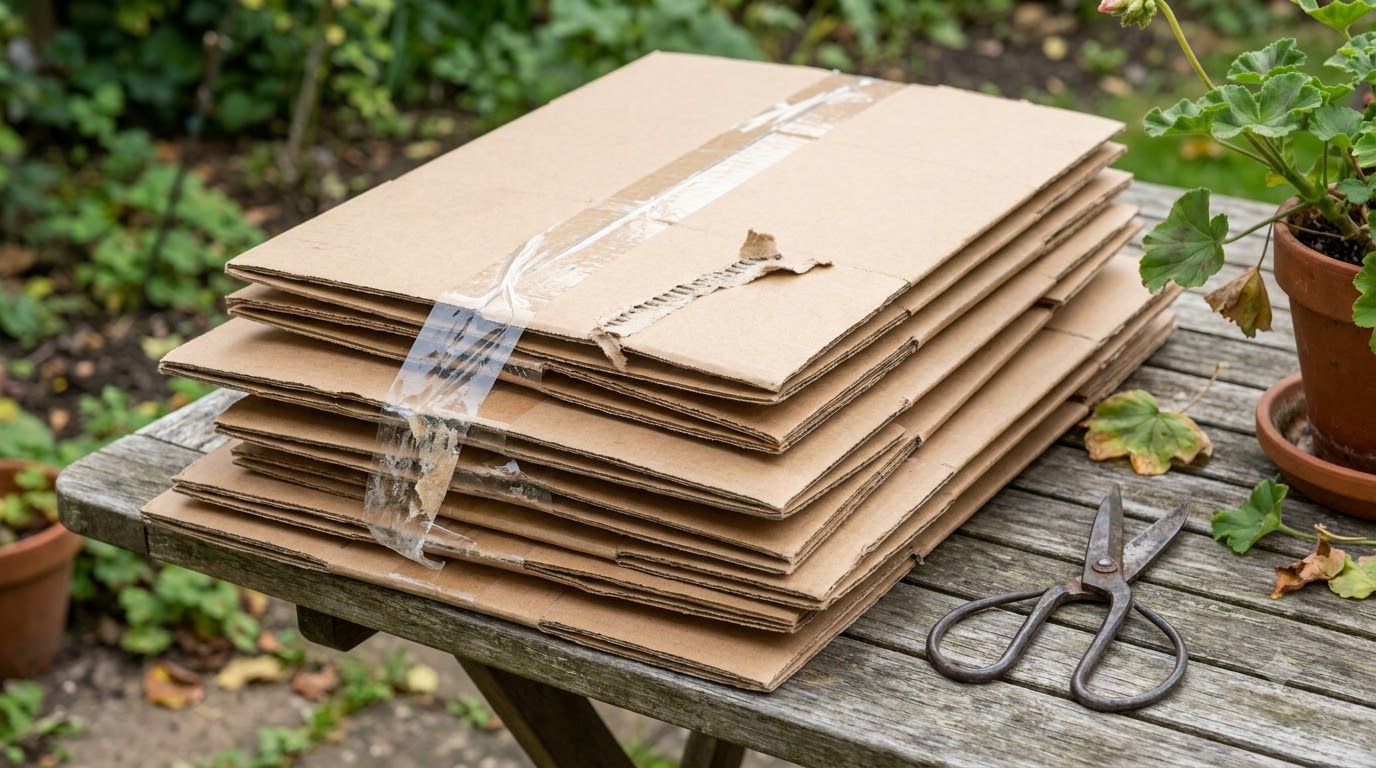
Use 1: under a new bed on grass (the classic)
This is step two of filling day, and it replaces the miserable job of stripping sod:
- Set and level the empty frame where the bed will live.
- Lay flattened cardboard across the entire footprint, overlapping every seam by 4–6 inches — grass finds any gap.
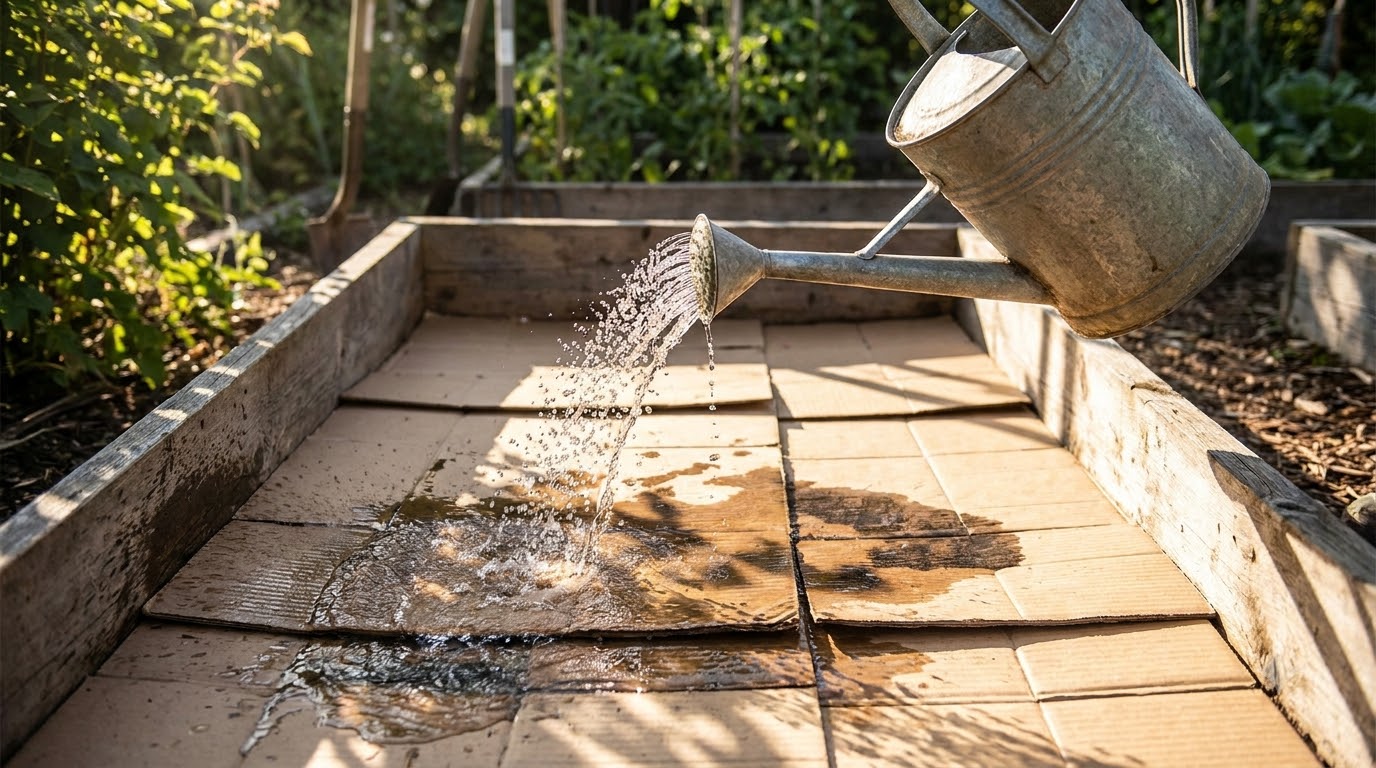
- Soak it thoroughly. Wet cardboard hugs the ground, starts decomposing, and stops behaving like a rain shield.
- Fill the bed on top. Done — the lawn below is already dying.
Beds 10 inches and deeper technically smother grass without help — the depth guide covers why — but cardboard costs nothing and removes all doubt at any depth.
Compare that with the alternative everyone dreads: stripping sod. Cutting and lifting the turf under a 4×8 bed is an afternoon of the heaviest work in gardening, it hauls away an inch of your best topsoil with the grass roots, and the spoils pile has to go somewhere. Cardboard converts that same lawn into worm food, in place, while you do nothing. The only scenario where sod-stripping still earns its keep is a very shallow bed — 6 inches or less — going in over an aggressive running grass like Bermuda, which laughs at anything short of excavation.
Use 2: inside the fill of a deep bed
Building a tall bed with the layered method? Flattened cardboard earns a place between the coarse woody layer and the fine organic layer — it slows soil from sifting down into the gaps, which means less settling in year one. Tear it into big pieces, don’t build a solid sealed floor mid-bed; water still needs to move.
Use 3: paths between beds
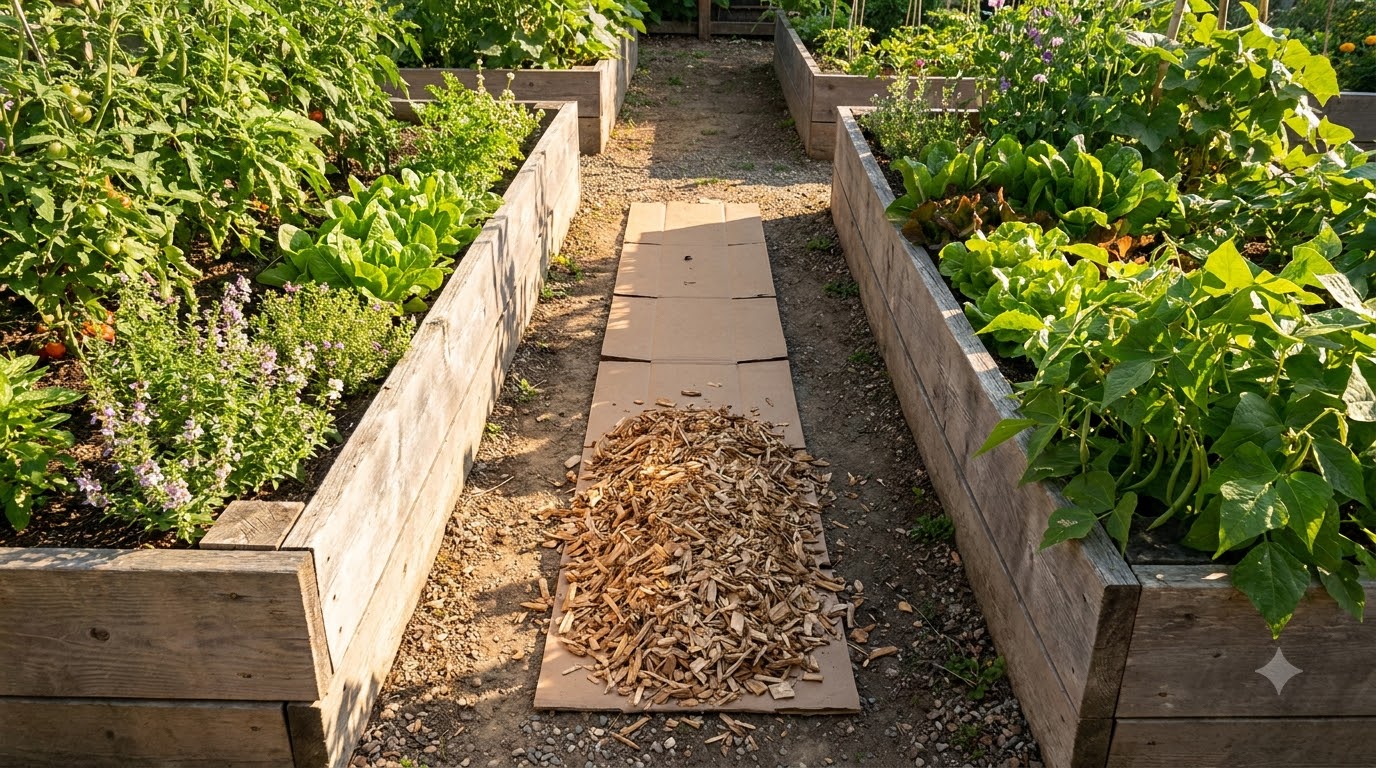
Cardboard under 3–4 inches of wood chips is the cheapest weed-free garden path there is. The cardboard blocks the first year’s weeds while the chips settle into a mat that handles the years after. Refresh the chips as they thin; the cardboard below has long since fed the soil.
Use 4: the winter smother
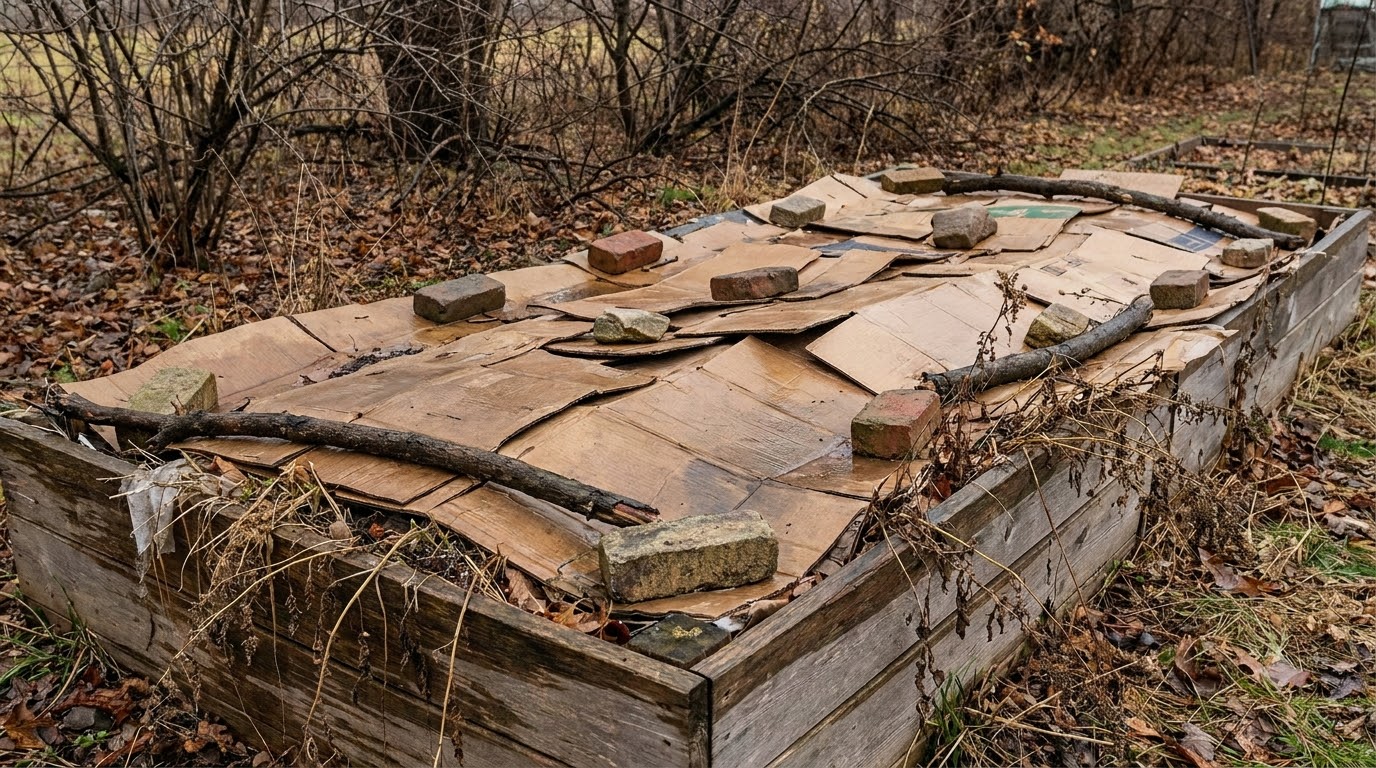
A bed that got away from you — weeds gone to seed, grass creeping in — can be reset for free: cut everything to the soil line in fall, cover the whole surface with overlapped cardboard, weight it with bricks, and walk away. By spring the weeds are dead, the worms have had a feast, and you plant into clean soil. It is the zero-cost version of the black-tarp winter cover.
Where cardboard backfires
- Exposed on the surface as mulch. Dry cardboard sheds rain instead of passing it, and the damp underside becomes a daytime hotel for slugs six feet from your lettuce. If you mulch with it, bury it under chips or straw — never bare.
- Lining the bed walls. It rots in weeks against damp soil and does nothing a wall liner is supposed to do. If you want a wall barrier — for old wood, say — use plastic on the walls, not cardboard.
- Piled against the house. Termites eat cardboard as happily as lumber. In the middle of the yard this is irrelevant; a soggy cardboard stack against your foundation is an invitation.
- Sealed layers in a wet bed. Many unbroken sheets mid-fill can briefly perch water. Tear pieces and overlap loosely inside the fill — solid flooring belongs only at the very bottom, over grass.
New to raised beds? Start with the complete raised garden bed guide — size, wood, soil, and cost in one place.
Frequently asked questions
Does cardboard under a raised bed really kill grass?
Yes. Overlapped cardboard blocks light completely, and grass without light dies within weeks. By the time the cardboard breaks down — usually within a season — the lawn under the bed is gone and the soil boundary is open for roots and worms.
How long does cardboard take to decompose in a garden bed?
Under moist soil, plain corrugated cardboard is usually soft within weeks and gone within a growing season. Dry cardboard lasts much longer — which is why you soak it at install time.
Is the tape and printing on boxes safe for gardens?
Strip off plastic tape, labels, and staples — they never break down. Standard printing on plain brown boxes is generally fine; skip glossy, coated, or waxed cardboard entirely, since the coating is the part that doesn’t belong in soil.
Do I need to remove the cardboard later?
No. That is the whole point — it smothers the grass, feeds soil life, and disappears on its own. If you find intact pieces a year later, the spot was too dry; water it and let it finish.
Is cardboard better than landscape fabric under a raised bed?
For beds on open soil, yes. Cardboard is free, kills the grass, then gets out of the way so roots and worms can cross. Landscape fabric costs money and then stays forever, blocking exactly the soil connection an open-bottom bed is built for.
Does cardboard attract termites?
Termites do eat cardboard, like any wood-based material. In the middle of a yard it is a non-issue; against a house wall, keep soggy cardboard away from the structure and stick to soil-covered use in beds.
Sources
- University of Minnesota Extension — Raised bed gardens (bed siting and construction context)