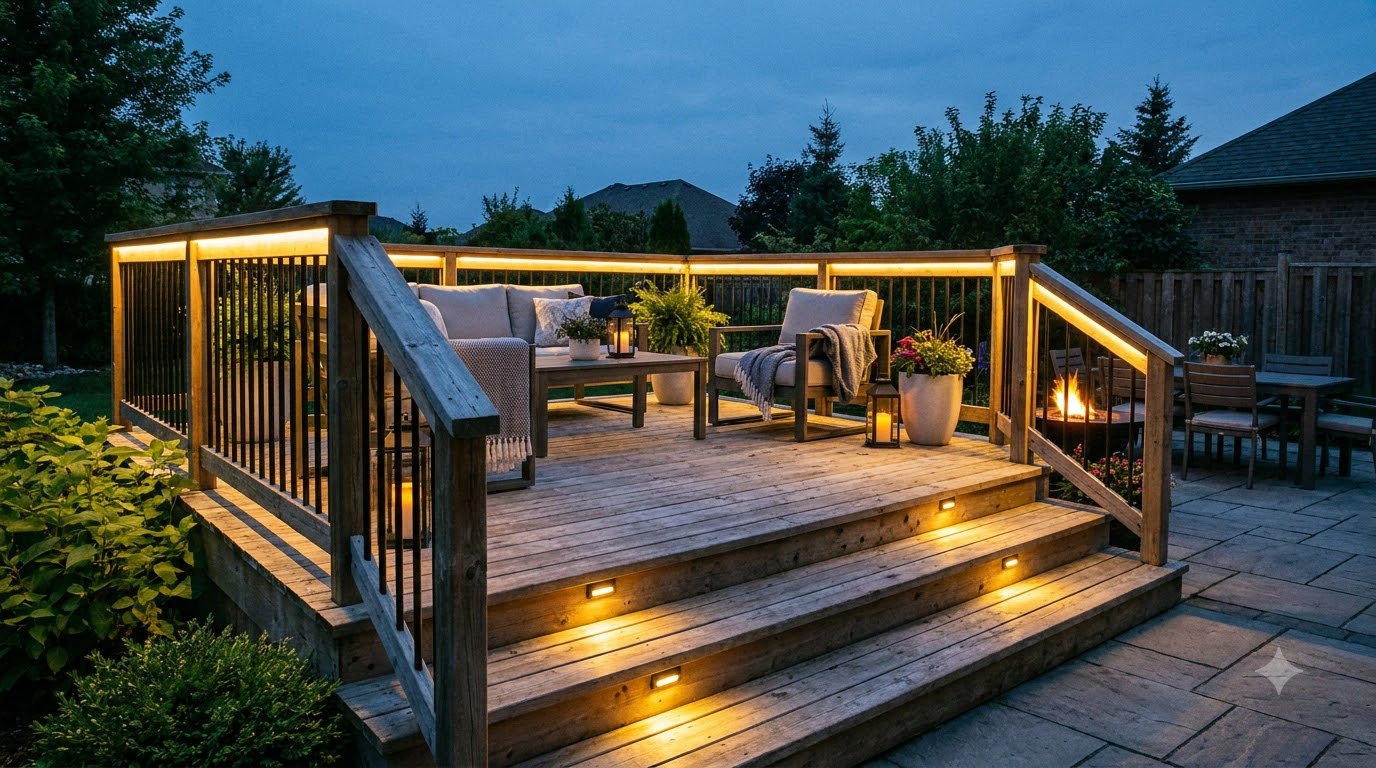
Good deck lighting ideas follow one principle: light the surfaces, not the eyes. Stairs, rails and floor edges want a low warm glow that shows you where the deck is; nothing should be bright enough to look at directly. Do that with a low-voltage system and you can install most of it yourself — a transformer on an existing outdoor outlet, 12-volt cable, and fixtures that clip on. Below: 14 ideas by location, plus the wiring plan and the glare mistakes to avoid.
Key takeaways
- Stairs first — the only deck lighting that is genuinely a safety feature.
- Low-voltage (12V) is DIY-friendly: transformer into an existing GFCI outlet, cable run on the surface or through framing.
- Warm white, ~2700K, matched everywhere. Mixed color temperatures ruin otherwise good schemes.
- Hide the source, show the effect — a visible bulb at eye level undoes an entire installation.
- Recessed fixtures are far easier during the build; post caps and strips retrofit fine.
Deck lighting ideas by location, at a glance
| Location | Fixture type | Job it does | Retrofit? |
|---|---|---|---|
| Stair risers | Recessed riser lights, under-tread strip | Safety — the one non-negotiable | Hard |
| Railing top | Post caps, under-rail strip | Defines the deck edge at night | Easy |
| Posts | Side-mount downlights | Pools of usable light on the floor | Easy |
| Deck surface | Recessed floor lights | Marks paths and level changes | Hard |
| Under the deck edge | Perimeter wash | Makes the deck appear to float | Medium |
| Overhead | String lights, pergola downlights | Atmosphere and dining light | Easy |
Stair and step deck lighting ideas (1–3)
1. Recessed riser lights. Small fixtures set into each riser wash light down onto the tread below — invisible sources, clearly lit steps. The gold standard for deck stairs.
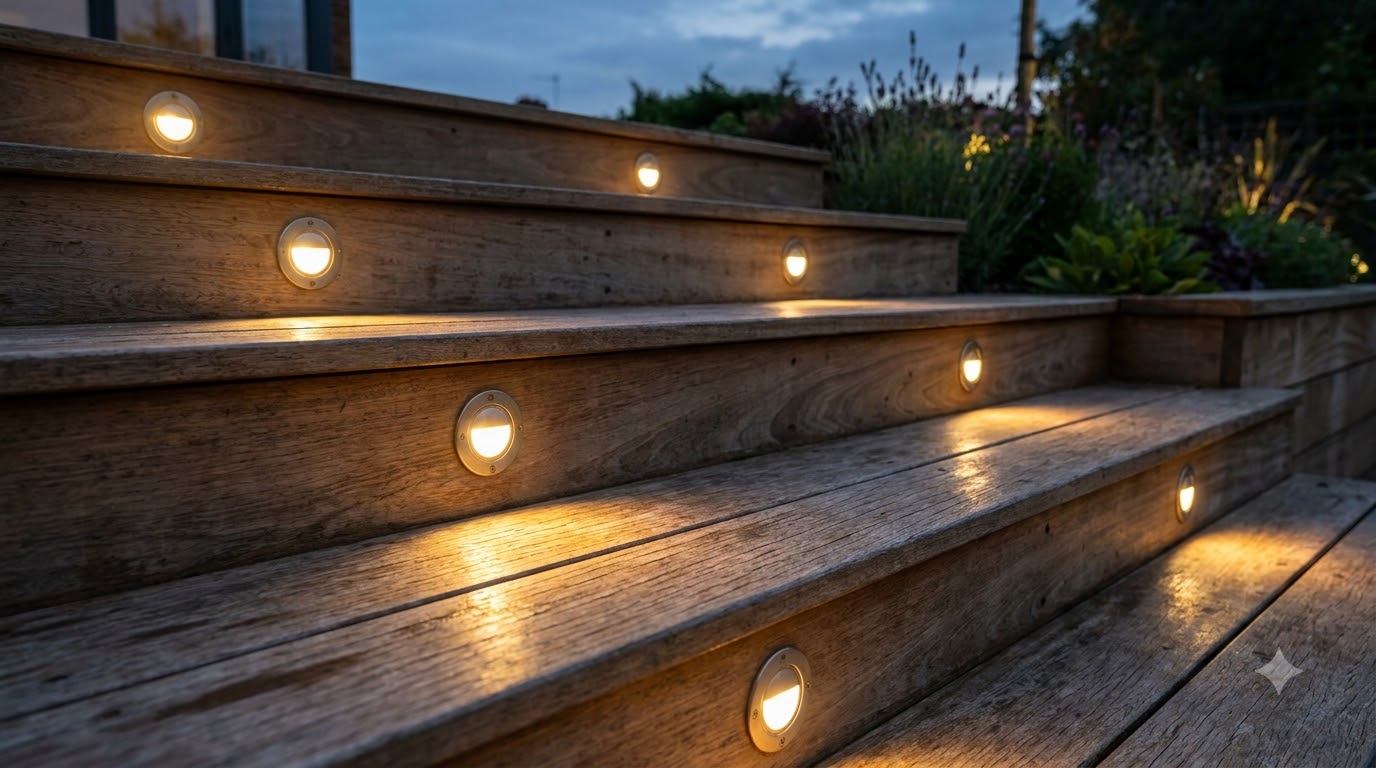
2. Under-tread strip. A continuous LED strip tucked under the nose of each tread gives the same effect with a floating look, and suits open-riser stairs where riser fixtures cannot go.
3. Lit stair posts. Post-cap or side-mount fixtures at the top and bottom of the flight mark where the stairs begin and end — the two points people misjudge in the dark.
Exterior stairs generally need illumination at the landing, and many jurisdictions expect treads and nosings to be clearly visible; requirements vary locally, so ask your building department. The American Wood Council deck guide is the plain-language reference for the stair geometry those rules assume.
Railing lighting (4–7)
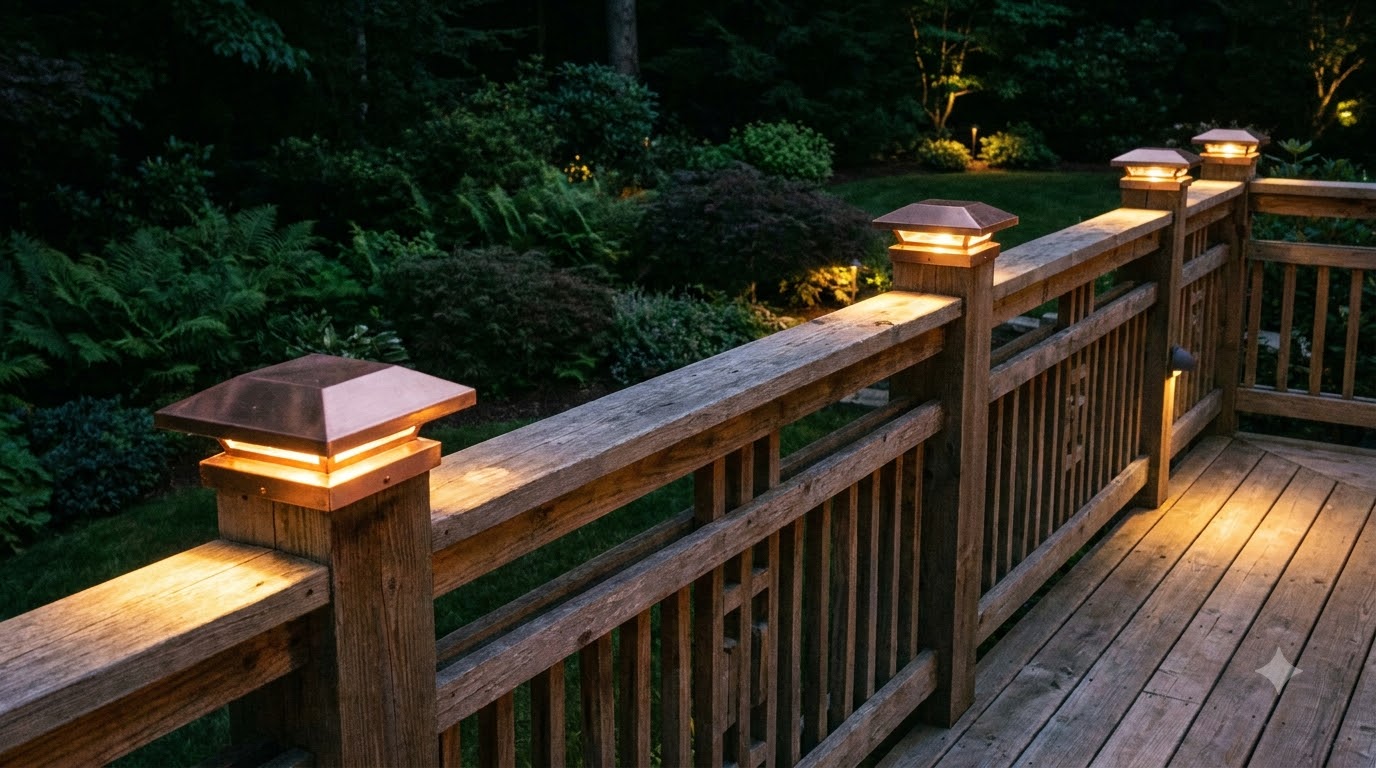
4. Post cap lights. The most popular retrofit: caps that glow softly, spaced evenly along the rail. Choose ones that emit downward and sideways rather than upward into your eyes.
5. Under-rail strip. A hidden strip beneath the top rail washing the deck below — no visible fixture, and it makes the railing appear to float. The most designer-looking option on this page.
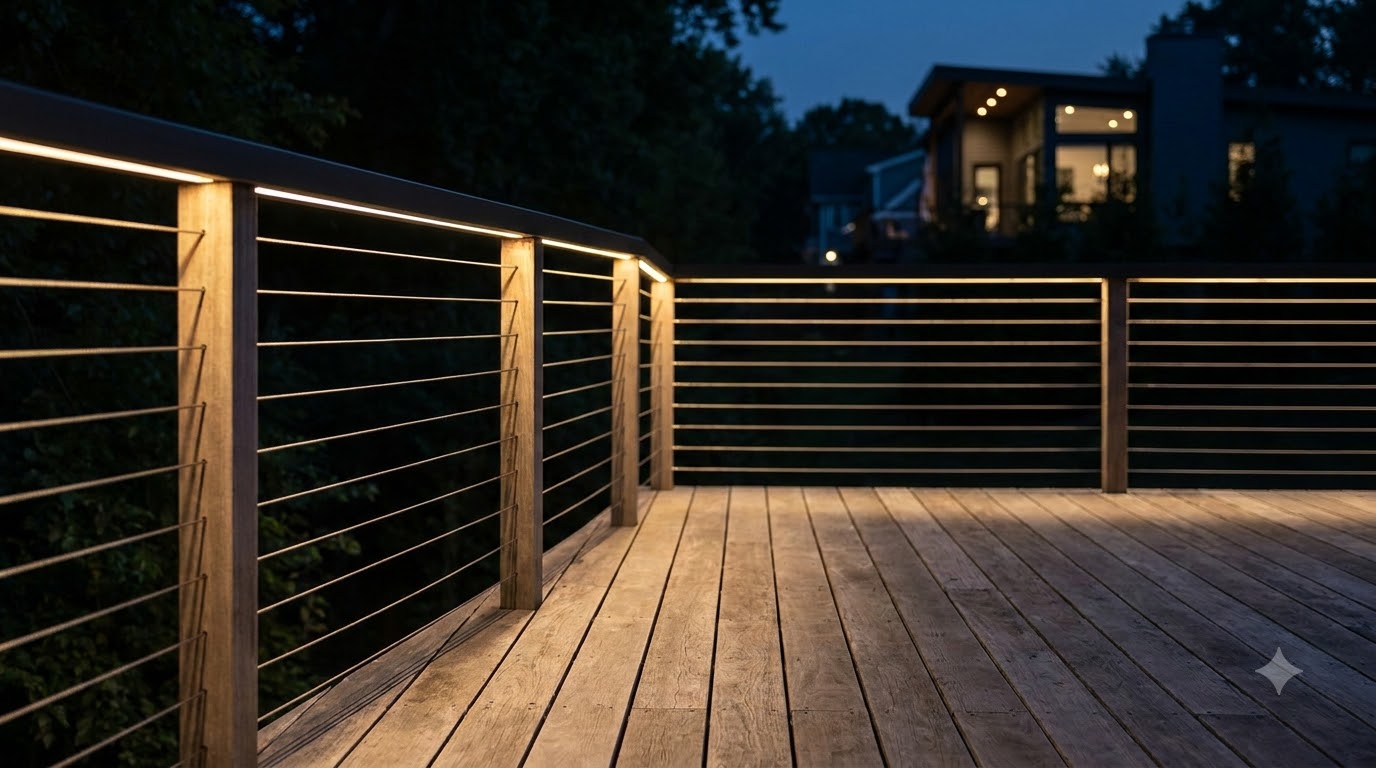
6. Baluster-level accent lights. Small fixtures set into the rail infill at intervals; effective on cable or metal railings where there is nowhere to hide a strip.
7. Post side-mount downlights. Fixtures on the inside face of each post throwing pools onto the deck surface — the closest thing to overhead lighting without anything overhead.
Surface and perimeter (8–11)
8. Recessed floor lights. Flush fixtures in the deck boards marking edges and pathways. Plan them at framing stage; retrofitting means cutting boards and fishing cable.
9. Perimeter wash from below. Fixtures mounted under the deck edge lighting the ground around it — the deck seems to hover, and the yard gains depth.
10. Lit skirting. A strip behind slatted deck skirting turns the panel into a glowing base; a strong effect on raised decks.
11. Bench and planter lighting. Strips under built-in seating or inside planter rims: functional light at ankle height with the fixture completely hidden.
Overhead and atmosphere (12–14)
12. String lights on a guide wire. Zigzagged overhead from the house to posts, tensioned on stainless wire so the cord never sags — the technique is the same as for pergola lighting.
13. Pergola-mounted downlights. If there is a pergola over the deck, its beams are the ideal place for proper overhead light — wire it during that build.
14. Portable and flame. Rechargeable table lamps, lanterns and a fire feature add the layer no fixed installation can: light that moves and can be carried where the evening goes.
Planning a low-voltage system
Nearly everything above runs on a 12-volt system, which is why deck lighting is one of the few electrical-adjacent projects a homeowner can safely do alone:
- Count the fixtures and add the wattages — that total drives the transformer size. Leave headroom for adding lights later.
- Site the transformer near an existing outdoor GFCI outlet, on a wall, off the ground.
- Plan the cable route before boards go down if you can: inside framing, up post cavities, and out of the way of screws.
- Keep runs reasonably short and use adequate cable gauge — long thin runs cause voltage drop, and the far fixtures dim.
- Add a timer or photocell so the deck lights itself at dusk.
- Test the layout at night before final fixing — lay the fixtures loose, power up, walk the deck, then commit.
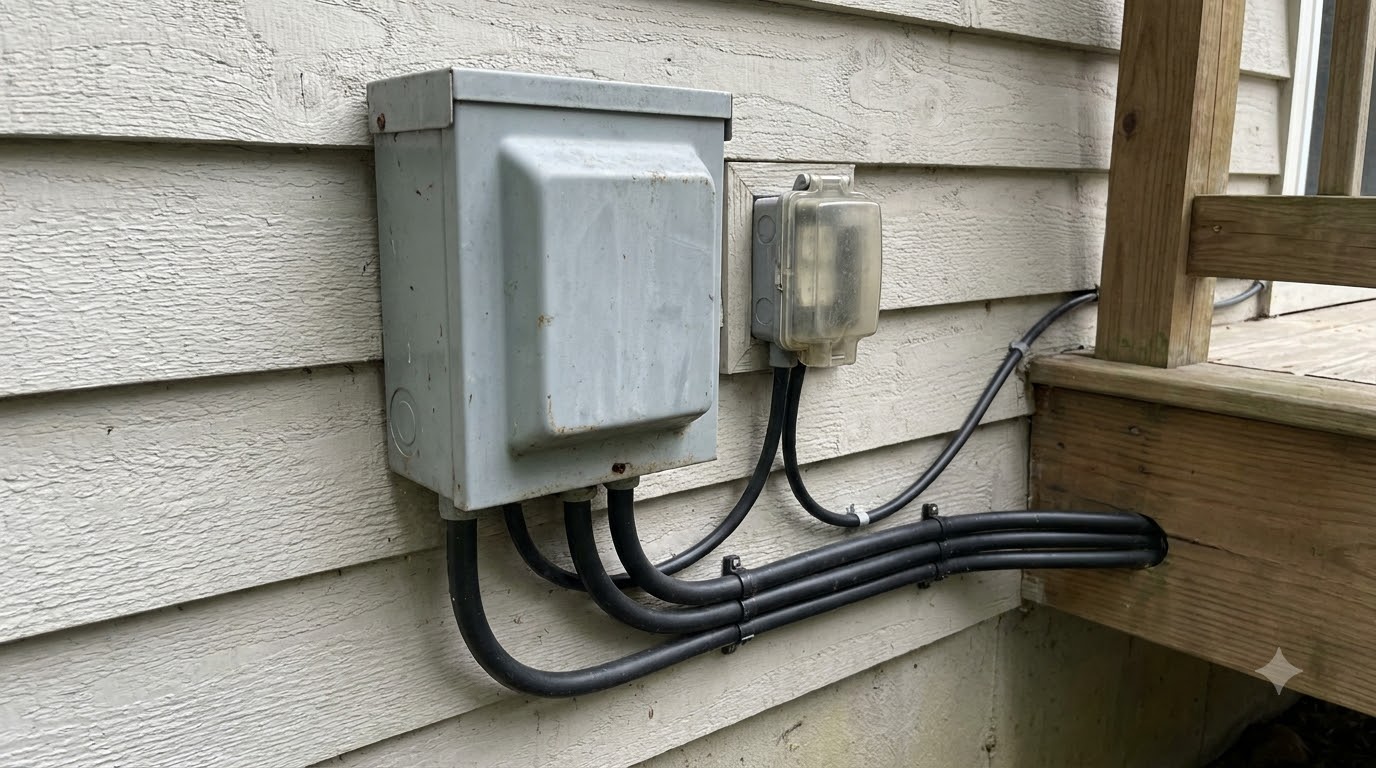
Fixture choice and safety notes
- Wet-rated fixtures for anything exposed to rain; damp-rated only under solid cover.
- Matched color temperature across every fixture — 2700K is the safe warm default.
- Outdoor-rated cable and connectors, with connections kept off the ground.
- GFCI protection on the outlet feeding the transformer, with an in-use cover.
- Shielded, downward-aimed fixtures keep glare off neighbors and the night sky — the same dark-sky logic that applies to any backyard lighting.
Mistakes that make a deck look worse at night
- Too bright. Deck lighting is orientation, not illumination — dim everything you can.
- Fixtures at eye level. Any visible glare point ruins the effect of a dozen well-placed lights.
- Even spacing everywhere. Rhythm and pools of light look better than a uniform grid.
- Mixed color temperatures — especially adding a cool-white floodlight to a warm scheme.
- Skipping the stairs. The one place lighting is not decorative.
Frequently asked questions
Do deck lights need an electrician?
Low-voltage systems generally do not: a transformer plugs into an existing outdoor GFCI outlet and the 12-volt cable is safe to run yourself. You need an electrician for a new outdoor circuit, a new receptacle, or line-voltage fixtures.
How bright should deck lighting be?
Dimmer than most people expect. Deck lighting is for orientation and atmosphere — many small warm sources beat a few bright ones. If a fixture is visible as a glare point from a seat, it is too bright or aimed wrong.
Are stair lights required by code on a deck?
Exterior stairs generally need illumination at the top landing, and many jurisdictions expect treads and nosings to be clearly visible. Requirements vary locally — and treat stair lighting as a safety feature regardless.
What color temperature is best for deck lights?
Warm white, around 2700K, matched across every fixture. Mixed temperatures are the most common reason a well-planned scheme still looks wrong at night.
Can you add deck lighting to an existing deck?
Yes. Post-cap lights, solar fixtures and surface-mounted strips retrofit easily. Recessed riser and floor lights are far easier during construction, since they need cable routed inside closed-up framing.
Is solar deck lighting any good?
For accent and marker lighting, yes — modern solar post caps are decent. For stair safety lighting use wired low-voltage, because solar output drops after cloudy days and in winter, exactly when dark evenings matter most.