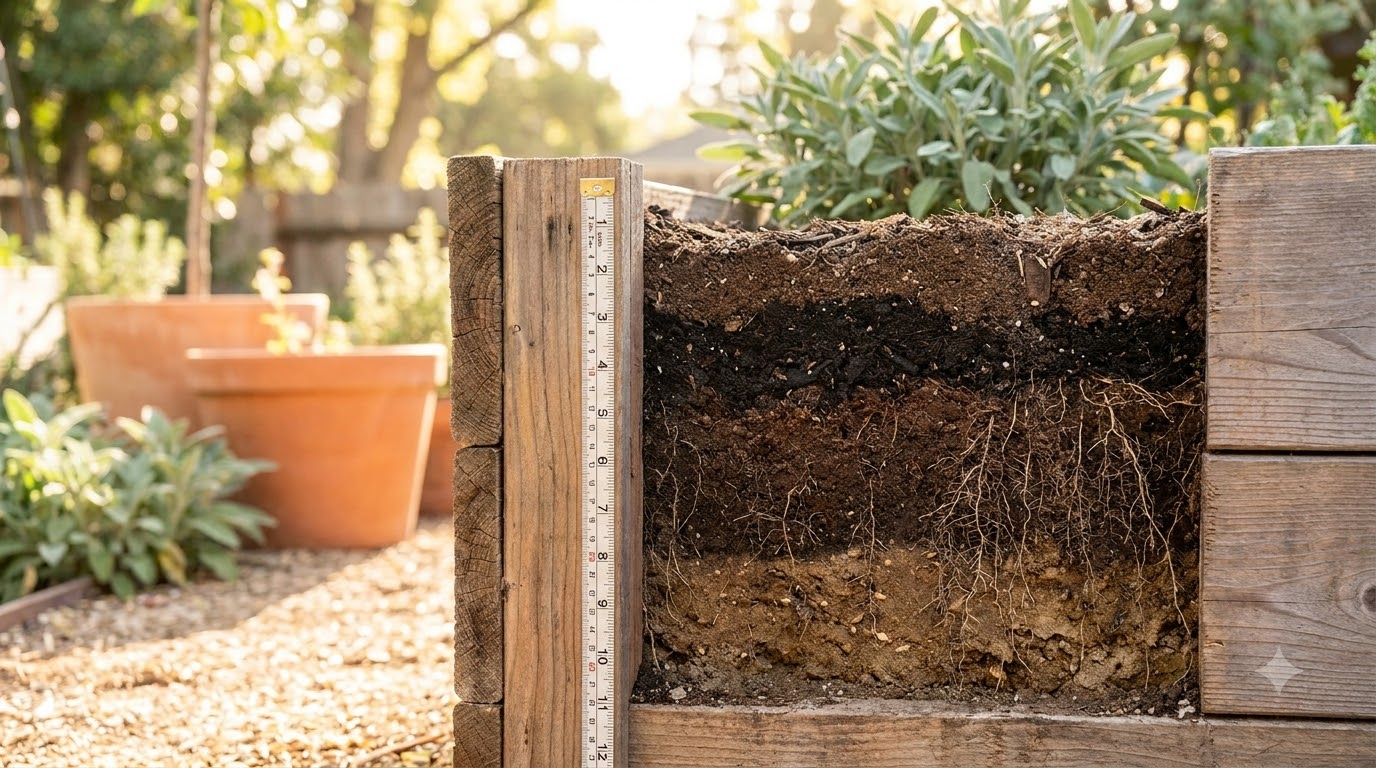
How deep should a raised garden bed be? Most need 10–12 inches of soil — but only if the bed sits on a hard surface like a patio, driveway, or gravel. If your bed sits on open ground, roots grow straight down into the soil beneath it, and 6–8 inches deep is often plenty. The University of Minnesota Extension puts it bluntly: for many gardeners, raising beds more than a few inches above the soil may not be necessary.
Key takeaways
- On open soil: 6–8 inches (15–20 cm) is enough for most vegetables, because roots continue into the native ground below.
- On concrete, patio, or gravel: 10–12 inches (25–30 cm) minimum — the bed is the entire root zone.
- Root crops on a hard surface: 18 inches (45 cm) for full-length carrots, parsnips, and potatoes.
- Doubling depth doubles soil cost. A 4×8 ft bed needs about 22 bags of soil at 12 inches and 43 bags at 24 inches.
- Depth and height are not the same number. A 24-inch-tall bed on open ground does not need 24 inches of purchased soil.
How deep a raised garden bed should be depends on what is underneath
Nearly every “how deep should a raised garden bed be” answer online gives a single number. That number is wrong about half the time, because it ignores the only variable that actually matters — whether roots can leave the bed.
| What the bed sits on | Minimum soil depth | Why |
|---|---|---|
| Open soil or lawn | 6–8 in (15–20 cm) | Roots pass through into native soil. The bed adds drainage and warmth, not the whole root zone. |
| Compacted clay or poor soil | 10–12 in (25–30 cm) | Roots can technically pass through, but slowly. Extra depth buys margin. |
| Patio, driveway, concrete | 12–18 in (30–45 cm) | Nothing below. The bed is the entire root zone, and heat radiates up from the slab. |
| Rooftop or balcony | 12 in (30 cm), weight permitting | Same as concrete, but check load limits before adding soil. |
| Over tree roots | 18 in (45 cm) | Tree roots will grow up into the bed and compete. Depth plus a barrier helps. |
Minnesota Extension adds a second reason to go deeper on hard surfaces: a bed sitting on pavement in a hot location benefits from being raised one to two feet, simply to reduce heat reaching the root zone.
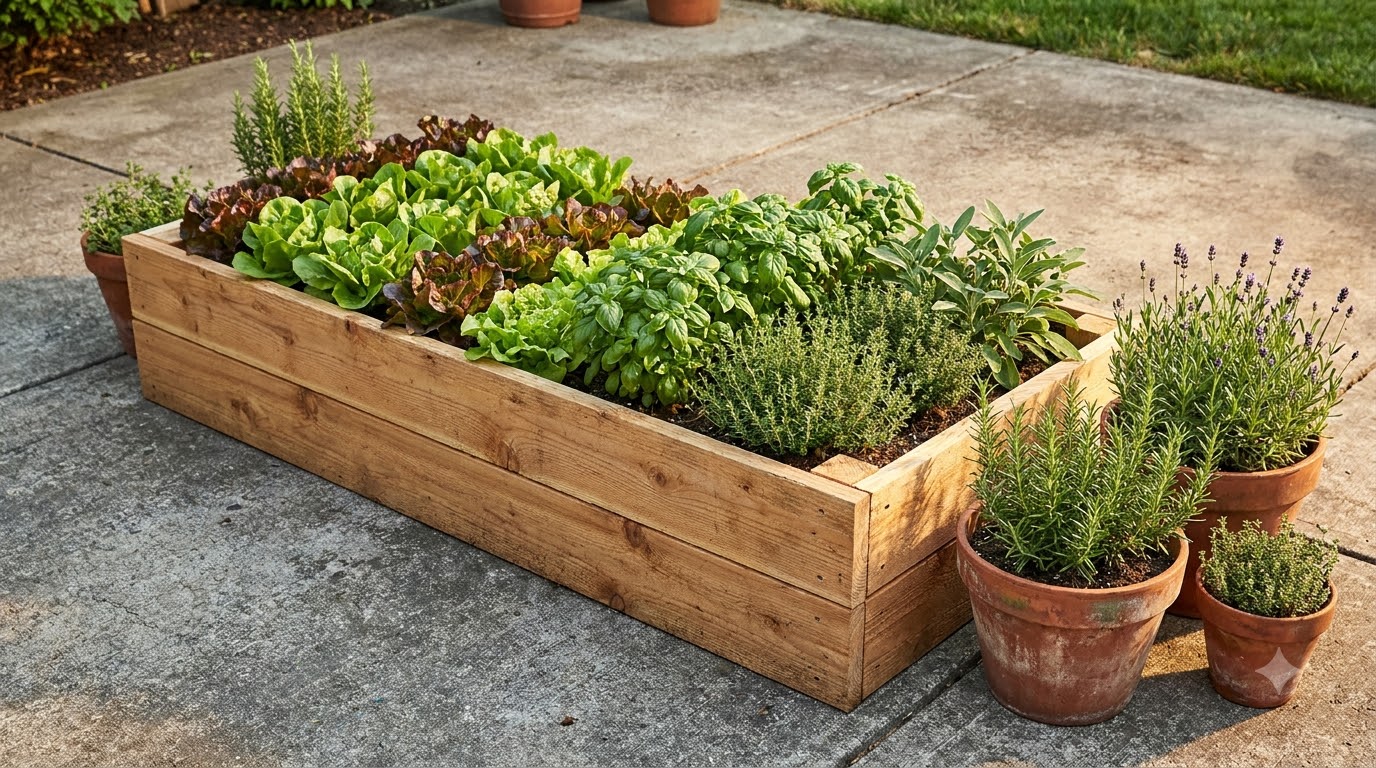
How deep for each crop
These figures are bed depths for beds on a hard surface. On open ground, subtract roughly a third — the native soil makes up the difference.
Shallow — 6 to 8 inches (15–20 cm)
- Lettuce, spinach, arugula, and other salad greens
- Radishes
- Most culinary herbs: basil, cilantro, parsley, thyme, oregano
- Green onions and garlic
- Strawberries
Medium — 10 to 12 inches (25–30 cm)
- Bush beans and peas
- Beets and short carrot varieties (Nantes, Chantenay)
- Peppers and eggplant
- Cucumbers and summer squash
- Swiss chard, kale, cabbage, broccoli
- Bulb onions
Deep — 18 inches or more (45 cm+)
- Full-length carrots and parsnips
- Potatoes and sweet potatoes
- Tomatoes — they will root as deep as you let them
- Winter squash and pumpkins
- Asparagus and rhubarb (permanent plantings)
If you want one number that covers a mixed vegetable bed on a patio, 12 inches handles everything on this list except full-length root crops.
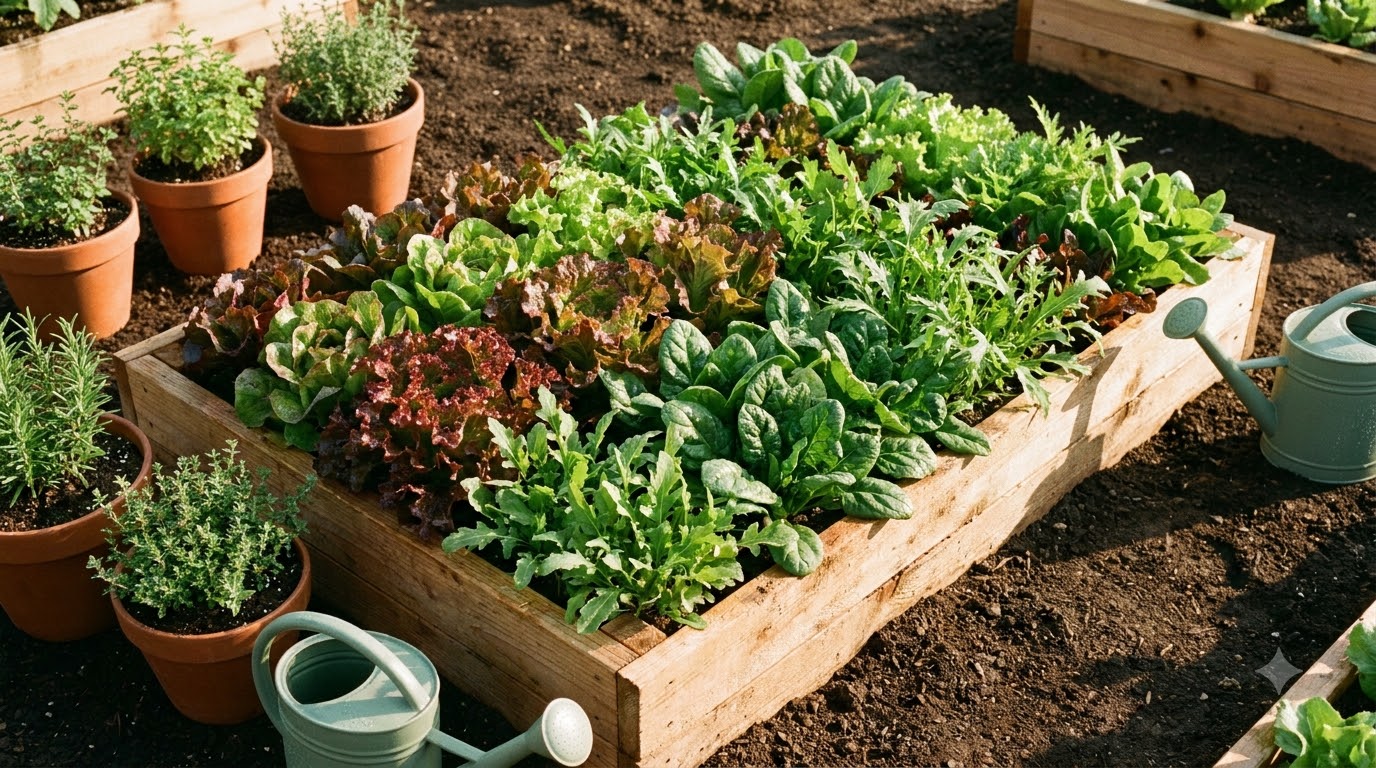
Why deeper is not automatically better
Depth is the single biggest driver of what a raised bed costs to fill. The frame is a one-time purchase; the soil is priced by volume, and volume scales directly with depth.
Here is a standard 4×8 ft bed (32 sq ft / 3 m²), using 1.5 cu ft bags:
| Depth | Soil volume | Bags (1.5 cu ft) | Bulk |
|---|---|---|---|
| 6 in | 16 cu ft | 11 bags | 0.6 cu yd |
| 8 in | 21 cu ft | 15 bags | 0.8 cu yd |
| 10 in | 27 cu ft | 18 bags | 1.0 cu yd |
| 12 in | 32 cu ft | 22 bags | 1.2 cu yd |
| 18 in | 48 cu ft | 32 bags | 1.8 cu yd |
| 24 in | 64 cu ft | 43 bags | 2.4 cu yd |
Going from 12 inches to 24 inches doubles the soil bill for a benefit most crops will never use. Bagged soil is the expensive route at this scale — past about one cubic yard, bulk delivery is usually cheaper per unit even after the delivery fee.
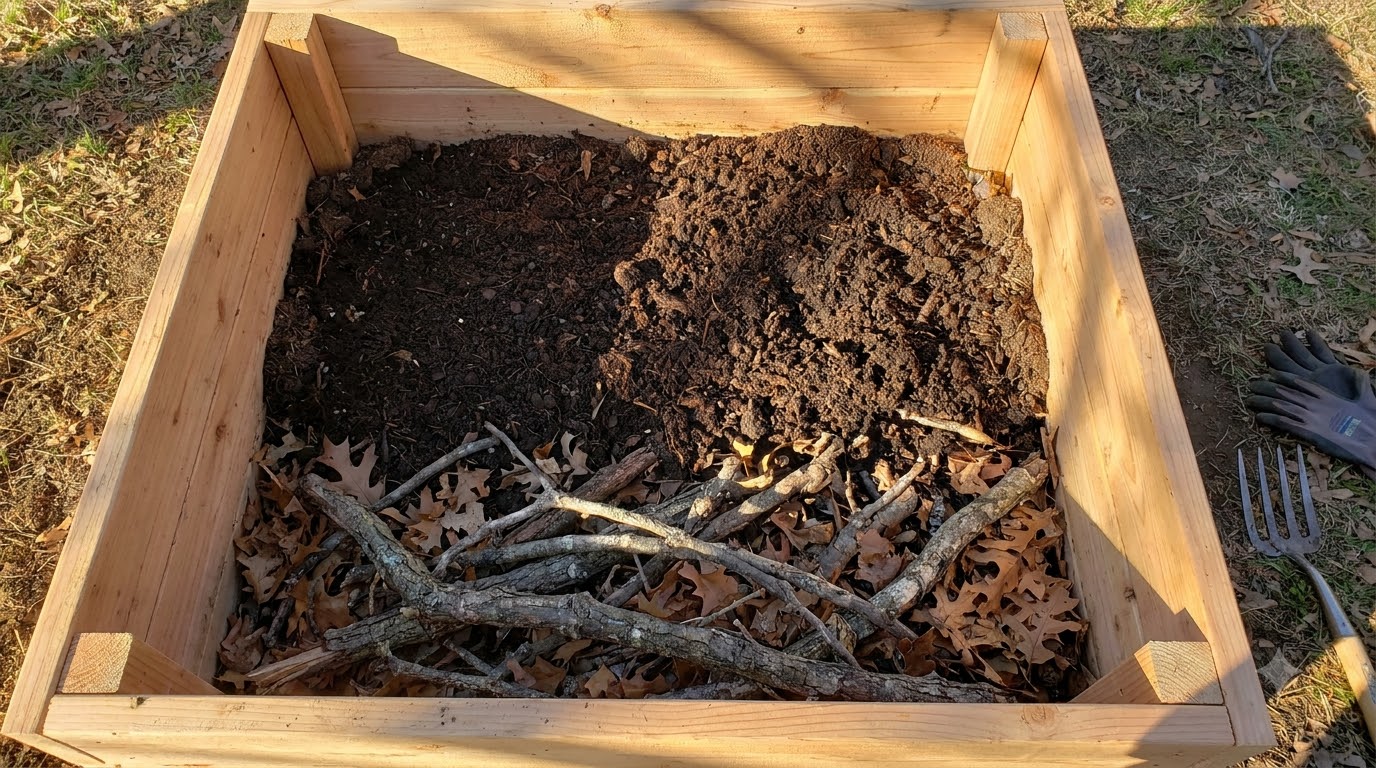
Minnesota Extension notes that gardeners building beds taller than two feet often fill the bottom with layered organic material — sticks, leaves, compost — specifically to avoid buying that much soil. The exact layers, and how much they save, are in our guide to filling a raised garden bed.
Depth and height are different numbers
This is the distinction that quietly costs people money.
- Height is how far the frame stands above the ground. It is an ergonomics decision: how far you want to bend.
- Depth is how much soil the roots actually have. It is an agronomy decision.
On open ground the two are not the same. A 24-inch-tall bed sitting on soil gives roots 24 inches of purchased mix plus whatever is below — far more than any vegetable needs. Many people build tall beds for their back, then fill the entire cavity with premium raised bed mix. The bottom half is doing nothing.
If you want a tall bed for comfort, Minnesota Extension gives a useful reference point: 27 inches is generally a comfortable working height for wheelchair users. Build the frame to that height, then fill the lower portion with coarse organic material and reserve the good soil for the top 12 inches.
Let standard lumber sizes pick your depth
If you are building the frame yourself, the practical depth options are already decided for you — dimensional lumber comes in fixed widths, and fighting them means extra cuts and extra cost. A “2×8” board is actually 7¼ inches wide, a “2×10” is 9¼ inches, and a “2×12” is 11¼ inches. (Before you buy boards, check which treated wood is safe for a food garden.)
| Frame build | Actual depth | Works for |
|---|---|---|
| One 2×8 | 7¼ in (18 cm) | Greens and herbs on open soil |
| One 2×10 | 9¼ in (23 cm) | Most vegetables on open soil |
| One 2×12 | 11¼ in (29 cm) | The all-purpose choice — lands right in the 10–12 inch sweet spot with a single board |
| Two 2×8s stacked | 14½ in (37 cm) | Mixed vegetables on a patio or concrete |
| Two 2×10s stacked | 18½ in (47 cm) | Root crops on a hard surface |
| Two 2×12s stacked | 22½ in (57 cm) | Waist-height comfort — layer the bottom, soil on top |
Metal kit beds follow their own steps — most brands sell 8-inch and 17-inch heights. The 8-inch size is an open-soil bed; the 17-inch size is the one to pick if the bed will live on pavement.
Soil settles — fill higher than you think
A freshly filled bed is mostly air. As the organic fraction decomposes and particles pack together, the level drops noticeably over the first season — a bed filled level with the rim in spring commonly sits a few inches low by fall. Plan for it:
- At fill time: fill to the very rim, water deeply to settle the mix, then top up again before planting.
- Every spring after: top up with an inch or two of compost. This replaces what decomposed and feeds the bed at the same time.
- Never compact it yourself. Pressing the soil down defeats the main advantage a raised bed has over ground soil — its loose structure.
Mistakes that cost a season
- Using potting soil to fill a bed. It is formulated for containers and dries out too fast at bed volume. Minnesota Extension recommends roughly one-half to two-thirds topsoil with one-third to one-half plant-based compost instead — see what to fill a raised bed with.
- Filling a deep bed entirely with compost. Too much compost holds water badly — it dries out quickly and can start repelling water once dry.
- Building on concrete at 6 inches. This is the most common failure. Six inches is fine on soil and far too shallow on a slab.
- Making the bed too wide to reach across. Width should be limited by your arm’s reach so you never step into the bed. Walking in it compacts the soil you just paid for.
- Ignoring what is under the bed before you build. A bed over tree roots or over a buried slab behaves like a container, not like a garden bed.
If your bed is already too shallow
Built at 6 inches and regretting it? You do not have to rebuild. Work with the depth you have:
- Switch to short-rooted varieties. Round carrots (Paris Market, Oxheart types), bush beans, determinate tomatoes, and every leafy green are bred for exactly this situation.
- Mound where it matters. Squash and melons only need depth at the planting hill — a mound of extra soil at each plant adds inches exactly where the roots start.
- Add a course of lumber. Screwing one 2×8 on top of the existing frame adds 7¼ inches of depth for the price of a few boards — far cheaper than a new bed, and you only top up the soil once.
- Water more often, feed lightly. A shallow bed holds less moisture and fewer nutrients. Expect near-daily watering in high summer, especially on a hard surface.
New to raised beds? Start with the complete raised garden bed guide — size, wood, soil, and cost in one place.
Frequently asked questions
Is 6 inches deep enough for a raised garden bed?
On open soil, yes, for greens, herbs, radishes, and strawberries. On concrete or a patio, 6 inches is too shallow for anything but shallow-rooted greens, and even those will need watering almost daily in summer.
Is 12 inches deep enough for a raised bed?
Yes, for almost everything. Twelve inches handles tomatoes, peppers, beans, squash, and short carrot varieties even on a hard surface. Only full-length root crops such as parsnips and long carrots want more.
How deep should a raised bed be for tomatoes?
Twelve inches is workable, 18 inches is better. Tomatoes root deeply when given the chance, and deeper soil holds moisture more evenly, which reduces blossom end rot caused by irregular watering.
Do I need to remove the grass under a raised bed?
Not if the bed is 10 inches or deeper — the grass dies from lack of light. For shallower beds, either strip the sod or lay plain cardboard down first to smother it.
How deep should a raised bed be on concrete?
Twelve inches minimum, 18 inches for root crops. On concrete the bed is the whole root zone, and the slab radiates heat upward. Extra depth also protects roots from that heat — and in high summer, a shade cloth over the bed takes the edge off from above.
Can a raised bed be too deep?
Not for the plants, but yes for your budget. Past about 18 inches you are buying soil the roots will not reach. Build the frame as tall as you want for comfort, then fill the bottom with coarse organic material.
Sources
- University of Minnesota Extension — Raised bed gardens (bed height, soil mix ratios, materials)