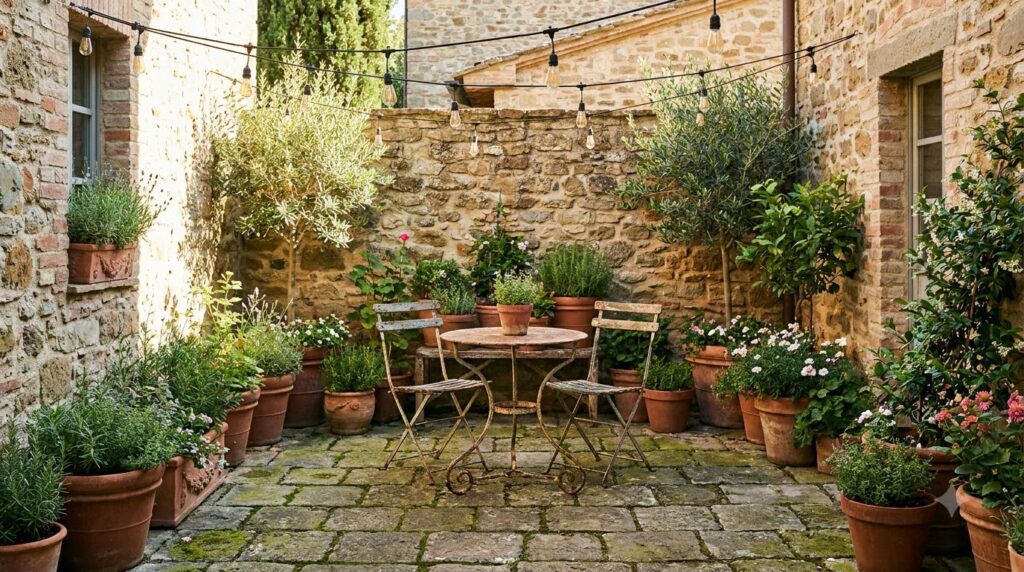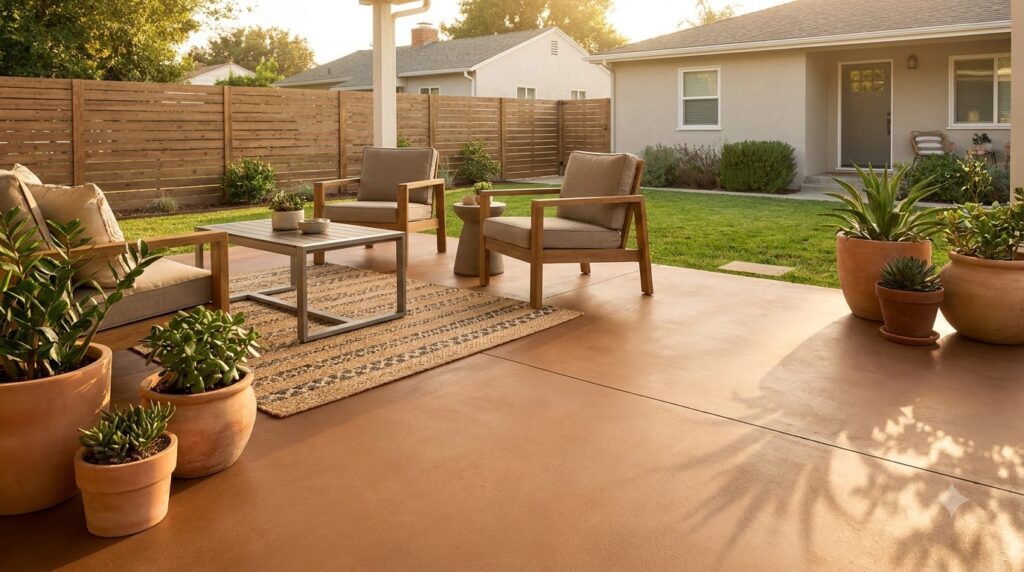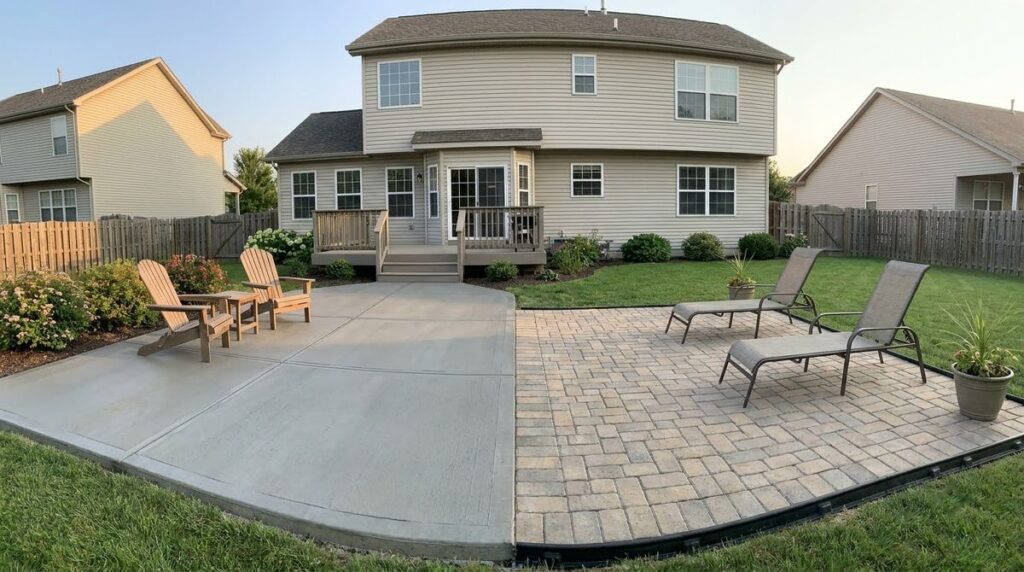
A plain concrete patio costs about $4 to $12 per square foot installed and a paver patio about $8 to $24, so concrete wins on price while pavers win on repairs. A cracked slab gets patched or torn out; a sunken paver is lifted, the base fixed, and the same paver set back.
Soil, winters and whether you build it yourself decide which one fits your yard. The verdict near the end sorts it by situation.
Key takeaways
- Plain concrete is roughly half the price of pavers. HomeGuide says installing pavers costs about twice as much as laying concrete; stamped concrete ($9–$30 per sq ft) overlaps with pavers.
- Concrete will crack; joints decide where. NRMCA says cracks cannot be prevented entirely, only controlled, with joints about every 10 feet in a 4-inch slab.
- Pavers fail by settling, and settling is fixable. CMHA says pavers can be removed and reinstated with little or no cutting.
- Pavers dig deeper. Quikrete’s patio plan excavates about 7½ inches for a slab; Unilock calls for 6–8 inches of gravel alone under a paver patio.
- Pavers are the realistic DIY job. A 12×12 slab is about 80 bags of 80-lb mix that must be placed and finished in one go.
| Option | Installed per sq ft | How it usually fails | Repair | DIY difficulty |
|---|---|---|---|---|
| Plain poured concrete | $4–$12 | Cracks, scaling after freeze-thaw and salt | Patch or resurface; tear out if it heaved | Hard: one continuous pour |
| Stamped concrete | $9–$30 | Same cracks as plain, more visible in a pattern | Patches rarely match the pattern | Pro only in practice |
| Concrete pavers | $8–$24 | Low spots, edge spreading, sand loss | Lift, rebuild base, relay the same pavers | Moderate: can be done in stages |
Concrete prices: HomeGuide concrete patio cost guide (written July 2025). Paver prices: LawnLove (updated December 2025), with HomeGuide’s $10–$17 typical range inside it.
Concrete vs paver patio cost, side by side
Concrete vs paver patio cost is the clearest difference between the two. A plain slab runs $4–$12 per square foot installed, pavers $8–$24. The full breakdown by material, labor and line item is in our paver patio cost per square foot and by size, and slab finishes are priced in concrete patio ideas on a budget.
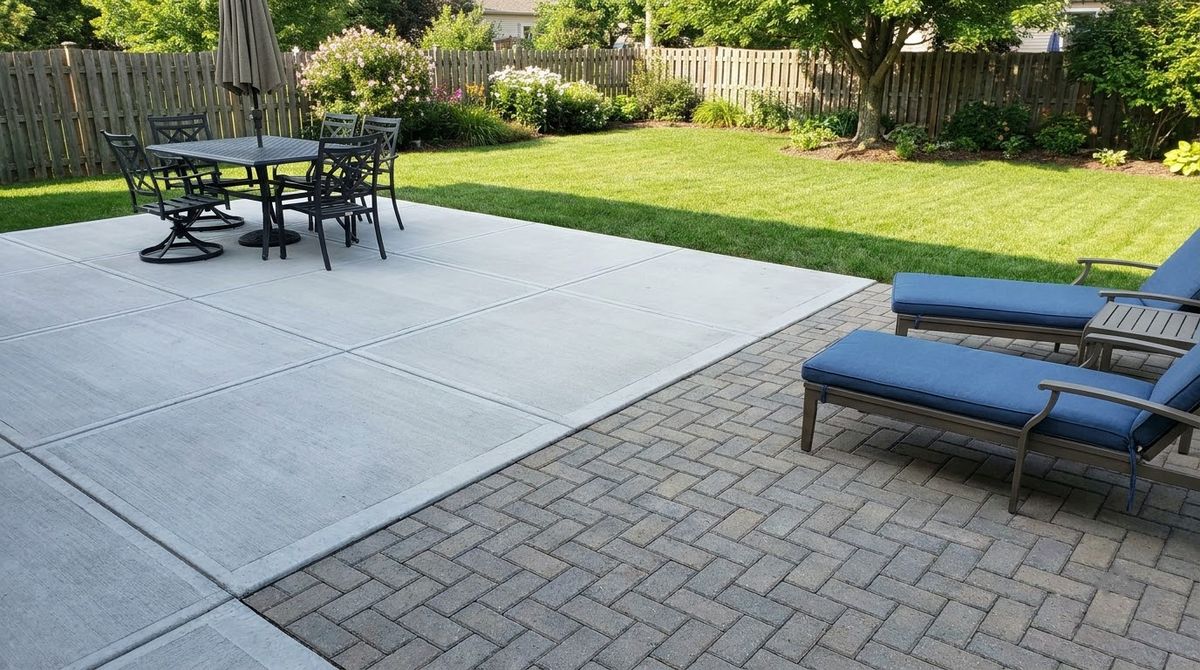
| Patio | 12×12 ft (144 sq ft) | 20×20 ft (400 sq ft) |
|---|---|---|
| Plain poured concrete | $580–$1,730 | $1,600–$4,800 |
| Stamped concrete | $1,300–$4,320 | $3,600–$12,000 |
| Concrete or brick pavers | $1,400–$2,500 | $3,200–$9,600 |
Assumptions: professionally installed rectangle, no tear-out or regrading. Concrete 20×20 and paver 12×12 totals are HomeGuide’s; the other cells are the per-square-foot range times the area. Paver 20×20 is LawnLove’s 400 sq ft range.
- Labor is the swing: HomeGuide puts concrete labor at 50%–60% of the job; paver labor runs $6–$11 per sq ft against $4–$6 for materials.
- Reinforcement: rebar or wire mesh adds $1–$3 per sq ft to a slab, per HomeGuide.
- Stamped is not the cheap middle: its range runs past pavers at the top end, and it still cracks like any slab.
Base requirements: what goes under each patio
Base requirements are where the two patios split before anything shows. A slab sits on a thin gravel layer and carries load as one plate. Pavers have no strength as a plate; the compacted gravel base and the edge restraint hold them, so the base is thicker and the dig deeper.
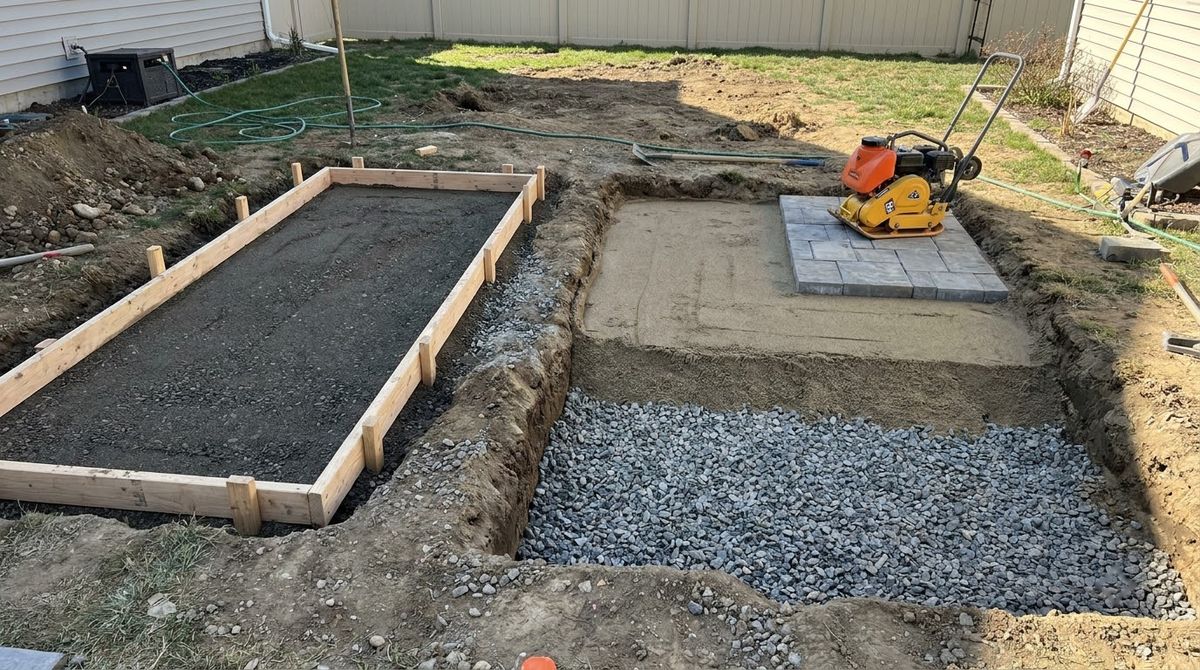
- Concrete (Quikrete patio plan): about 5 inches of compactible gravel tamped to 4 inches, then 3½ inches of concrete in 2×4 forms, so the dig is about 7½ inches. The gravel should reach at least 6 inches past the slab edge.
- Concrete against the house: Quikrete glues a ½-inch asphalt-impregnated fiber board to the wall as an isolation joint so the two can move apart.
- Pavers (Unilock planning guide): 6–8 inches of gravel for a patio, compacted in 2–3 inch layers, plus a 1-inch bed of coarse sand, plus the paver itself.
- Pavers at the edge: Unilock calls edge restraint critical and says it must be spiked into the compacted base.
Clay, wet or frost-prone soil pushes the paver base deeper still. Depths by soil type, which gravel to buy and how to compact it are in patio paver base depths that stop sinking. Call 811 before either dig.
Cracking vs settling: how each fails and how it is repaired
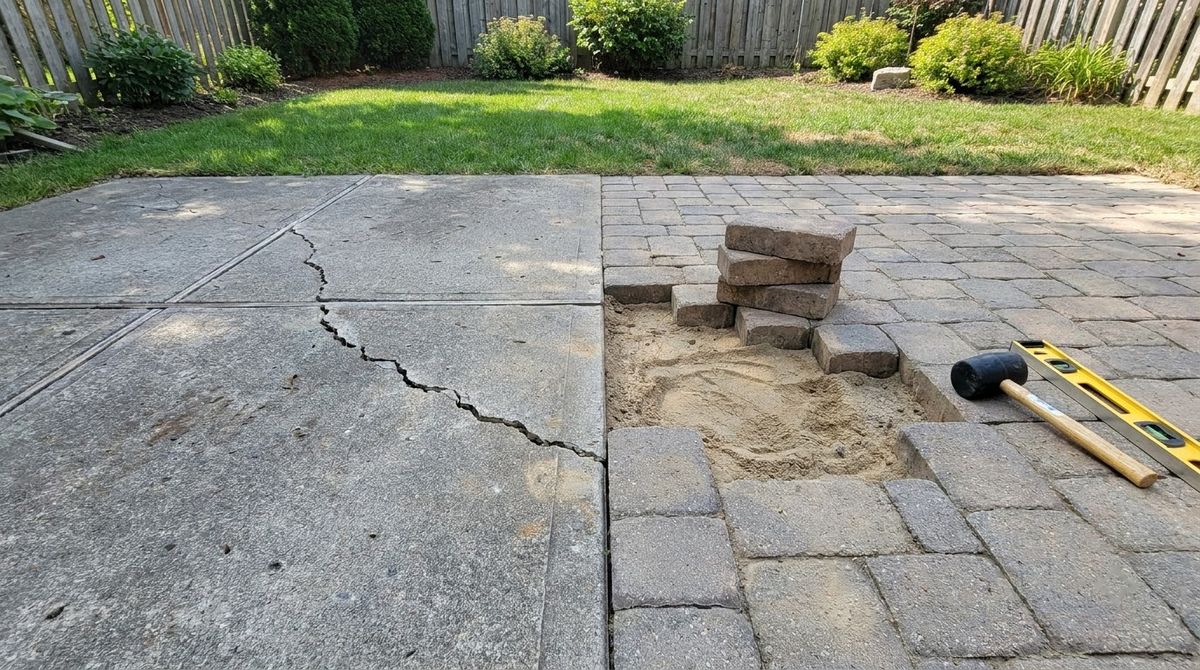
Cracking vs settling is the real long-term difference. NRMCA’s guide to joints in slabs on grade states that cracks in concrete cannot be prevented entirely, only controlled. Concrete shrinks as it dries; restrained, it cracks. Control joints are planned weak lines that make the crack happen in a straight groove instead of across the patio.
- Joint spacing: NRMCA gives 24 to 36 times the slab thickness, about 10 feet for a 4-inch slab, and no more than 15 feet.
- Panel shape: square or nearly so, the long side no more than 1.5 times the short side; avoid L-shaped panels.
- Groove depth: at least a quarter of the slab thickness and never under 1 inch.
- Quikrete’s rule of thumb: any patio larger than 10×10 feet needs control joints.
A crack inside a joint is expected. A crack across a panel can be filled, and surface damage resurfaced, but a slab that heaved or dropped in sections has a ground problem underneath, and the fix is breaking it out and pouring again.
Pavers fail differently. CMHA’s maintenance guide traces low spots to a settled base, often from poor compaction, and spreading joints to a lost edge restraint. The repair is local: a crew can reinstate the same pavers with little or no cutting, often rebuilding only the top layers. With nothing to cure, CMHA adds, repairs are fast.
Freeze-thaw and deicing salt
Freeze-thaw is where a poor concrete order shows up within a few winters. NRMCA’s guide on scaling says most surface flaking comes from concrete with too little entrained air, salt on weak or poorly cured concrete, or finishing while bleed water is on the surface.
- Order air-entrained concrete: 6%–7% air for severe exposure, 4%–6% where deicing salt will not be used.
- Strength: NRMCA says 3,500 psi for freeze-thaw exposure and 4,000 psi where deicers are used should be adequate.
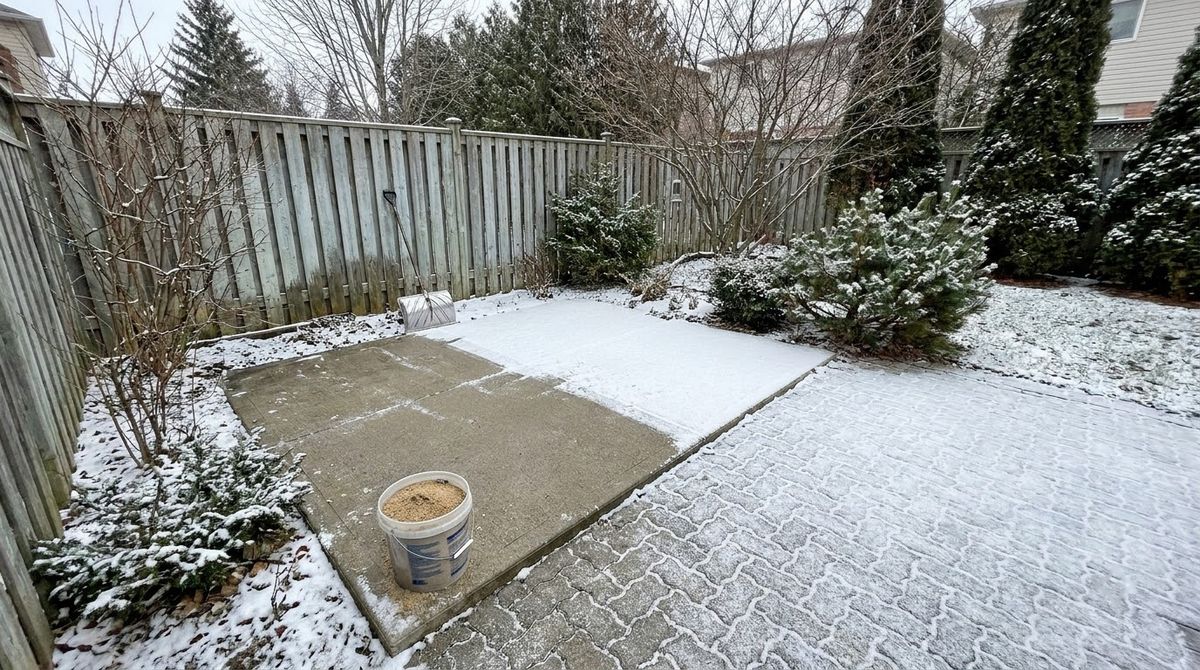
- No salt in year one: do not use calcium or sodium chloride in the first year after the pour; use clean sand for traction.
- Never use ammonium sulfate or ammonium nitrate deicers, which are in most fertilizers and attack concrete.
Concrete pavers are made for this exposure. CMHA notes that ASTM C936, the standard for interlocking concrete pavers, includes freeze-thaw and deicing salt durability criteria tested under ASTM C1645. CMHA still advises sand first, rock salt over harsher deicers, and only as much as the ice needs. Frost heave lifts both patios; pavers can be reset, a slab cracks.
Drainage and permeability
Drainage and permeability matter less than many sales pages suggest, because a standard paver patio sheds most rain across its surface just like a slab. Both are built to a fall away from the house so water does not pond against the foundation.
- Concrete: Quikrete’s standard slope is ⅛ inch per foot, so a 10-foot patio drops 1¼ inches.
- Pavers: CMHA recommends a minimum slope of 2%, about ¼ inch per foot, to drain water and wash off deicer.
- Truly permeable: the EPA lists permeable interlocking pavers and pervious concrete among surfaces that let rain soak through. Permeable pavers use open-graded stone and gravel-filled joints, not the standard sand-set build.
If your town caps impervious surface, ask whether a permeable paver system counts differently before choosing, and check with your local building department.
DIY-ability: which one you can build yourself
DIY-ability favors pavers by a wide margin. A paver patio can stop at the end of any day: dig one weekend, base the next, lay pavers after that. A slab has to be placed, screeded, floated, jointed and cured in one session once the concrete arrives.
- Concrete volume: Quikrete rates an 80-lb bag of Concrete Mix at about 0.60 cubic feet. A 12×12 slab 4 inches thick is 48 cubic feet, or about 80 bags, which is why most DIY slabs that size use ready-mix.
- Curing: Quikrete’s data sheet says keep the slab moist for 5 days in warm weather (70°F or higher) or 7 days at 50–70°F, and protect it from freezing for the first 48 hours.
- Use: HomeGuide says you can walk on new concrete after 24–48 hours; full cure takes about 30 days.
- Pavers: HomeGuide puts a DIY paver patio at $5–$10 per sq ft, about 50% less than hiring out, including a rented plate compactor at $70–$250 a day.
The paver catch is labor: HomeGuide estimates a two-person crew lays about 100 square feet a day, so a 20×20 patio is around four crew-days, longer for a first-timer. Patterns and accents are covered in paver patio ideas, patterns and base basics.
Lifespan and resale: what the sources support
Lifespan estimates overlap, so they do not settle the choice. HomeGuide’s concrete patio guide lists plain and stamped concrete at 30–50 years and paver patios at 25–75 years. These are cost-guide estimates, not test results, and both depend on the base and climate more than the surface.
For resale, no source opened for this article gives a dollar return for a patio of either type. HomeGuide says only that both can add curb appeal when installed and maintained well. Treat any “pavers add more value” claim without data as a sales line.
Verdict: pick concrete if… pick pavers if…
The verdict follows your yard and your budget, not taste alone. Use the situation that matches yours.
Pick concrete if:
- The budget is fixed and plain gray or broom finish is fine; $1,600–$4,800 for a 20×20 slab is hard to beat.
- The soil is stable and drains well, and the patio is a simple rectangle a crew can pour in one day.
- You are hiring the job out anyway and want the shortest install.
- Winters are mild, or you will order air-entrained concrete and skip salt the first year.
- You plan to add pavers or tile on top later; Quikrete notes a slab can serve as a subbase for a mortared paver patio.
Pick pavers if:
- You will build it yourself over several weekends.
- The yard has freeze-thaw, clay or tree roots, where movement is likely and a reset beats a tear-out.
- Utility lines or an irrigation main run under the patio and may need to be dug up someday.
- You want curves, borders or patterns and can carry roughly twice the cost of plain concrete.
Skip stamped concrete if the reason is to save money over pavers: its installed range overlaps and runs past pavers, and repairs rarely match the pattern.
Mistakes to avoid with either patio
Mistakes to avoid with either patio mostly happen below the surface, before anyone sees the finish.
- Thinning the base to save a day of digging. Settlement under pavers and cracking under slabs both start here.
- No control joints, or joints too far apart. A 4-inch slab wants them about every 10 feet.
- Pouring tight to the house without an isolation joint.
- Salting a new slab its first winter, or using fertilizer-based deicers at any age.
- Skipping edge restraint on pavers, or spiking it into soil instead of the base.
- A flat patio. Water that sits freezes, scales concrete and softens a paver base.
Frequently asked questions
Is a paver patio more expensive than a concrete patio?
Yes, in most cases. A plain poured concrete patio costs $4 to $12 per square foot installed, while a paver patio costs about $8 to $24, and HomeGuide says pavers cost about twice as much as laying concrete. Stamped concrete, at $9 to $30 per square foot, overlaps with pavers and can cost more at the top end.
Do pavers crack less than concrete?
Pavers rarely crack as a surface because each unit moves a little on its own; they fail by settling or spreading instead. Concrete slabs crack as they shrink, and NRMCA says cracks cannot be prevented entirely, only controlled with joints. The bigger difference is repair: a sunken paver area can be lifted and relaid with the same pavers.
Which lasts longer, a concrete or paver patio?
The estimates overlap. HomeGuide lists concrete patios at 30 to 50 years and paver patios at 25 to 75 years. Those are cost-guide figures, not test data. In practice the base, drainage and freeze-thaw exposure decide which patio lasts, and a paver patio can be repaired in sections rather than replaced as a whole.
Is a concrete or paver patio better in cold climates?
Both can work if built for it. Concrete for freezing climates should be air-entrained, 6% to 7% air for severe exposure, and kept free of deicing salt in its first year, according to NRMCA. Pavers made to ASTM C936 meet freeze-thaw and deicing salt criteria, and frost-lifted pavers can be reset instead of patched.
Can I pour a concrete patio myself?
A small one, yes, but it is a one-day job with no pause. A 12 by 12 foot slab 4 inches thick needs about 48 cubic feet of concrete, roughly 80 bags of 80-pound mix at Quikrete’s yield of 0.60 cubic feet per bag. It must be placed, leveled, floated and jointed before it sets, then kept moist for 5 to 7 days.
Do pavers add more home value than concrete?
No source opened for this article gives a measured resale return for either patio. HomeGuide says both can raise curb appeal and value when installed and maintained well, and that replacing a damaged slab with new concrete can have a similar effect. Choose on cost, soil and repairs, and treat value claims without numbers with caution.
Sources
- HomeGuide, How Much Does a Concrete Patio Cost? (written July 10, 2025).
- HomeGuide, How Much Does a Paver Patio Cost? (written Sep 18, 2024).
- NRMCA, CIP 6: Joints in Concrete Slabs on Grade (1998 edition, copy hosted by Prairie Materials).
- NRMCA, CIP 2: Scaling Concrete Surfaces (1998 edition, copy hosted by Prairie Materials).
- Concrete Masonry & Hardscapes Association, PAV-TEC-006: Operation and Maintenance Guide for Interlocking Concrete Pavement (checked Oct 2026).
- Quikrete, Building a Concrete Patio (checked Oct 2026).