A DIY gravel patio is a 4- to 5-inch-deep excavation, compacted, edged, and filled with 1/4- to 3/8-inch pea gravel or 1/2-inch clear crushed stone. Stake the edging every 4 feet (every 2 feet on curves), and add a stabilizer grid if you want the surface to stay flat under chairs and bare feet.
Key takeaways
- Pick the stone for the feet that use it. Smooth 1/4- to 3/8-inch pea gravel is the soft, barefoot choice; 1/2-inch clear crushed stone locks tighter and holds furniture better.
- Never use round rock as the base. TRUEGRID calls for clean, angular 3/4- to 1-inch stone (#57) under its grids, compacted in 4-inch lifts.
- Edging does the real work. Without it, loose stone drifts into the lawn and beds. Set it before the gravel goes in.
- A grid is what makes a gravel patio feel solid. CORE’s patio grid is 1.38 inches tall and wants only 1/2 to 1 inch of stone over the top.
- Call 811 a few business days before you dig. The service is free.
Here are the tools and materials a gravel patio takes, with what to choose for each.
| Item | What to choose | Notes |
|---|---|---|
| Surface gravel | Pea gravel, 1/4–3/8 in, or 1/2-in clear crushed stone | Round 3/8 in where small dogs or bare feet go (CORE) |
| Base stone | Clean angular 3/4–1 in (#57), or compactible road base | TRUEGRID: no round rock in the base |
| Edging | Aluminum, steel or heavy plastic edging, or a block border | Plastic Terrace Board: stakes every 4 ft, 2 ft on curves |
| Stabilizer grid | Interlocking honeycomb panels | Optional; CORE Cana panels are 22.9 × 18.9 × 1.38 in |
| Fabric | Non-woven separation geotextile | Between soil and stone, not as a weed cure |
| Tools | Spade, flat shovel, rake, hand tamper, plate compactor, 6-ft level, string line, rubber mallet | A plate compactor is a rental for most DIYers |
Choosing gravel size for a DIY gravel patio
Choosing gravel size for a DIY gravel patio is a trade between comfort and firmness. Round stone feels soft underfoot but rolls; angular stone locks together but is harder on bare feet. The stone on top and the stone underneath are not the same product.
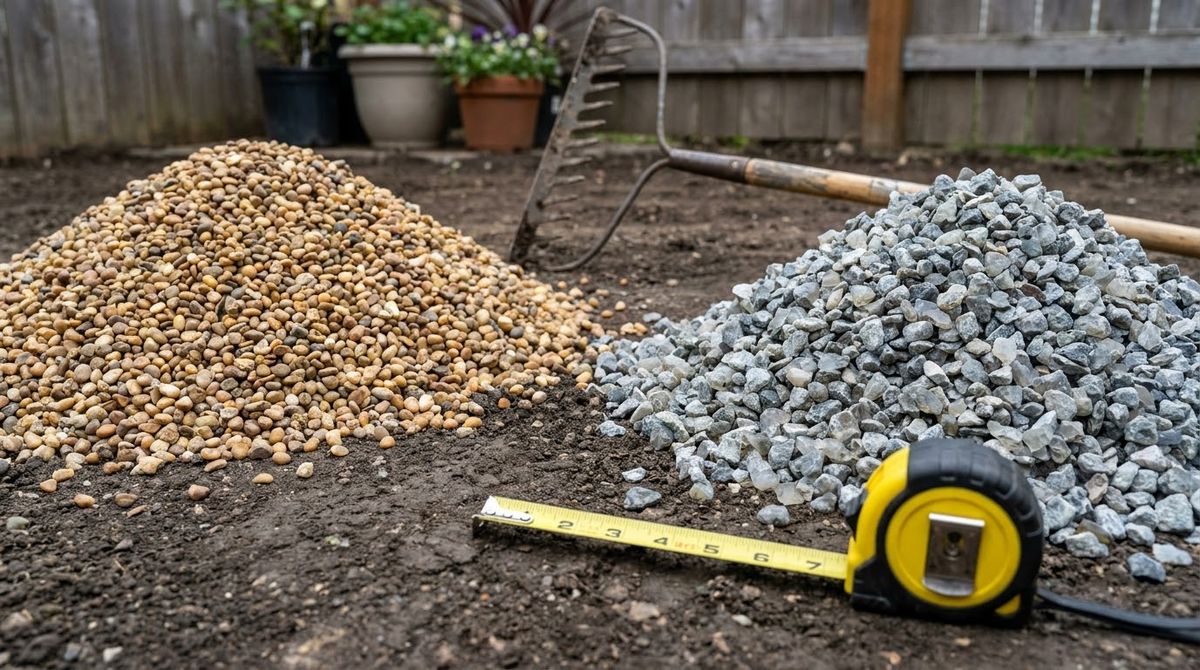
- Pea gravel (surface). Kolor Scape’s product sheet lists pea gravel as small, smooth stones, generally 1/4 to 3/8 inch. It is the classic pea gravel patio look, and it shifts the most underfoot.
- Clear crushed stone (surface or grid fill). CORE fills its patio grids with 1/2-inch clear crushed aggregate and switches to round 3/8-inch stone for areas with small dogs or bare feet. TRUEGRID lists 5/8- or 3/4-inch fill rock as common infill for its grids.
- Base stone (under the surface). TRUEGRID’s residential guide calls for clean, angular 3/4- to 1-inch stone, #57 being the common size, or a compactible road base where drainage storage is not needed. Its instructions say plainly: do not use round rock for base aggregate.
- No fines in a grid. CORE says not to fill its grids with fines or dirty gravel, so skip stone dust and crusher run on top.
If you want pea gravel and furniture that does not sink, use pea gravel inside a grid, or over a compacted crushed base, rather than loose over soil.
How deep to dig, and where the base depth comes from
How deep to dig for a gravel patio depends on whether you are laying loose stone on compacted soil or building on a gravel base. This Old House’s pea gravel patio build says 4 or 5 inches is deep enough, shallower than a paver patio.
- Loose pea gravel on compacted soil. Dig 4 to 5 inches, remove rocks and roots, and compact damp soil with a plate tamper before laying fabric and stone (This Old House).
- Grid patio. CORE’s formula is base plus grid plus overfill: a 3-inch base, 1.37-inch grid and 1/2-inch overfill take about 5 inches of excavation.
- Gravel over a crushed base. Add the base thickness to your surface depth. TRUEGRID gives 4 to 6 inches of base for patios and walkways, measured after compaction.
Base depth by soil type, compaction lifts and plate-compactor passes are the same job as under pavers, so they are covered in detail in patio paver base depths that stop sinking. Clay, wet or frost-prone ground needs the thick end of those ranges whichever surface goes on top.
How much gravel to order
Cubic yards equal square feet times depth in inches, divided by 324. A 10 × 10 patio at 3 inches is 100 × 3 ÷ 324, or about 0.93 cubic yard. In bags, Kolor Scape’s chart puts a 100-square-foot area at 32 half-cubic-foot bags for 2 inches, 49 for 3 inches and 64 for 4 inches.
Edging that keeps a gravel patio in place
Edging for a gravel patio is what separates a patio from a pile of stone that drifts into the lawn. Put it in before any gravel, so it sits on firm ground and the stone is placed against it, not the other way around.
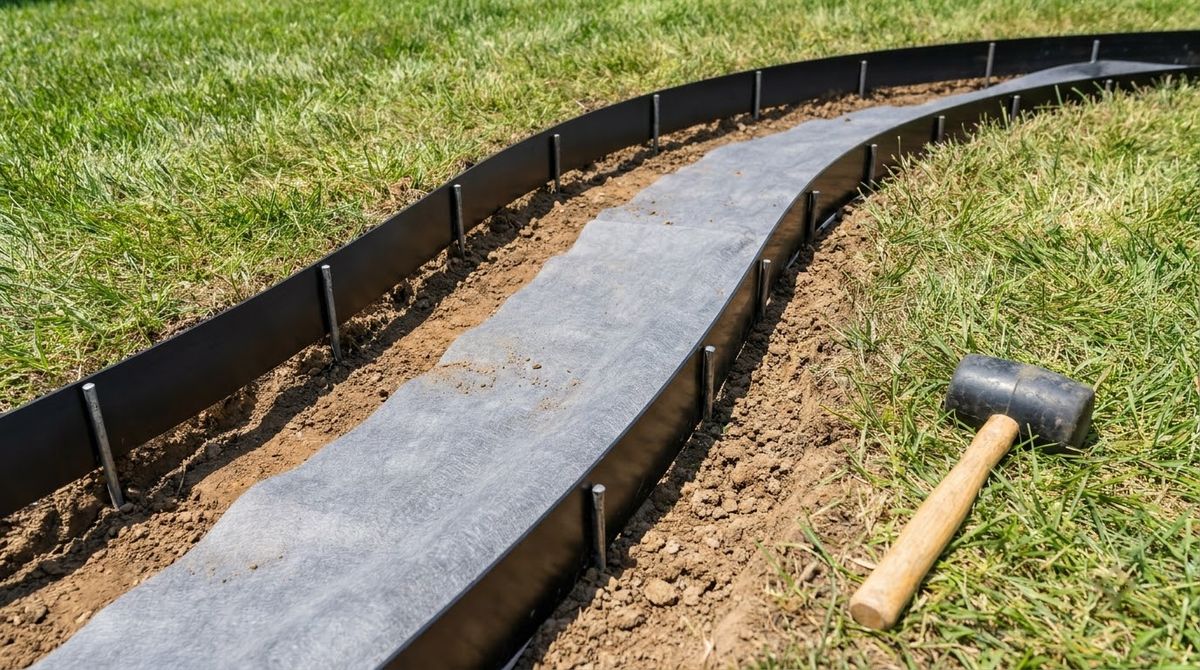
- Aluminum or steel edging. This Old House uses aluminum edging wherever its patio wall does not hold the stone. Permaloc lists its PermaStrip, AsphaltEdge and CleanLine XL profiles for aggregate walkways.
- Plastic board edging. Avon Plastics’ Terrace Board guide calls for a trench at least 1.5 inches deep, stakes every 4 feet and every 2 feet on curves, and at least 3 inches of overlap on each side of a stake where pieces join.
- Block or stone border. A low wall or a soldier course of pavers works as edging too. This Old House sets its border wall on 3 to 4 inches of tamped crushed stone in a trench about 12 inches deep and 16 inches wide.
- Height. Keep the top of the edging at or slightly above the finished gravel. TRUEGRID sets its grid 1/4 inch or slightly below the surrounding edging, so stone stays inside the line.
Lay plastic edging in the sun for at least 30 minutes before installing it, with a weight on each end. Avon says this straightens the board and reduces waves along the trench.
Stabilizer grids: when they are worth it
A stabilizer grid is a honeycomb of plastic cells that holds each stone in a small pocket, so the surface stops rutting and spreading. It is the difference between a gravel patio you can set a dining table on and one you rake flat every week.
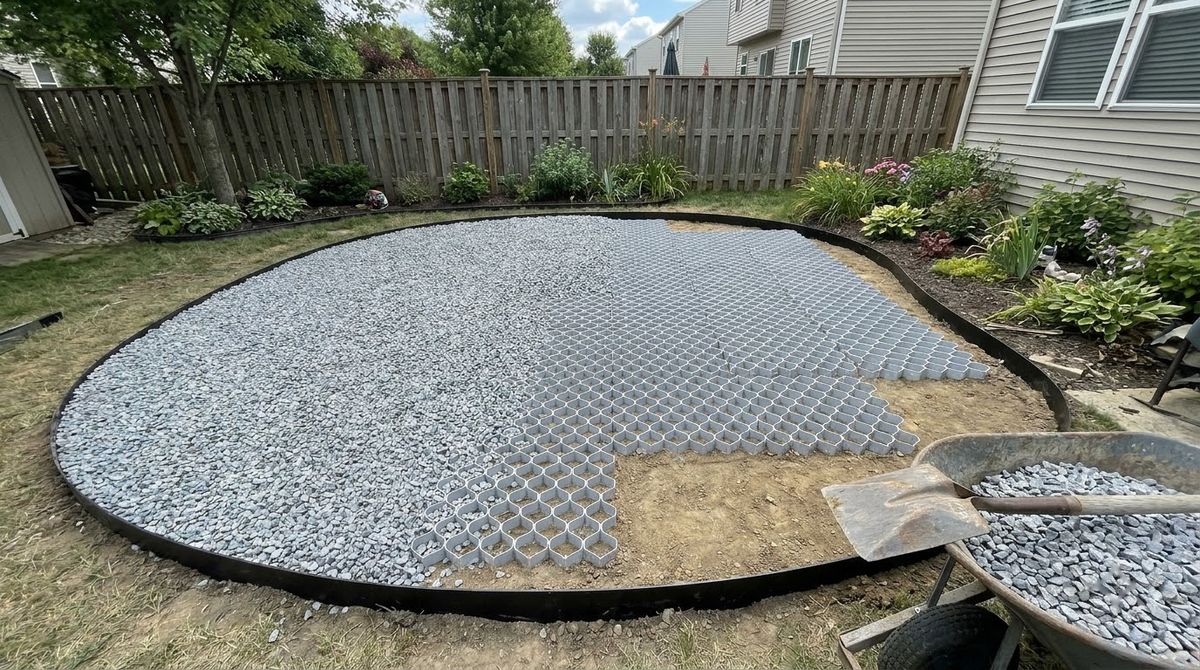
- Size. CORE’s Cana grid panels measure 22.9 by 18.9 inches and 1.38 inches tall, about 3 square feet each, so a 10 × 10 patio takes about 34 panels before cuts.
- Under the grid. CORE says small residential patios can use about 1 inch of sand as the sub base; heavier use takes 2 to 5 inches of compacted road crush.
- Fill and overfill. Fill the cells with clean stone and cover the grid by 1/2 to 1 inch (CORE). On larger areas, lightly compact the overfill with a plate compactor and top it up.
- Laying. Start at a straight edge, join panels with a soft mallet, and walk the laid grid to find voids underneath. CORE pins panels on slopes with 8- to 12-inch nails; TRUEGRID cuts its grids with a circular or reciprocating saw.
Skip the grid for a fire pit seating area with a few chairs. Use one where a table, a grill on wheels or daily traffic would push loose stone into ruts.
How to build a DIY gravel patio, step by step
How to build a DIY gravel patio comes down to nine steps. The order follows This Old House’s pea gravel patio build, with grid steps from the CORE and TRUEGRID install guides; follow your own product’s instructions where they differ.
Step 1: Mark the outline and call 811
Lay out the shape with a garden hose or stakes and string, then mark it with paint. Contact 811 a few business days before digging and wait until every utility has marked its lines.
Step 2: Excavate
Dig the area 4 to 5 inches deep for loose stone, or to base plus grid plus overfill for a grid patio. Remove sod, roots and rocks. TRUEGRID says the subgrade must be relatively dry with no standing water.
Step 3: Compact the soil
Compact the bottom with a plate compactor or tamper. This Old House dampens the soil first so it compacts well without a lot of dust. On soil that drains poorly, TRUEGRID calls for drainage, such as perforated pipe running to a low point.
Step 4: Install the edging
Set the edging on the outline, stake it at the spacing its maker gives, and check the top line with a string or level. Corners and curves get extra stakes.
Step 5: Lay the separation fabric
Roll out the fabric with each piece overlapping the last by a few inches, shingled so water runs toward the drainage side (This Old House). Run it up against the edging.
Step 6: Build the base
Spread and compact angular base stone if your design has a base, using the depth and lifts set out in the paver base guide linked above. For a grid patio on light-use ground, CORE’s minimum is about 1 inch of sand.
Step 7: Lay the grid (optional)
Start in a corner or along a straight edge, lock the panels together and cut them to fit the edging. Walk over the grid to check that nothing rocks or dips.
Step 8: Spread and compact the gravel
Add a couple of inches of stone, wet it and run a plate compactor over it, then add the rest and screed it with a long level to cut high spots and fill low ones (This Old House). On a grid, fill to 1/2 to 1 inch over the cells.
Step 9: Bind, set stepping stones and let it cure
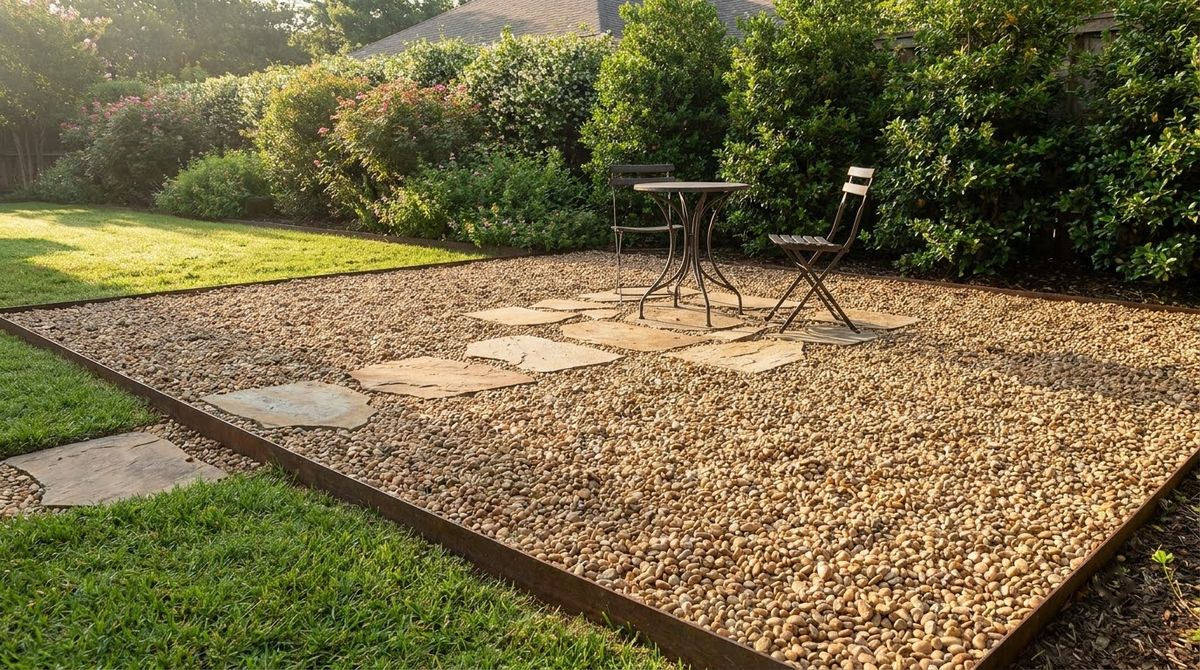
This Old House sprays a gravel binding agent on the stone, following the maker’s instructions, and lets the patio dry for 72 hours before use. Stepping stones go in holes dug twice the stone’s thickness, on an inch of compacted crushed stone and an inch of wet stone dust.
Gravel patio ideas on a budget
Gravel patio ideas on a budget work because the stone is the cheapest surface you can walk on, and the money goes into edging and the dig. These layouts keep the build simple:
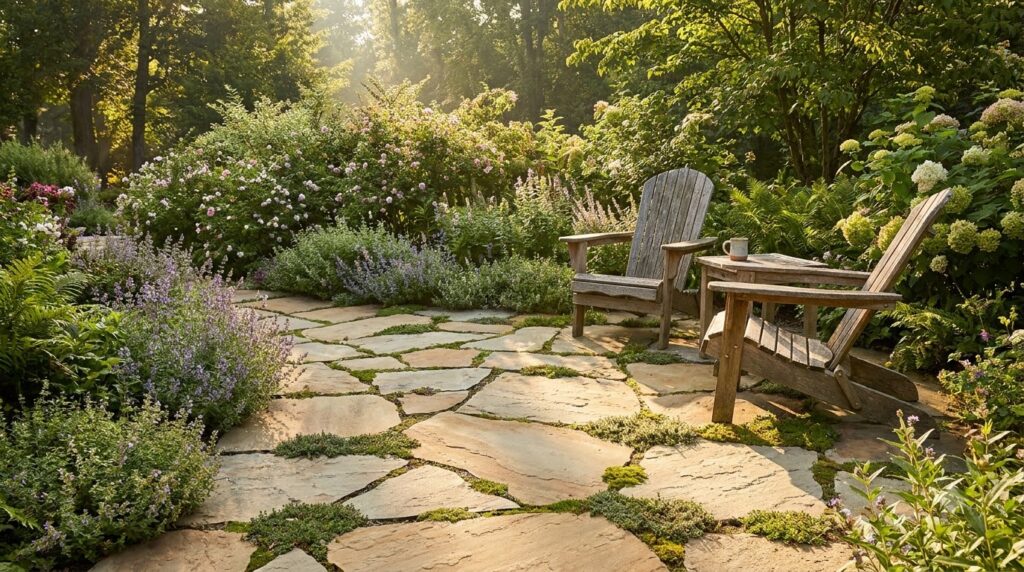
- Gravel with stepping stones. A line of flagstones across the gravel gives a firm path to the door; set them as in Step 9. Stone shapes and joints are covered in flagstone patio ideas and patterns.
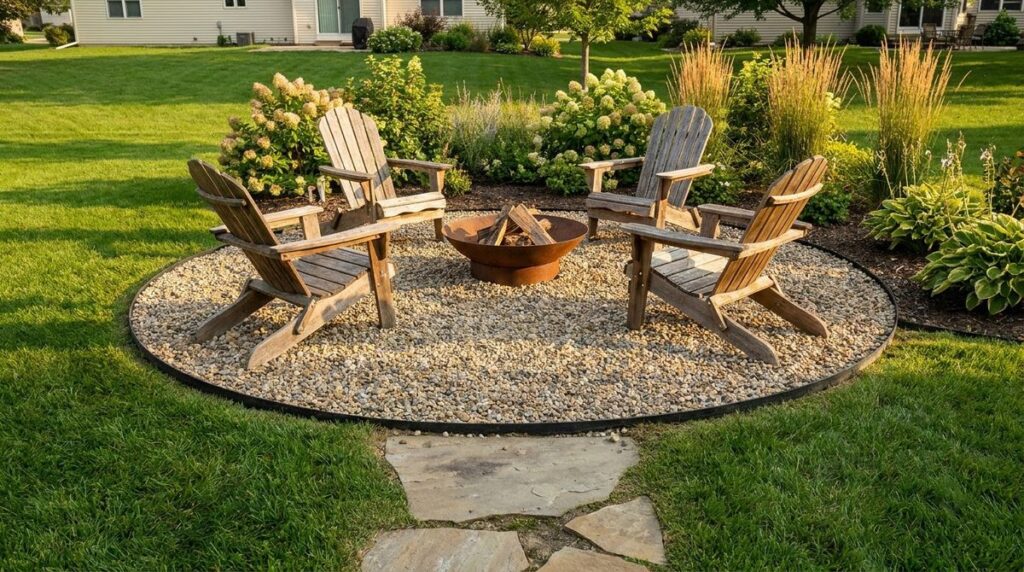
- Gravel around a fire pit. A round pea gravel patio with steel edging is a short build and needs no grid for a ring of chairs.
- Gravel border around pavers. A paver pad for the table, with a gravel band around it, uses fewer pavers; layouts are in paver patio ideas by pattern.
- Grid only where the table sits. Loose stone for the edges, a grid under the dining area.
Common mistakes with a gravel patio
Gravel patios usually go wrong for a few repeatable reasons:
- No edging, or edging added after the stone. Stone drifts out over the lawn.
- Pea gravel as the base. Round stone does not lock. TRUEGRID rules out round rock for base aggregate.
- Stone dust or dirty gravel in a grid. CORE says not to fill its grids with fines.
- Counting on weed fabric to stop weeds. CSU Extension notes that weeds germinate on top of woven fabric and root into or through it, and that woven fabrics eventually clog.
- Too much stone over a grid. CORE keeps overfill to 1/2 to 1 inch; much more and the surface behaves like loose gravel again.
- Digging next to the house without drainage. On tight clay, a gravel patio holds water against the foundation unless the subgrade drains away.
Safety, and when gravel is not the right patio
Safety on a gravel patio build is mostly about what is underground and what you cut. Avon tells installers to wear safety glasses when cutting, staking and installing edging, and the same goes for cutting grid panels with a saw.
- Do not dig before the 811 marks are in, and hand-dig near flagged lines.
- Use eye and hearing protection with a plate compactor or saw. Rental sizes and tool choices are in paver patio installation tools.
- Mind the bags. About 49 half-cubic-foot bags for a 10 × 10 patio at 3 inches is a lot of lifting; use a wheelbarrow and lift with your legs.
Gravel is the wrong surface where you need a level, wheel-friendly floor: under walkers and wheelchairs, beside a pool where stone gets carried in, or at a back door where grit tracks inside. Pavers or a slab suit those spots better.
Frequently asked questions
How deep should a gravel patio be?
For loose pea gravel on compacted soil, This Old House digs 4 to 5 inches. A grid patio takes about 5 inches: CORE’s example is a 3-inch base, a 1.37-inch grid and 1/2 inch of stone on top. On clay or wet soil, add a thicker compacted crushed base under the gravel, sized the same way as under pavers.
What size gravel is best for a patio?
For a soft, barefoot surface, pea gravel of 1/4 to 3/8 inch. For a firmer surface that holds chairs, 1/2-inch clear crushed stone, which is what CORE uses to fill its patio grids. Under any surface stone, use angular base stone such as 3/4- to 1-inch #57; TRUEGRID says never to use round rock for the base.
Do you need landscape fabric under a gravel patio?
A separation fabric between soil and stone keeps the two from mixing, and This Old House lays one, overlapped by a few inches. Do not count on it for weeds. CSU Extension says woven fabrics eventually clog and that weeds germinate on top of the fabric and root through it, so plan to pull or spot-treat weeds.
How do you keep pea gravel from moving?
Three things: edging set before the stone, a stabilizer grid that holds each stone in a cell, and a thin layer. CORE covers its grids with only 1/2 to 1 inch of stone. This Old House also compacts wetted pea stone with a plate compactor and sprays on a binding agent, then lets it cure 72 hours.
How many bags of pea gravel do I need for a 10×10 patio?
Kolor Scape’s chart, using half-cubic-foot bags, gives 32 bags for 2 inches deep, 49 bags for 3 inches and 64 bags for 4 inches over 100 square feet. In bulk, divide square feet times depth in inches by 324 for cubic yards: about 0.93 cubic yard at 3 inches.
Sources
- This Old House, Create a DIY Pea Gravel Patio (checked October 2026).
- CORE Gravel, CORE Cana Grid Medium Install Guide Summary (checked October 2026).
- TRUEGRID Pavers, Typical Residential Gravel Installation (checked October 2026).
- Kolor Scape, Pea Gravel 0.5 cu ft product sheet (checked October 2026).
- Avon Plastics, Terrace Board Landscape Edging Install Guide (checked October 2026).
- Colorado State University Extension, GardenNotes #245: Mulching (reviewed April 2023).