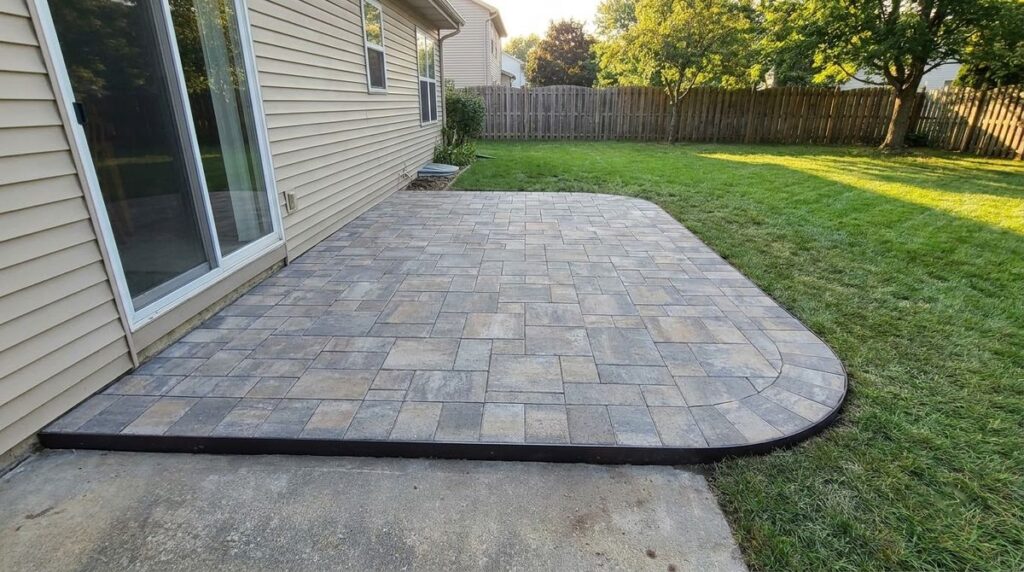
How to lay pavers on concrete: confirm the slab is sound and sheds water, drill 1- to 2-inch drain holes at its low spots, screed a 1-inch sand bed, and lay pavers inside an edge restraint fastened to the slab. Or bond thin pavers in 3/4 inch of latex-modified mortar, which Belgard advises against where freeze-thaw and deicing salts are expected.
Key takeaways
- The overlay is only as good as the slab. Hairline cracks are fine; wide gaps, heaving or sections that rock mean a rebuild on a compacted stone base (Unilock).
- Sand-set overlays need drain holes. CMHA, formerly ICPI, specifies 1- or 2-inch weep holes at the lowest points, filled with washed pea gravel and covered with geotextile.
- Plan the height before you buy pavers. The IRC lets the landing at a required exit door sit no more than 1½ inches below the threshold.
- Mortar-set is for warm, well-drained slabs. Belgard calls for at least a 2% slope and 40–90°F during installation.
- Never span a slab expansion joint with a mortared paver; line a paver joint up with it.
Here is how the two methods compare, using the manufacturer and CMHA guides cited below.
| Item | Sand-set overlay | Mortar-set (bonded) overlay |
|---|---|---|
| Bed | Nominal 1 in of washed concrete sand (ASTM C33), never mason sand | 3/4 in latex-modified mortar bonded to the slab |
| Drainage | 1–2 in weep holes at low spots, pea gravel, geotextile over | Surface drainage: at least 2% (1/4 in per ft) slope |
| Pavers | Thin overlay pavers, 20–60 mm in Belgard’s range | Units under 2 in thick suit bonded overlays best |
| Joints | 1/16–3/16 in, filled with joint sand | 3/16 in minimum for pointing mortar |
| Edges | Metal or plastic restraint fastened to the slab | Border units bonded in mortar |
| Climate | CMHA’s overlay spec covers freezing climates, with pavers tested to ASTM C1645 | Not recommended with freeze-thaw and deicing salts |
| Tools | Same kit as any paver patio, plus a way to bore the drain holes; see paver patio installation tools to buy, rent or skip | |
Is your slab good enough to pave over?
Whether your slab is good enough to pave over is the first call, and the guides agree on the test: the concrete must be structurally sound and not moving. Belgard says cracks are acceptable as long as there is no shifting or heaving; Unilock draws the line at wide gaps, heaving or sections that rock.
- Walk and tap the slab. Unilock says to look for large cracks, hollow sounds or sections that move. Any of those means rebuild, not overlay.
- Wet it and watch. Belgard says to hose the slab before you lay anything and confirm no water pools. Puddles now become trapped water under the pavers later.
- Check flatness. CMHA’s overlay spec says the paver installer cannot correct a bad base with extra bedding sand, and it bans using sand to fill depressions.
- Check the slab under any new pour. Belgard’s minimum for a new slab poured to receive pavers is 4 inches thick at 4,000 psi.
If the patio will grow past the old slab, Unilock says to build the extension on a compacted stone base so the whole surface has support. Depths for that part are in patio paver base depths for gravel and sand.
Sand-set or mortar-set: choosing the method
Choosing between sand-set and mortar-set comes down to climate, traffic and how well the slab drains. Belgard lists three overlay methods for concrete: sand set, bituminous set and mortar set. The middle one, bituminous set, is a commercial method: Belgard notes few contractors have the experience and the pavers need a height tolerance of ±1/16 inch.
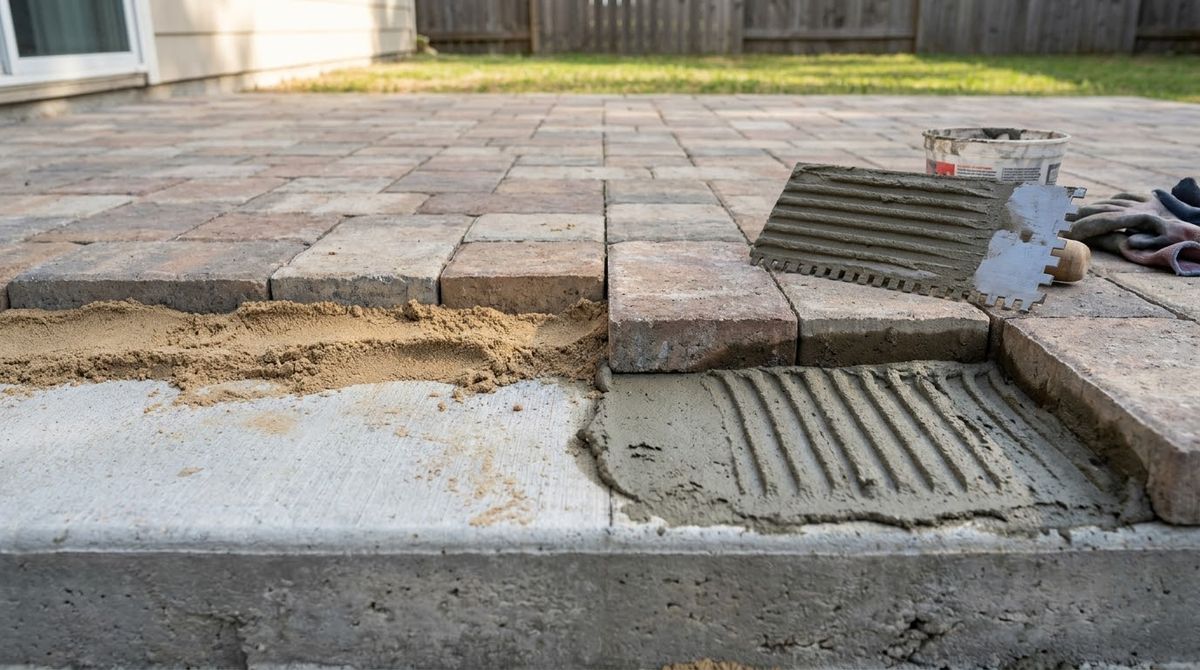
- Pick sand-set if you live where the ground freezes, the slab can take drain holes, and you want to lift and reset pavers later. It is the method Belgard calls most common for foot traffic.
- Pick mortar-set if the climate is mild, the slab already sheds water at 2% or more, and you want no sand to wash out. Belgard’s technical note says mortar-set is not recommended in freeze-thaw areas, especially where deicing salts are used.
- Be wary of dry-mix bonding powders. Belgard’s homeowner guide suggests a dry-set powder at 1/4 to 1/2 inch, activated with water. Its later technical note warns that watering is hard to control and that slabs larger than 15 by 15 inches are unlikely to bond fully in the center.
Height: doors, steps and thresholds
Height is the problem most overlays hit first: pavers and a bed go on top of a slab that already meets the door. The 2021 IRC, Section R311.3.1, says the landing at the required egress door can be no more than 1½ inches below the top of the threshold. Section R311.3.2 allows up to 7¾ inches at other exterior doors.
Work the numbers before ordering. Techo-Bloc notes pavers settle about 3/8 inch into the sand when compacted, so a 1-inch bed ends up near 5/8 inch:
- 60 mm (2⅜ in) paver on sand: about 3 inches added.
- 30 mm (about 1 3/16 in) overlay paver on sand: about 1.8 inches added.
- 30 mm paver on a 3/4-inch mortar bed: about 1⅞ inches added.
- 20 mm porcelain paver on 1/4 inch of dry-set: about 1 inch added.
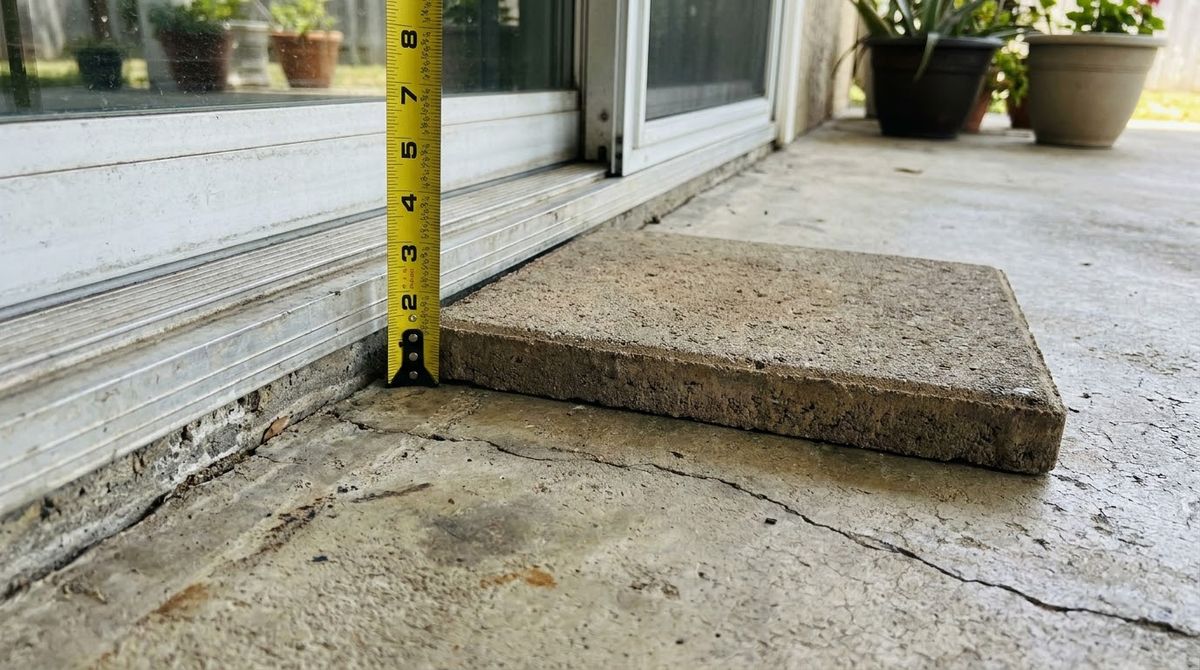
Steps are the other trap. IRC Section R311.7.5.1 caps risers at 7¾ inches and lets the tallest riser in a flight exceed the shortest by only 3/8 inch. Overlaying the patio at the foot of existing steps shortens the bottom riser by the full overlay height. Check your local building department for how this applies to your stair.
When the numbers do not fit, Belgard says you can grind the slab down near the door as long as at least 4 inches of concrete remains, or cut out that strip and re-pour it lower. Belgard also says to allow for frost heave in the height math in freeze-thaw zones.
Drainage: where the water goes
Drainage decides whether pavers laid on concrete stay flat. Unilock calls poor drainage the most common risk: concrete is impervious, so water that runs down the joints sits on the slab, where Unilock says trapped moisture leads to uneven pavers, winter damage and weeds in the joints.
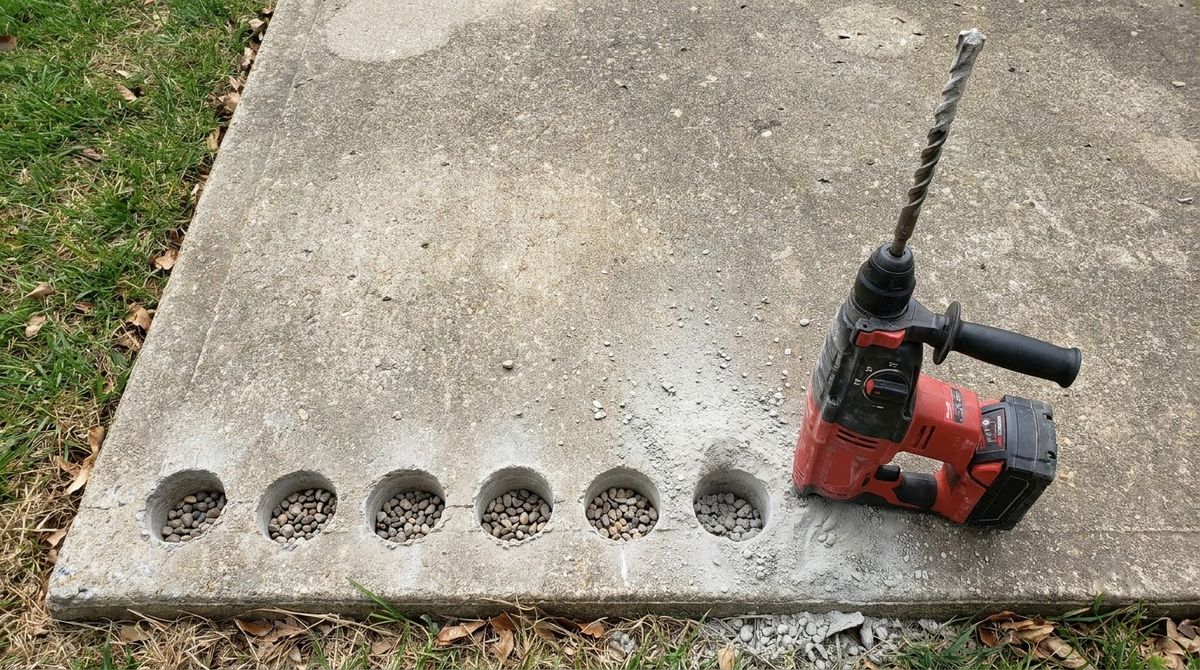
- Hole size and fill. CMHA’s overlay guide spec calls for 1- or 2-inch diameter weep holes at the lowest elevations, filled with washed pea gravel and covered with geotextile so bedding sand cannot wash into them.
- A larger detail. Techo-Bloc’s bituminous-set detail over a concrete slab shows a 3-inch drainage hole at the lowest elevation, filled with 1/2-inch free-draining aggregate.
- Edges. CMHA suggests a 12-inch strip of geotextile turned up against the edge restraints to stop sand loss.
- Slope. Techo-Bloc builds its paver grades at 1.5% (3/16 inch per foot); Belgard wants at least 2% under mortar-set pavers.
Where holes cannot go, Belgard suggests a low, permeable edge along the downhill side as a dedicated drain, or a French drain to keep water from flowing toward the house.
How to lay pavers on concrete, step by step
How to lay pavers on concrete with the sand-set method takes nine steps. They follow CMHA’s overlay guide specification, Belgard’s overlay guide and Unilock’s instructions; where your paver maker’s guide differs, follow it.
Step 1: Inspect, measure and test the slab
Tap for hollow spots, check cracks for movement, and hose the slab to find where water pools. Measure from the slab to the bottom of each door threshold and to each stair nosing, then pick a paver thickness that fits the height math above.
Step 2: Clean the surface
Unilock says to power clean the slab and let it dry, remove paint, grease and loose debris, and lightly grind high spots so the pavers lay flat. Grinding and drilling concrete throws silica dust; the dust rules are in the tools guide linked above.
Step 3: Drill the drain holes
Mark the low spots you found with the hose test and drill 1- or 2-inch holes through the slab there, per CMHA. Fill each with washed pea gravel to the top of the slab.
Step 4: Lay the geotextile
Cover every hole with geotextile and run a 12-inch strip along the edges where the restraint will go, turned up against it, as CMHA suggests.
Step 5: Fasten the edge restraint
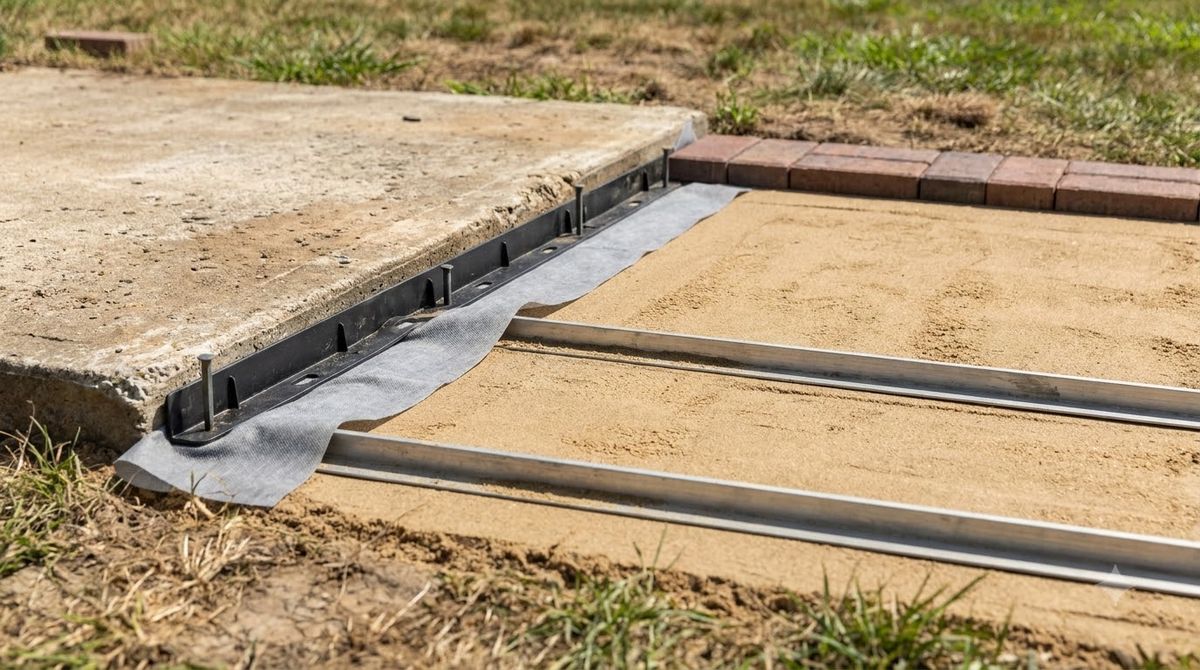
On any side not held by a wall or step, fasten metal or plastic edging to the slab. CMHA says to fasten it to concrete with a powder-actuated fastener or expansion bolts. Unilock says good edges prevent lateral creep and trip hazards.
Step 6: Screed a 1-inch sand bed
Set screed rails and pull washed concrete sand to a nominal 1 inch. CMHA bans mason sand, stone dust and limestone screenings for the bed. Screed only what you will cover that day, and do not disturb the screeded sand.
Step 7: Lay the pavers
Start from a straight reference line and set pavers hand tight. CMHA’s spec keeps joints between 1/16 and 3/16 inch. Cut edge pieces with a masonry saw or splitter.
Step 8: Compact
Unilock says to compact with a protective mat on the plate. CMHA’s spec names a low-amplitude plate of at least 5,000 lbf at 75 to 100 Hz, and says not to compact within 6 feet of an unrestrained edge. Replace any paver that cracks.
Step 9: Fill the joints and check
Sweep joint sand in while compacting; CMHA calls for at least four passes, until the joints are full. With polymeric sand, mist as its maker directs. CMHA allows no more than 1/8 inch of lippage between pavers. Walk the field and reset any paver that rocks.
Mortar-set overlay: what changes
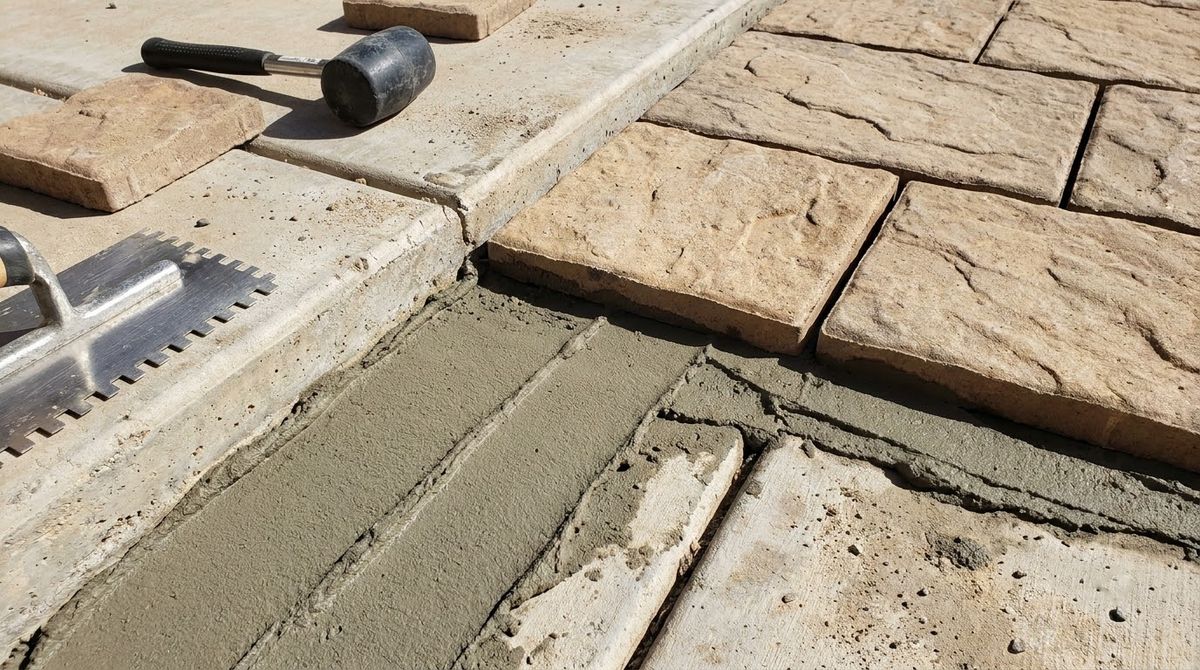
A mortar-set overlay swaps the sand bed and drain holes for a bonded bed, and the details below come from Belgard’s mortar-set guidance and technical note. Belgard says to use the system with design input from the mortar supplier.
- Seal the slab’s joints first. Protect full-depth expansion joints with backer rod and caulk, carry them up through a paver joint, and never span one with a paver.
- Bed: 3/4 inch of latex-modified mortar, worked in small areas so it stays wet. A bond coat improves adhesion to the slab.
- Joints: at least 3/16 inch for pointing mortar. Belgard notes most products are installed with 1/8-inch joints, so wider joints limit patterns.
- Weather: 40 to 90°F during installation for most mortar-set systems.
- Finish: seal the pavers. In northern climates, Belgard says mortared joints need regular upkeep and deicing salts are discouraged.
Mistakes to avoid: why pavers on concrete crack or heave
The mistakes that crack or heave pavers on concrete almost all trace back to water, movement or height:
- Paving over a slab that moves. Belgard and Unilock both send heaving or shifting slabs to a rebuild.
- No drain holes on a flat slab, so water sits in the sand bed and freezes.
- Mason sand or stone dust as the bed, both ruled out by CMHA.
- Leveling dips with sand. Fix the slab, not the bed.
- Mortar-set in a freeze-thaw, salted climate, against Belgard’s note.
- Spanning an expansion joint with a bonded paver; it will crack along the joint.
- Forgetting the door and steps until the pavers are on site.
Hire a contractor if the slab carries vehicles, the overlay meets an existing stair, or you doubt the slab. Belgard sends site-specific or heavy-load designs to its representatives or a civil or geotechnical engineer. If you are weighing a full tear-out instead, see the build options in paver patio ideas by pattern and base.
Frequently asked questions
Can you lay pavers directly on concrete without sand?
Yes, with a bonded method. Belgard’s mortar-set detail uses a 3/4-inch latex-modified mortar bed, and its homeowner guide also describes a dry-set powder at 1/4 to 1/2 inch. Laying pavers dry on bare concrete with no bed or bond is not a method any of these guides describe. Mortar-set is not recommended in freeze-thaw areas with deicing salts.
Do you need drainage holes when laying pavers over concrete?
For a sand-set overlay, yes. Belgard says drain holes are required at low spots so water that seeps through the joints can escape. CMHA’s overlay spec calls for 1- or 2-inch holes at the lowest elevations, filled with washed pea gravel and covered with geotextile. A mortar-set overlay instead relies on at least a 2% surface slope.
How thick should pavers be over a concrete patio?
Thin. Belgard offers overlay-friendly pavers from 20 to 60 mm and calls thin pavers the best choice unless you want to raise the slab; its mortar-set note says units under 2 inches suit bonded overlays. Pick the thickness that keeps the finished surface within 1½ inches of the door threshold, per IRC R311.3.1.
Can you lay pavers over cracked concrete?
If the cracks are stable, yes. Belgard says cracks are acceptable as long as there is no shifting or heaving, and Unilock treats hairline cracks as normal. Wide gaps, heaving or sections that rock point to ground movement, and both say to remove the slab and build a compacted stone base instead.
What kind of sand goes under pavers on concrete?
Washed concrete sand meeting ASTM C33, screeded to a nominal 1 inch. CMHA’s overlay guide specification rules out mason sand, sand meeting ASTM C144, stone dust and limestone screenings for the bedding layer. Do not use extra sand to fill low spots; fix the slab instead.
Sources
- Concrete Masonry & Hardscapes Association (formerly ICPI), Interlocking Concrete Pavement Overlay guide specification, PAV-GSP-006-25 (2025).
- Belgard, Guide to Laying Pavers Over Concrete or Asphalt (checked October 2026).
- Belgard Commercial, Technical Note: Mortar-Set Overlays for Belgard Pavers and Slabs (2023).
- Unilock, Installing Pavers Over Concrete (checked October 2026).
- Techo-Bloc, Pavers Installation Guide (rev. 2019).
- International Code Council, 2021 IRC Chapter 3, Sections R311.3.1 and R311.7.5.1.