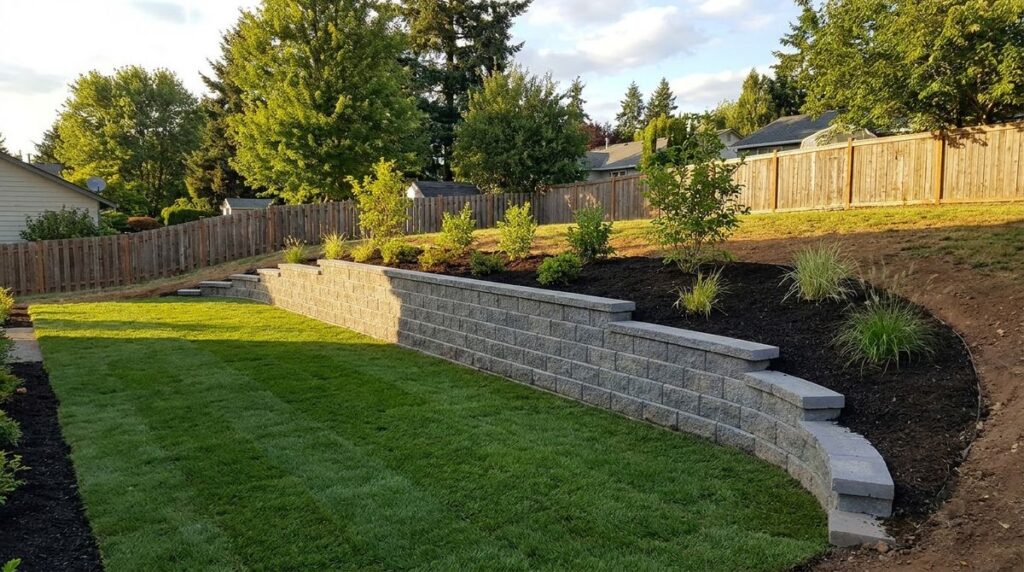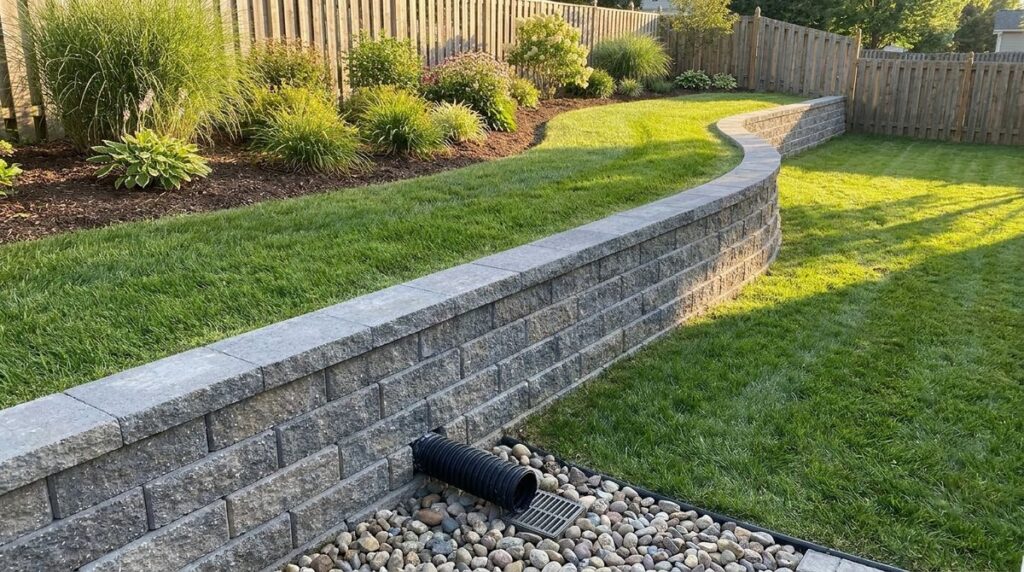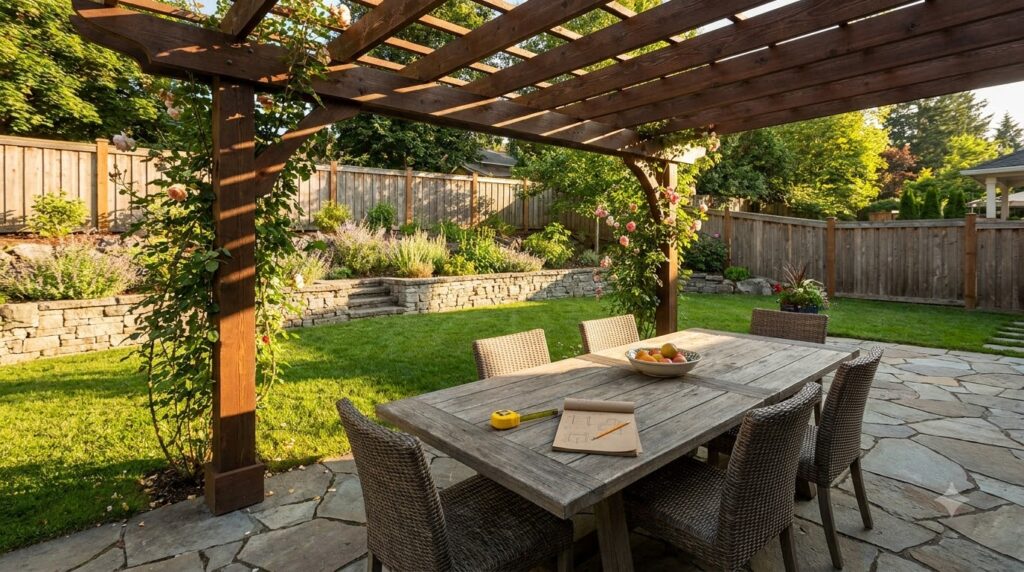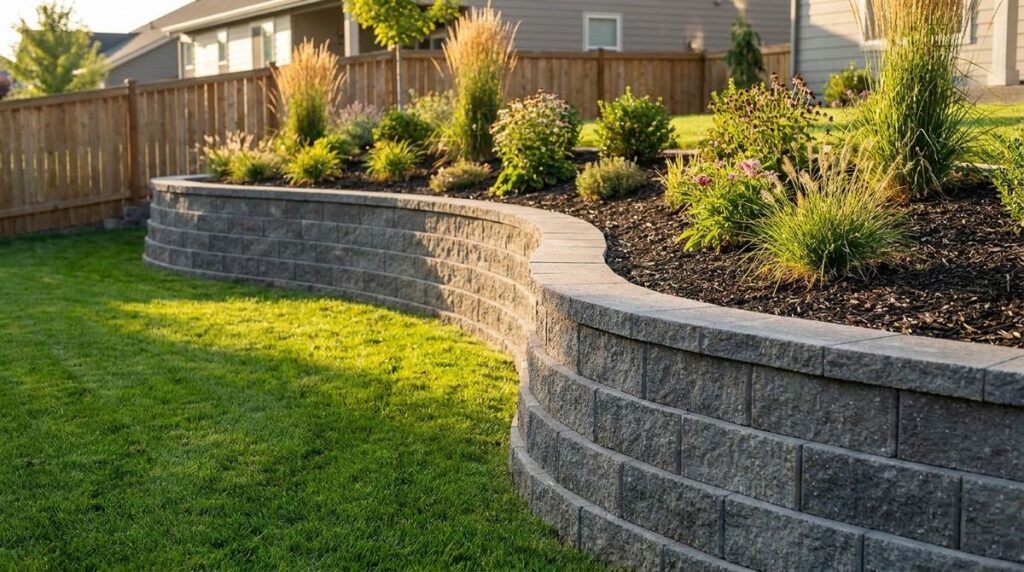
A retaining wall costs about $15 to $65 per square foot of wall face, installed, and most projects land between $3,500 and $10,000.
The spread comes from three things: the material (timber and cinder block sit at the bottom, natural stone at the top), the height (a wall over 4 feet usually adds an engineer and a permit), and the site work a quote may or may not include.
Key takeaways
- Price per square foot of face: timber $15–$30, segmental block $10–$50, poured concrete $20–$55, natural stone $15–$100, installed.
- A 50-foot wall, 4 feet tall (200 sq ft of face) runs roughly $4,000–$13,000 installed.
- 4 feet is the line to watch. The model code exempts walls up to 4 ft, measured from the bottom of the footing, from a permit unless they carry a surcharge; past 48 inches of retained soil, on a wall not braced at the top, it calls for an engineered design.
- Labor is 40–60% of the bill, so access, soil and slope move the price as much as the block does.
- Replacing a failed wall costs a new wall plus $10–$20 per sq ft to tear out the old one.
| Cost item | Typical range | How to keep it down |
|---|---|---|
| Wall, installed (all common materials) | $15–$65 per sq ft of face | Choose block or timber over cut stone; keep it under 4 ft |
| Whole project, typical | $3,500–$10,000 | Bundle with other yard work to clear the contractor minimum |
| Contractor project minimum | $1,500–$3,000 | Short walls cost more per foot; combine small walls into one job |
| Labor | $50–$75 per hour | Clear access for a machine; do demolition of plantings yourself |
| Engineer (tall walls) | $500–$2,000+ | Terrace two short walls instead of one tall one, where space allows |
| Permit | $25–$450 | Ask the building department before design, not after |
| Remove an old wall | $10–$20 per sq ft | Ask whether sound block or stone can be reused |
Assumptions: professionally installed, materials and labor included, no regional adjustment. Ranges span HomeGuide (2026 prices, Jan 2026), Fixr (updated Jan 2025) and LawnLove (updated Oct 2026); where they disagree the table shows the full span.
Retaining wall cost per square foot, by material
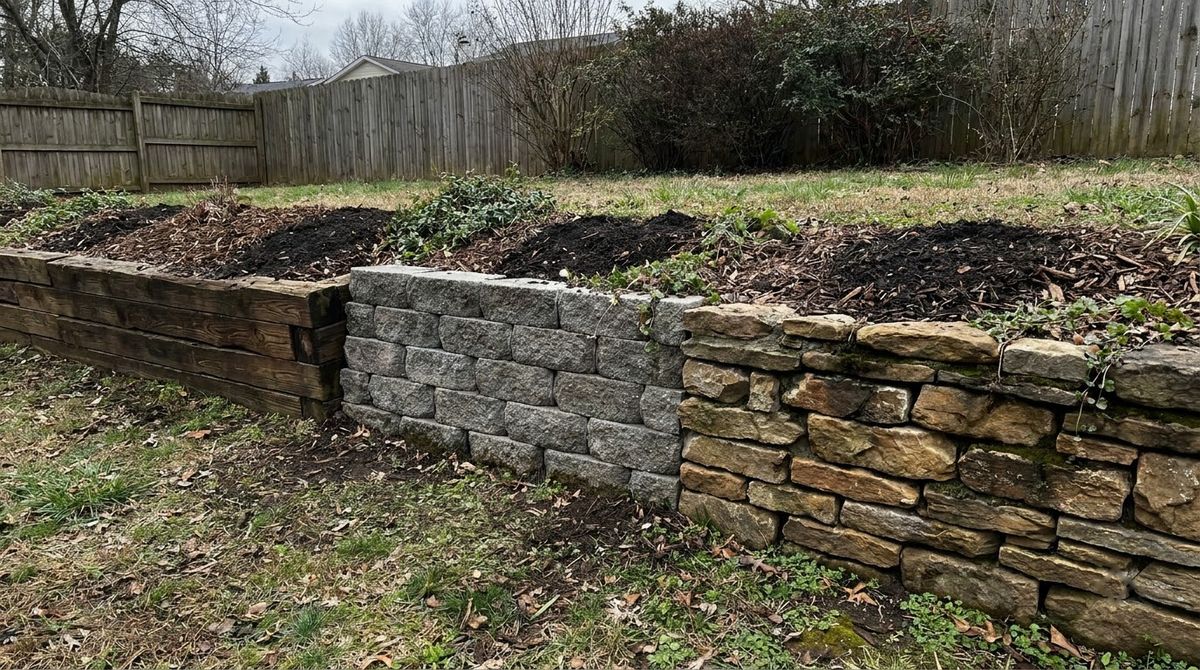
Retaining wall cost per square foot is quoted on the face of the wall: length times exposed height. A 30-foot wall that stands 3 feet tall is 90 square feet. Material is the first big lever, and the three cost guides used here agree on the order even where their ranges differ.
| Material | Installed cost per sq ft of face | Notes |
|---|---|---|
| Segmental concrete block (interlocking, dry-stacked) | $10–$50 | Most common for homes; cinder block $10–$15, decorative concrete block $30–$50 (Fixr) |
| Timber / pressure-treated wood | $15–$30 | All three sources agree on this range; shortest lifespan |
| Railroad ties | $10–$25 | Less common now because of their toxic coating (LawnLove) |
| Poured concrete | $20–$55 | Needs forms and steel; precast panels $25–$35 (Fixr) |
| Brick (usually veneer over block) | $20–$60 | Sources disagree widely |
| Natural stone | $15–$100 | Granite $20–$45, limestone $50–$100 (Fixr) |
| Gabion (rock-filled wire baskets) | $10–$55 | No concrete footing needed |
| Vinyl sheet | $10–$20 | Short decorative walls |
Assumptions: materials plus professional labor, typical residential heights. Spanning range of HomeGuide (2026), Fixr (2025) and LawnLove (2026).
What the ranges hide is lifespan. HomeGuide puts concrete walls at 50–100 years, stone at 50–200, metal at 20–40 and wood at 10–40. A timber wall at $20 per square foot that you rebuild once is no longer the cheap option against block at $30.
- Segmental block is the default for a reason: the units interlock without mortar, so labor is fast, and HomeGuide notes segmental walls handle heights up to 3–4 feet without extra reinforcement.
- Timber is the cheapest wall that still looks like landscaping, and the easiest to build yourself.
- Natural stone has the widest range because “stone” covers everything from fieldstone stacked by hand to cut limestone.
- Poured concrete costs more per foot but is the material engineers reach for on taller walls.
Retaining wall cost by height and length
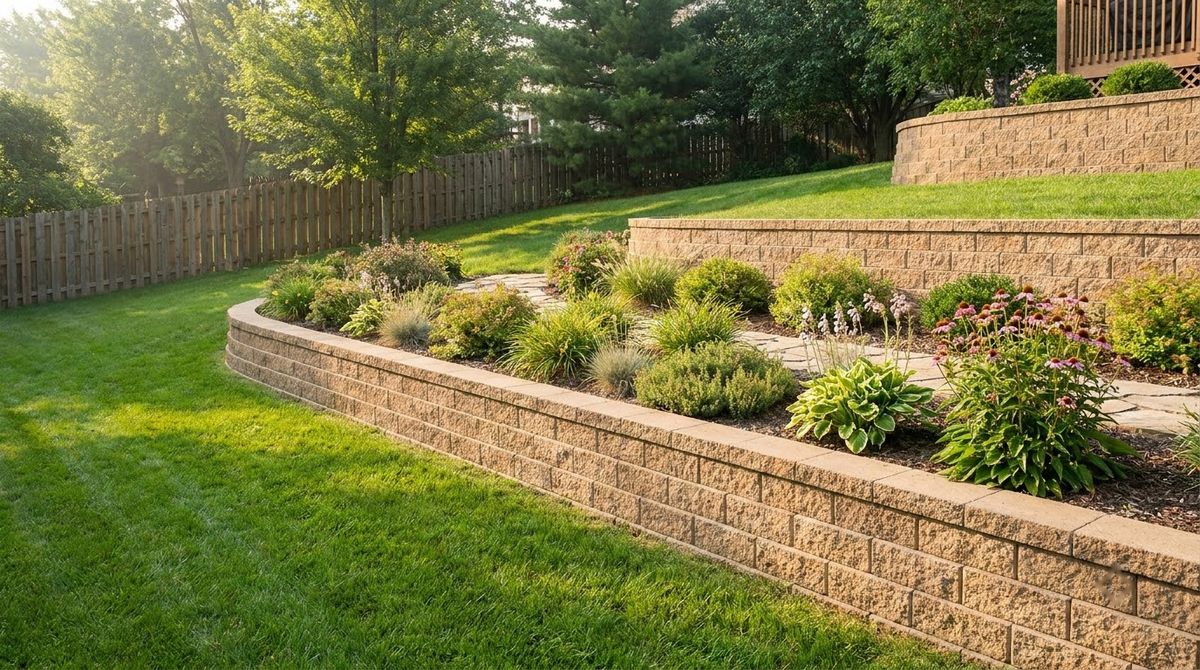
Retaining wall cost by height climbs faster than the face area suggests, because a taller wall needs a deeper buried course, more drain rock and often reinforcement. The table shows installed totals for common lengths at three heights.
| Wall length | 2 ft tall | 4 ft tall | 6 ft tall |
|---|---|---|---|
| 10 ft | $400–$1,300 | $800–$2,600 | $1,200–$3,900 |
| 25 ft | $1,000–$3,250 | $2,000–$6,500 | $3,000–$9,750 |
| 50 ft | $2,000–$6,500 | $4,000–$13,000 | $6,000–$19,500 |
| 100 ft | $4,000–$13,000 | $8,000–$26,000 | $12,000–$39,000 |
Assumptions: installed, materials and labor, mixed common materials. Low end from Fixr (updated Jan 2025), high end from HomeGuide (2026 prices). Small walls usually hit a contractor minimum of $1,500–$3,000 (HomeGuide), so the lowest figures in the 10-foot row are rarely what you will pay.
Read the 6-foot column with care. Both guides price it as if the wall were simply taller, but a 6-foot wall usually crosses the height where a permit and an engineered design come in. HomeGuide says walls taller than 4 feet need additional engineering, permits and deeper foundations that “significantly increase costs.”
For a sense of scale, Fixr prices a 25-foot-long, 4-foot-high concrete block wall at around $5,460 installed, which sits in the upper half of the 25-foot row above.
The line items a retaining wall quote should show
The line items a retaining wall quote should show are where two bids for the same wall drift thousands of dollars apart. One contractor folds drainage and excavation into the per-foot price; another lists them separately or leaves them out. Ask for each of these as its own line.
| Line item | Typical cost | What it covers |
|---|---|---|
| Excavator time | $100–$300 per hour | Digging the base trench and the zone behind the wall; removing old walls |
| Grading | $0.40–$2.00 per sq ft | Leveling the area above and below the wall |
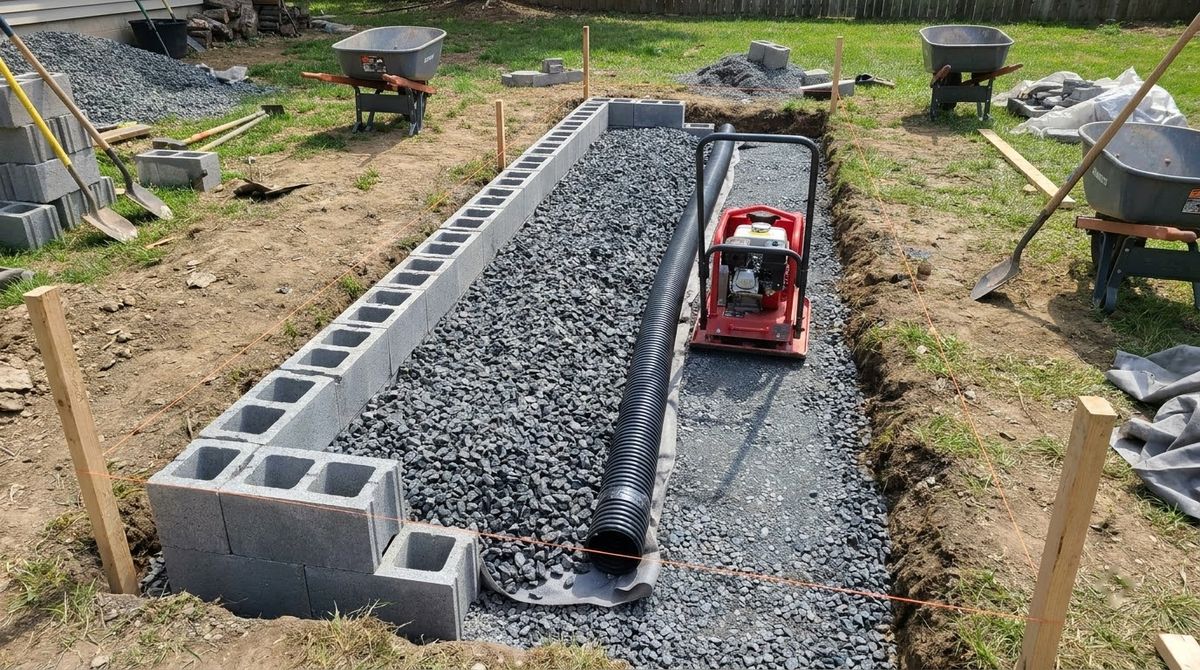
| Drainage (French drain style) | $10–$85+ per linear ft | Perforated pipe at the base, gravel backfill, outlets |
| Waterproofing | $2–$10 per sq ft | Keeps moisture behind the wall from seeping into it |
| Concrete footing (taller walls) | $18–$55 per linear ft | Poured footing under concrete or tall block walls |
| Rebar | $0.80–$2.50 per sq ft | Steel in poured or grouted walls |
| Geogrid | No published price | Reinforcement layers behind taller block walls, per the approved plan |
| Structural engineer | $500–$2,000+ | Design for walls 4 ft and up or walls with loads above them |
| Permit | $25–$450 | Building permit where height or surcharge triggers it |
| Cap stones | $5–$15 each | Finished top course |
Assumptions: HomeGuide (2026) for excavator, grading, drainage, footing, engineer, caps; rebar spans Fixr (2025) $0.80–$1.60 and HomeGuide/LawnLove $1.50–$2.50; permits span Fixr $25–$100, LawnLove $40–$335 and HomeGuide $50–$450.
Excavation and base
Excavation and base work is the part of a retaining wall you never see. Allan Block’s installation guide calls for a base trench 24 inches wide (18 inches for walls under 4 feet), deep enough for at least 6 inches of compacted wall rock plus about 1 inch of buried block for every foot of wall height.
HomeGuide notes rocky or clay soil can raise labor by up to 50%.
Drainage aggregate and pipe
Drainage aggregate and pipe are the line most often cut, and the one that decides whether the wall lasts; see retaining wall drainage with gravel and pipe. The same Allan Block guide fills the block cores and a 12-inch zone behind the wall with wall rock.
It also requires a drain pipe for any reinforced wall, any gravity wall over 4 feet, and any site with poor drainage, vented to daylight every 50 feet.
Geogrid for taller walls
Geogrid for taller walls is a mesh laid between courses and run back into compacted soil, which turns the soil itself into part of the wall.
The extra cost is mostly digging: Allan Block says to excavate behind the wall to the design length of the geogrid shown on the approved plans. None of the cost guides opened for this post prices geogrid separately, so get it itemized.
- Is drain rock behind the wall included, and how deep?
- Is there a perforated pipe, and where does it outlet?
- Who pulls the permit and pays the engineer?
- Is hauling away spoil and the old wall included?
Height thresholds: when a permit and an engineer come in
Height thresholds for permits and engineering come from the building code your city adopted, usually a version of the International Residential Code (IRC). Two provisions in the 2021 IRC set the numbers most local rules start from.
- Permit exemption, IRC R105.2 (Building, item 3): permits are not required for “retaining walls that are not over 4 feet (1219 mm) in height measured from the bottom of the footing to the top of the wall, unless supporting a surcharge.”
- Engineered design, IRC R404.4: walls not laterally supported at the top that retain more than 48 inches of unbalanced fill, or walls over 24 inches tall that resist lateral loads in addition to soil, “shall be designed in accordance with accepted engineering practice,” with a safety factor of 1.5 against sliding and overturning.
Two details catch people.
First, the 4 feet in R105.2 is measured from the bottom of the footing, so a wall showing 3.5 feet above grade with buried courses can already be over the line.
Second, a surcharge, such as a driveway, a fence, a shed or a slope above the wall, removes the exemption and, past 24 inches, brings in engineering.
Cities amend these rules, and many are stricter. HomeGuide reports most cities require permits for walls over 3 to 4 feet. Check with your local building department before you price the job, because the answer changes the quote by the engineer’s fee and the permit.
Concrete retaining wall cost
Concrete retaining wall cost depends on which “concrete” you mean: hollow block, precast panels, sprayed shotcrete or a wall poured in forms. The guides price them quite differently.
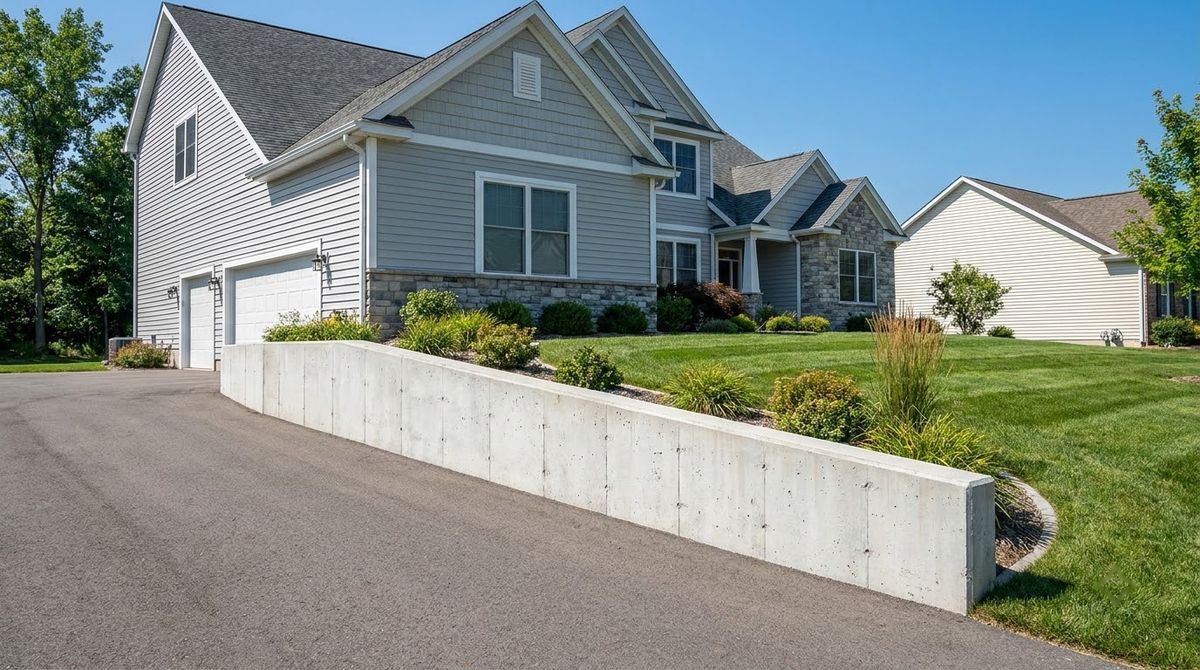
- Poured concrete: $20–$55 per sq ft installed across the three sources (Fixr alone puts it at $30–$40).
- Precast concrete: $25–$35 per sq ft (Fixr).
- Shotcrete: $10–$30 per sq ft (Fixr), quicker to apply than cast-in-place.
- Concrete block: $15–$40 per sq ft (HomeGuide).
- Cantilevered reinforced concrete: $40–$80 per sq ft (HomeGuide), the type it recommends for walls over 4 feet.
Poured walls carry extra line items that block walls skip: a concrete footing ($18–$55 per linear foot), rebar, and often waterproofing on the soil side. In exchange, HomeGuide gives poured concrete a 50–100-year life, and it can be stamped or stained to look less like a foundation.
Cost of replacing a retaining wall
The cost of replacing a retaining wall is the price of a new wall plus demolition, hauling and usually a drainage fix, since bad drainage is what kills most walls. Fixr says replacement costs the same as a first-time build with added demolition, regrading and site prep.
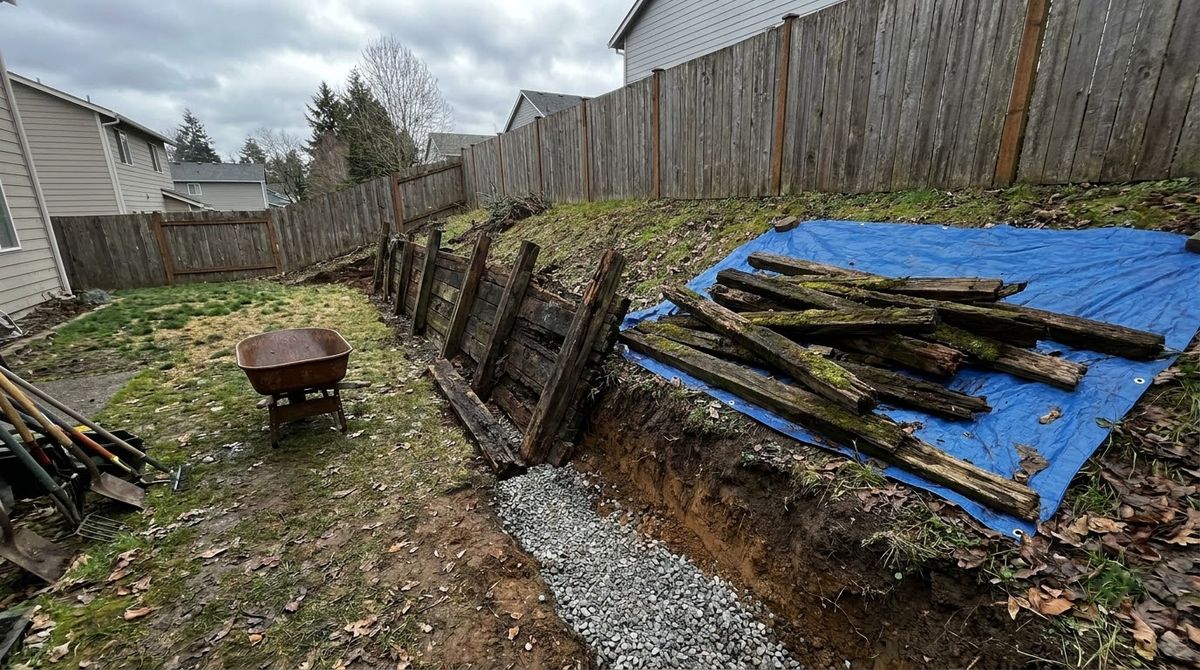
- Tear-out: $10–$20 per sq ft of wall (Fixr), or $15–$30 per linear foot plus disposal fees (HomeGuide).
- All-in replacement: Fixr estimates close to $60–$70 per sq ft once demolition and disposal are added.
- Adding drainage to a standing wall: about $60–$70 per linear foot where the soil behind it can be dug out (Fixr).
- Repairs short of replacement: roughly $200–$1,200 (Fixr) or $400–$1,065 (LawnLove) for patching, tiebacks or drainage work.
HomeGuide points out that a rebuild is a chance to salvage sound block or stone and correct the drainage that failed. If the old wall leans or bulges, the fix that holds is usually the base and drain, not new facing.
DIY vs. hiring a pro
DIY vs. hiring a pro comes down to height. Labor makes up 40–60% of a retaining wall’s cost and runs $50–$75 per hour (HomeGuide), so building it yourself removes roughly half the bill on a short wall. LawnLove notes timber, concrete block and dry-stone walls under about 3 feet can be DIY projects.
- Reasonable DIY: a garden or terrace wall under 3 feet, segmental block or timber, on firm soil, with nothing heavy above it.
- Hire a pro: anything near or over 4 feet, any wall holding up a driveway, patio, fence or slope, clay or wet soil, or tight access where hand-digging adds days.
- Budget the tools: a plate compactor is required for the base and backfill in the Allan Block steps; rent one rather than skip compaction.
Call 811 before digging, whoever builds it. If the wall will level ground for a terrace, the paver patio ideas post covers what to put on top, and a low block wall can double as the side of a raised garden bed.
Mistakes that make a retaining wall cost twice
Mistakes that make a retaining wall cost twice nearly all happen below grade, where nobody looks once the job is done.
- Skipping drain rock and pipe. Water pressure behind a wall is what bows and cracks it; retrofitting drainage costs $60–$70 per linear foot if the wall can be saved at all.
- Backfilling with the dug-out soil. Allan Block says organic material cannot be used as backfill; it holds water and settles.
- Measuring height from the lawn. The code measures from the bottom of the footing, so a wall that looks short can still need a permit.
- Ignoring the surcharge. A parked car, a shed or a slope above the wall changes the design and the paperwork.
- Comparing per-foot prices instead of line items. The low bid often leaves out excavation, drainage or hauling.
Frequently asked questions
How much does a 100-foot retaining wall cost?
Installed, a 100-foot retaining wall runs about $4,000 to $13,000 at 2 feet tall, $8,000 to $26,000 at 4 feet, and $12,000 to $39,000 at 6 feet, based on Fixr and HomeGuide tables. Material moves the number most: timber and block sit at the low end, stone near the top. Walls over 4 feet usually add engineering and permit costs.
What is the cheapest retaining wall material?
Vinyl, cinder block and timber are the cheapest, at roughly $10 to $30 per square foot of wall face installed. Railroad ties are similar, but LawnLove notes they are less common now because of their toxic coating. Wood has the shortest life, about 10 to 40 years per HomeGuide, so segmental block often costs less over the life of the wall.
Do I need a permit for a 3-foot retaining wall?
Under the 2021 IRC, a retaining wall up to 4 feet tall, measured from the bottom of the footing to the top of the wall, is exempt from a permit unless it supports a surcharge such as a driveway or slope. Buried courses count toward the height, and many cities set lower limits, so check with your local building department first.
How much does it cost to replace a retaining wall?
Plan on the price of a new wall plus removal. Fixr puts tear-out at $10 to $20 per square foot and estimates a full replacement at close to $60 to $70 per square foot once demolition and disposal are included. HomeGuide prices demolition at $15 to $30 per linear foot plus disposal. Reusing sound block or stone trims the bill.
How long does a retaining wall last?
HomeGuide gives concrete walls 50 to 100 years, natural stone 50 to 200, metal 20 to 40 and wood 10 to 40. Drainage matters more than material: a wall with clogged or missing drainage fails early whatever it is made of. Clean weep holes each year and inspect for bulging, cracks and water stains twice a year.
Does every retaining wall need a drain pipe?
Not every one. Allan Block’s installation guide requires a perforated drain pipe for any reinforced wall, any gravity wall over 4 feet tall, and any site with poor drainage, vented to daylight every 50 feet. Shorter gravity walls on well-draining sites are not on that list, though they still get a 12-inch zone of wall rock behind the block.
Sources
- HomeGuide, How Much Does a Retaining Wall Cost? (2026) (written Jan 16, 2026).
- Fixr, Retaining Wall Cost (updated Jan 31, 2025).
- LawnLove, How Much Does a Retaining Wall Cost in 2026? (updated Oct 9, 2026).
- International Code Council, 2021 IRC Chapter 1, Section R105.2 Work exempt from permit (2021 edition).
- International Code Council, 2021 IRC Chapter 4, Section R404.4 Retaining walls (2021 edition).
- Allan Block, Basic Installation (checked Oct 15, 2026).