The best sloped backyard landscaping ideas depend on the grade: below about 33 percent (a 3:1 slope), plants and mulch can hold the soil, from 33 to 50 percent they need erosion netting until roots take, and past 50 percent you need terraces or retaining walls. Below are 17 sloped backyard landscaping ideas, sorted by the slope each one handles, from groundcovers to terraces, steps, paths and flat sitting spots.
Key takeaways
- Measure first. Percent slope = rise ÷ run × 100. Mississippi State Extension calls anything over 20 percent (2 feet of rise in 10 feet) a steep slope.
- Plants handle most yards. The NRCS homeowner guide says slopes under 33 percent have a good chance of controlling runoff with plants and mulch alone.
- Steeper than 50 percent needs structure: retaining walls, rock or terraces, per the same NRCS guide.
- Keep DIY walls low. MSU Extension suggests homeowners building their own walls keep them to a foot or two high.
- Terraces need room. Allan Block spaces terraced walls at least twice the lower wall’s height apart, or the pair needs an engineer.
| Idea | Slope it suits | DIY? | Relative cost |
|---|---|---|---|
| 1. Groundcover instead of lawn | Up to about 33% | Yes | $ |
| 2. Native grasses and sedges | Up to about 50% | Yes | $ |
| 3. Shrubs and spreading junipers | Up to about 50% | Yes | $–$$ |
| 4. Planting through coir netting | 33–50% | Yes | $ |
| 5. Mulch that stays put | Up to about 33% | Yes | $ |
| 6. Rock garden with boulders | Any, rocks set by machine | Partly | $$ |
| 7. Dry creek bed | Along the natural drainage line | Yes | $–$$ |
| 8. Rain garden at the bottom | Under 12% where it sits | Yes | $ |
| 9. Earth terraces (cut and fill) | 20–50% | Yes, small | $–$$ |
| 10. Low stone or block terrace walls | Over 20%, walls 1–2 ft | Yes | $$ |
| 11. Two-tier retaining walls | Over 50% | To a plan | $$$ |
| 12. Terraced vegetable beds | Any, once terraced | Yes | $$ |
| 13. Switchback path | Too steep for a straight path | Yes | $ |
| 14. Stone or timber steps in the bank | Any | Yes | $$ |
| 15. Block stairs through a terrace wall | Terraced slopes | Yes | $$ |
| 16. Patio cut into the slope | Gentle to moderate | Partly | $$–$$$ |
| 17. Deck over the steepest drop | Too steep for walls | Rarely | $$$ |
Slope ranges from the NRCS homeowner erosion guide, MSU Extension and UW Extension (see Sources). Relative cost is a ranking by materials: plants and mulch lowest, walls and decks highest. Wall materials and their height limits are compared in the retaining wall ideas by material and height.
Measure the slope before you pick an idea
Measure the slope before you pick an idea, because the grade decides what will hold. Drive a stake at the top and one 10 feet downhill, tie a string between them, level it with a line level, and measure from the string to the ground at the low stake. That drop divided by 10, times 100, is your percent slope.
| Slope | Ratio (run:rise) | What the sources say works |
|---|---|---|
| Under 12% | Flatter than about 8:1 | Lawn, beds, paths, rain gardens (UW Extension limit for a rain garden) |
| Under 20% | Flatter than 5:1 | Usually more stable and easier to maintain (MSU Extension) |
| Under 33% | Flatter than 3:1 | Plants and mulch alone have a good chance of controlling runoff (NRCS) |
| 33–50% | 3:1 to 2:1 | Plant, but hold the soil with an erosion blanket, coir mat or jute netting until roots establish (NRCS) |
| Over 50% | Steeper than 2:1 | Retaining walls, rock, riprap or terraces; NRCS rates revegetation success “improbable” |
Length matters too. MSU Extension notes that terraces cut erosion by breaking a long hillside into shorter steps, so a long bank may call for a terrace or two even where its grade alone would allow plants.
Planting: sloped backyard landscaping ideas that hold soil
Planting is the cheapest of the sloped backyard landscaping ideas, and on slopes under about 33 percent it is often all you need. MSU Extension notes that lawn grass binds soil but does a poor job of slowing runoff, while taller grasses, wildflowers, shrubs and trees slow water far better.
1. Groundcover instead of lawn
Replace the hard-to-mow part of the slope with a low, spreading groundcover. MSU Extension lists prostrate junipers, ivies, rugosa rose and sedums for full sun with little watering, and low vines, ferns and perennials that carpet and bind the top layer of soil in shade.
- Slope: up to about 33 percent on its own; add netting above that.
- Pick it if: mowing the bank is the job you most want to stop doing.
2. Native grasses and sedges
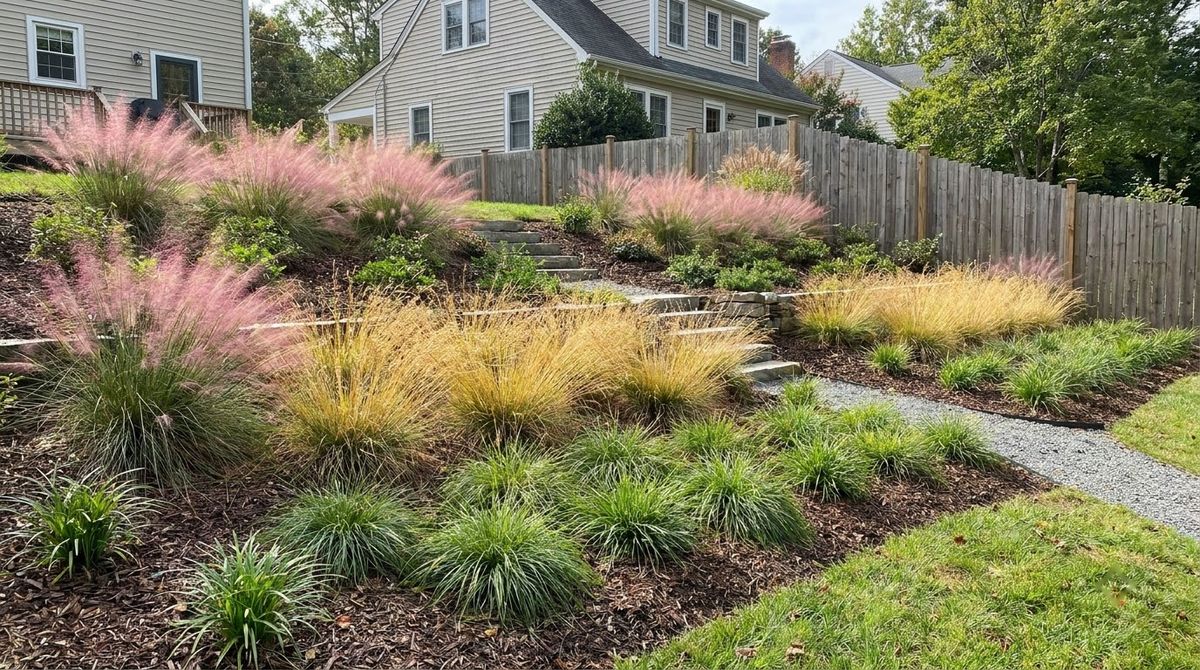
Native grasses and sedges root deeply and need little care once settled. Penn State Extension calls them especially good for slopes: river oats builds a firm root mass, muhly grass reaches 2 to 3 feet, and Pennsylvania sedge can be cut back to about 3 inches in late winter.
- Slope: moderate to steep banks, planted through netting where the grade passes 33 percent.
- Pick it if: you want a meadow look and almost no mowing.
3. Shrubs and spreading junipers
Shrubs give a slope a woody root network that holds deeper soil than turf. Penn State Extension notes common juniper, 3 to 6 feet tall, does well on rocky slopes, and MSU Extension says trees and shrubs form a tight network of roots and stems that binds soil particles together.
- Slope: any slope you can stand on to plant; mass them across the face.
- Pick it if: the bank faces a street or neighbor and you also want screening.
4. Planting through coir netting
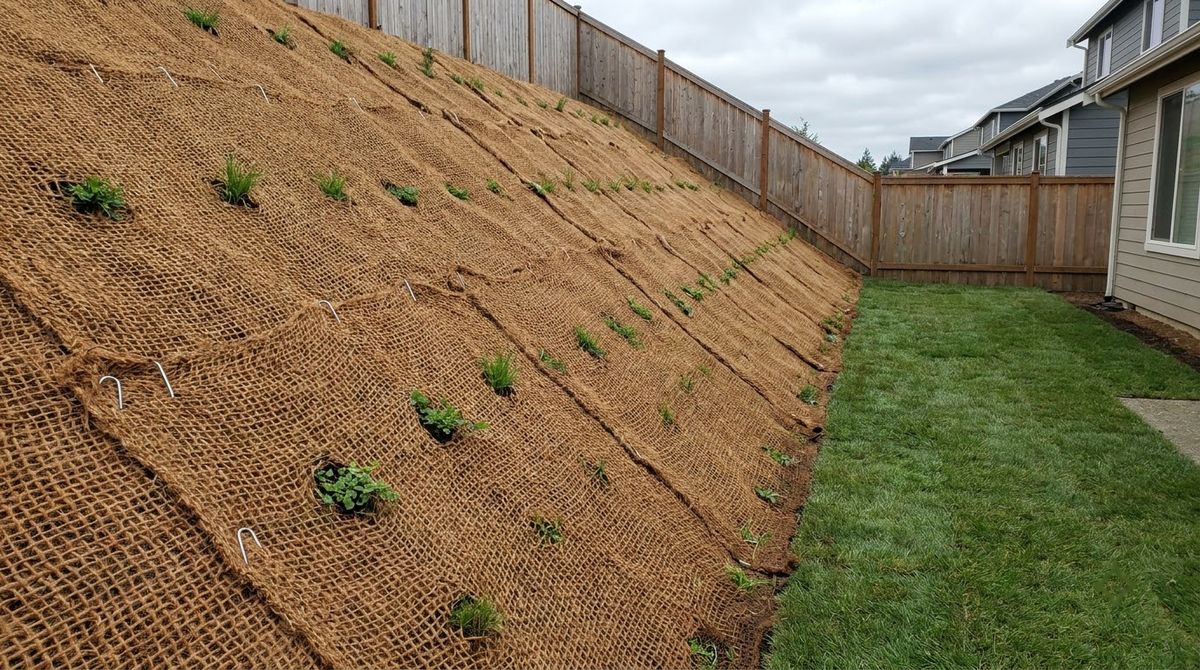
On a 33 to 50 percent slope, the NRCS guide says you can still plant, but you may need an erosion control blanket, coconut fiber mat or jute netting to hold the soil until plants establish. Penn State Extension adds that natural coir or plant-fiber netting disappears in time, so you cut holes and plant straight through it.
- Slope: 33 to 50 percent (3:1 to 2:1).
- Pick it if: the slope is freshly graded or bare and it rains often.
5. Mulch that stays put
Mulch covers bare soil between new plants so rain cannot strike it directly. The NRCS guide lists bark chips, pine needles, wood chips and stone, and says up to 2 inches of bark, chips or needles will not create a fire hazard. Penn State Extension suggests at least 2 inches after planting, so about 2 inches is the working number.
- Slope: under about 33 percent; steeper slopes shed loose mulch in heavy rain.
- Pick it if: you are planting in stages and the soil will sit exposed for a season.
6. Rock garden with boulders
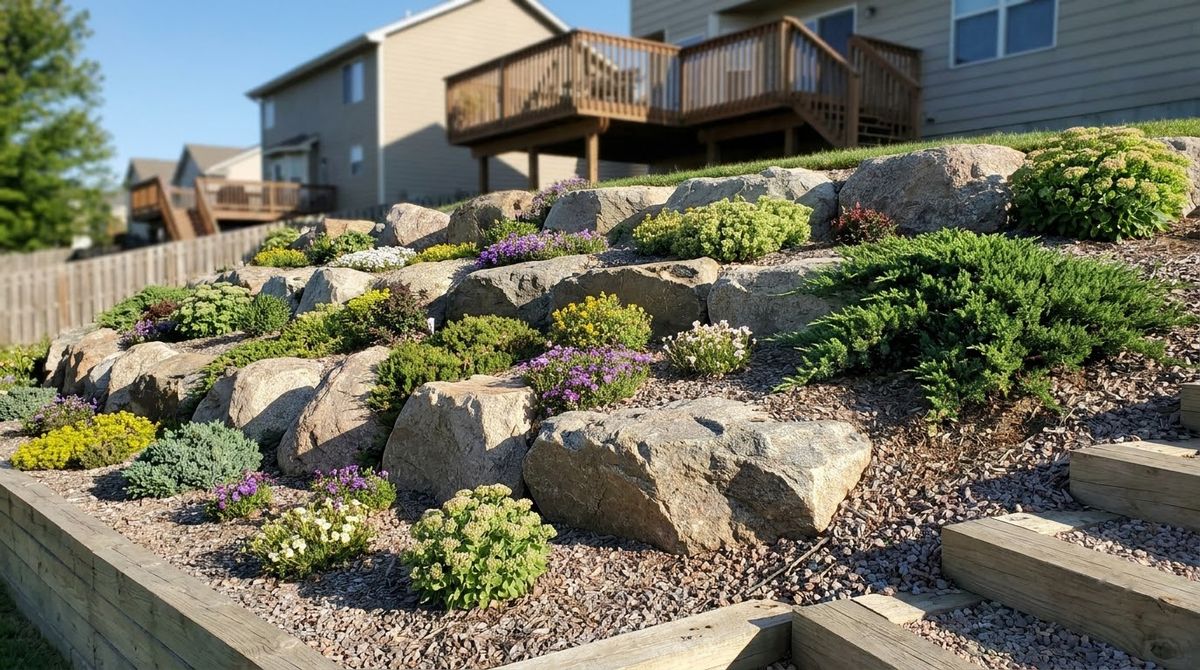
A rock garden turns the steepest, driest patch into a feature instead of a chore. Set large boulders partly buried, with the long side across the slope, and fill the pockets between them with sedums and other plants MSU Extension lists for full sun and little water.
- Slope: works on steep ground, but boulders big enough to stay put need a machine to place.
- Pick it if: the slope is sunny, thin-soiled and already rocky.
Water ideas: give runoff a place to go
Water ideas for a slope work with the route rain already takes. MSU Extension notes that water follows the lowest, easiest course, so it is best to keep or even create permanent drainage channels, and that gullies left unchecked can grow large enough to undermine a house foundation.
7. Dry creek bed
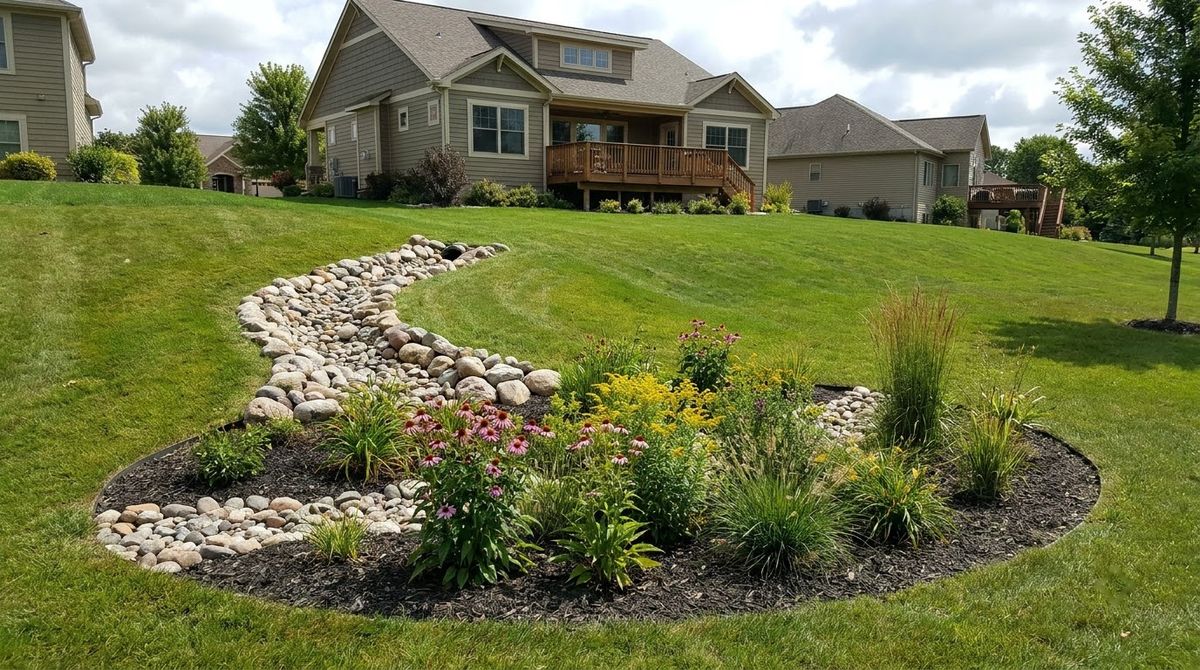
A dry creek bed lines the natural drainage swale with river rock and boulders, so storm runoff has a stable channel instead of cutting a gully. MSU Extension suggests placing boulders, stones or small check dams in existing gullies to slow the water. Plant the banks of the channel to blend it into the yard.
- Slope: follow the existing low line; do not route it toward the house or a neighbor.
- Pick it if: you already see a washout line after storms.
8. Rain garden at the bottom
A rain garden is a shallow planted basin that soaks up runoff where the slope flattens out. University of Wisconsin Extension says to site it on ground with less than a 12 percent slope, at least 10 feet from a foundation, not over a septic system, with a flat bottom and in sun or part sun.
- Slope: the basin itself sits on the flatter ground at the toe of the slope.
- Pick it if: water pools at the bottom of the yard after rain.
Terrace ideas for a sloped backyard
Terrace ideas for a sloped backyard turn one long slope into level steps you can plant, sit on or mow. MSU Extension says terraces cut erosion by breaking a long hillside into shorter, more even steps, and the NRCS guide lists terracing and retaining walls for slopes over 50 percent.
9. Earth terraces (cut and fill)
Earth terraces use the soil you already have. MSU Extension describes the cut-and-fill method: dig soil from the uphill side of each level and use it to fill the downhill side. The short, steep banks between levels are then planted with groundcover or grasses from ideas 1 to 4.
- Slope: moderate slopes where each bank stays plantable.
- Pick it if: you want level beds without buying wall material.
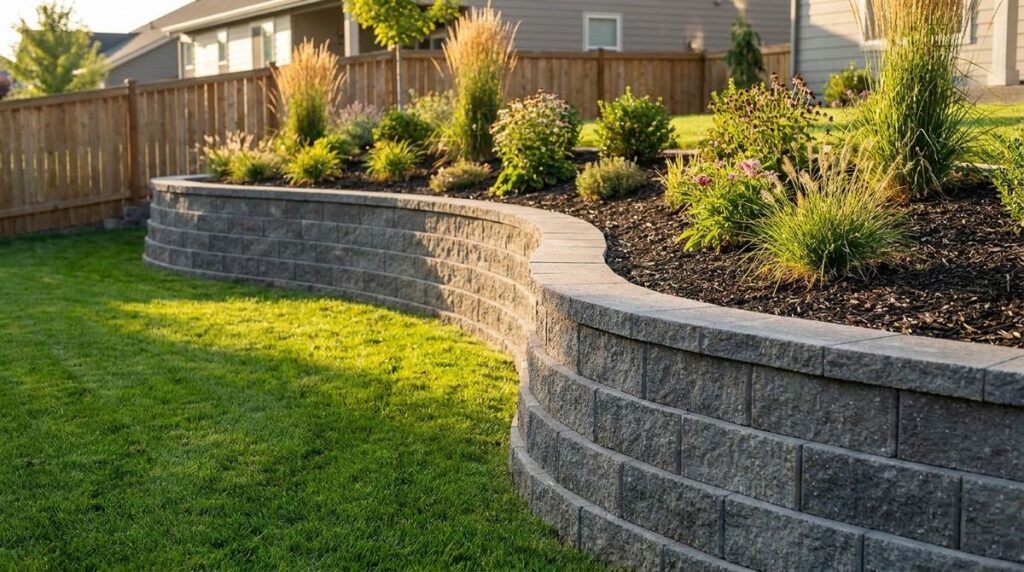
10. Low stone or block terrace walls
Low walls hold the front of each terrace so the levels stay flat. MSU Extension suggests homeowners doing their own construction keep walls to a foot or two high, because of the pressure soil and water put on a wall. Natural stone and segmental block both work; compare them in the retaining wall ideas by material and height.
- Slope: steep enough that earth banks would wash out.
- Pick it if: you want a finished, garden-wall look on a DIY budget.
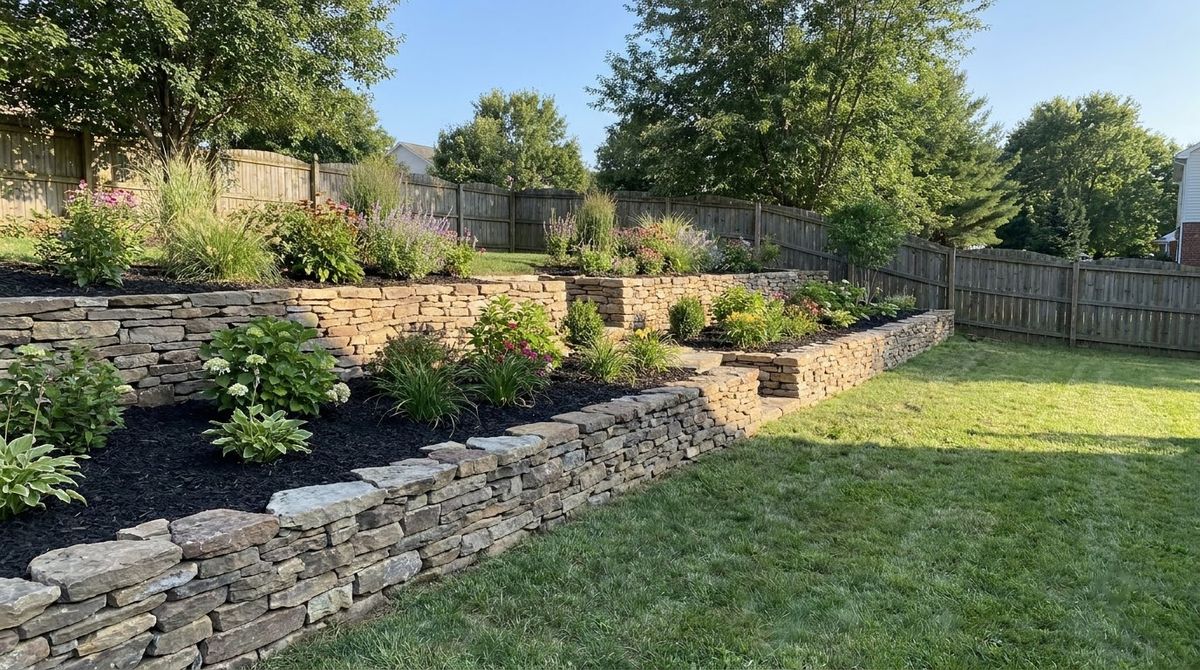
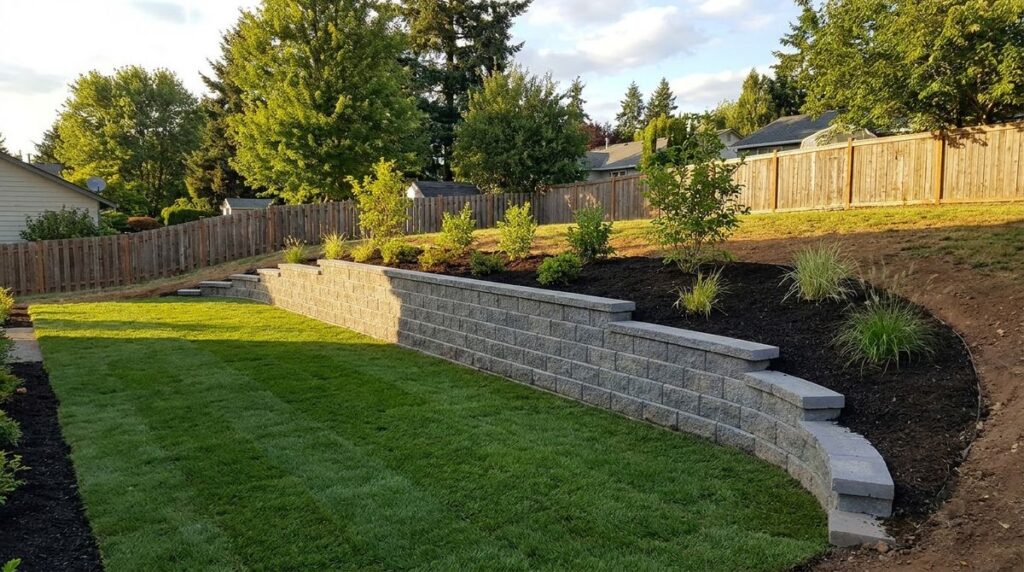
11. Two-tier retaining walls
Two shorter walls can replace one tall wall if they are spaced properly. Allan Block says the upper wall should be no taller than the lower one, and the gap between them at least twice the lower wall’s height. Closer walls, more than two terraces or a structure above call for an engineer. Base and drainage: see building a retaining wall on a slope.
- Slope: over about 50 percent, or wherever you want two usable levels.
- Pick it if: you need real flat space and have room to dig back into the hill.
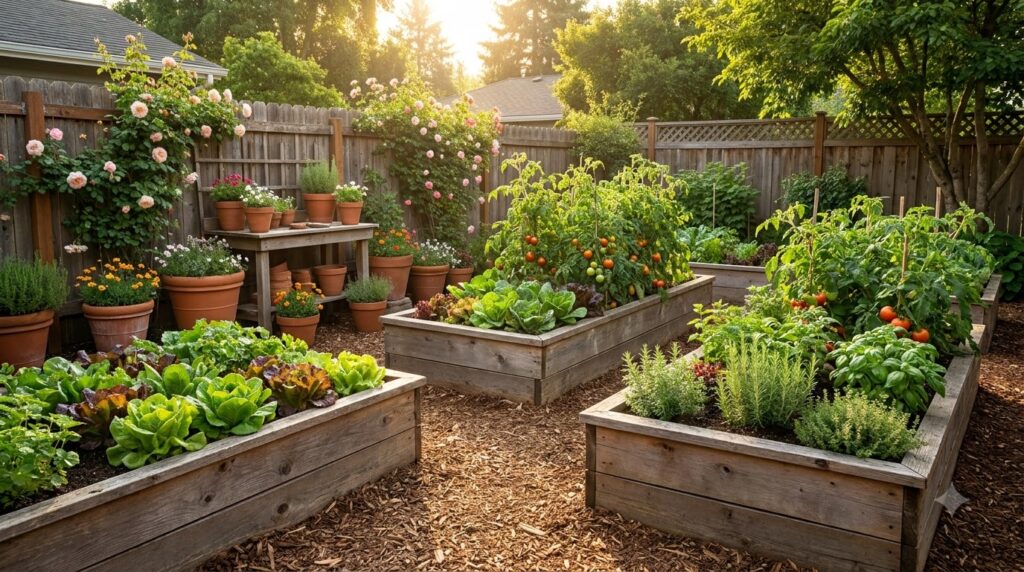
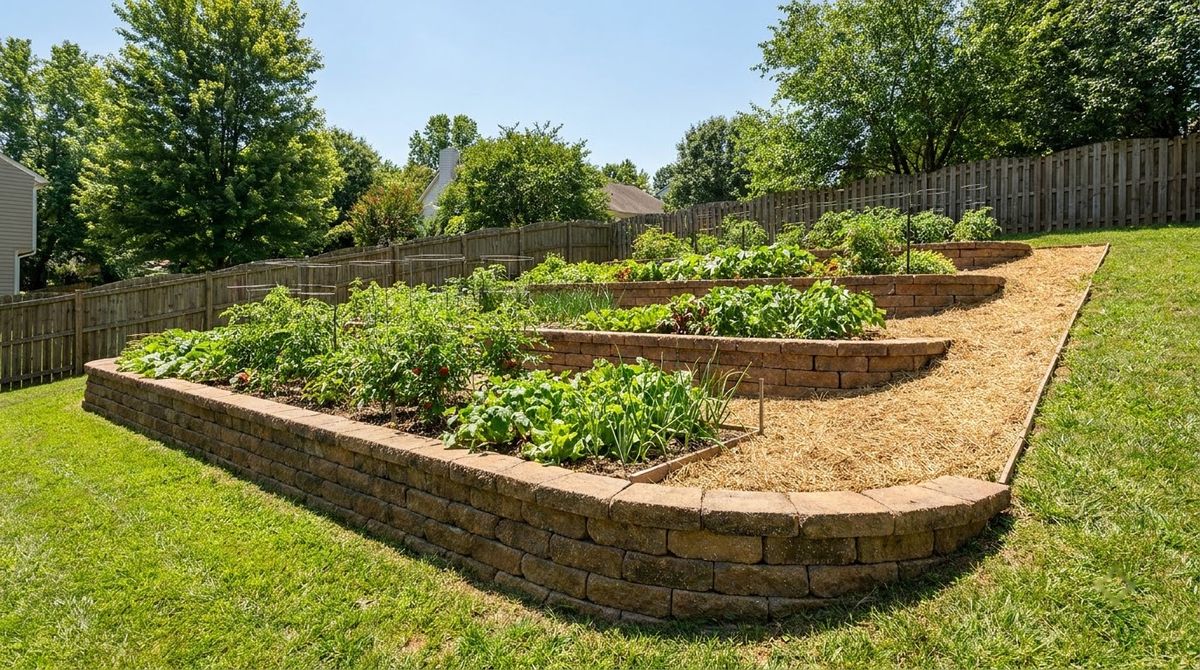
12. Terraced vegetable beds
Terraced vegetable beds put each level to work. Once terraces are in, each flat step takes a bed running along the contour, with a mulched path on the uphill side for picking and weeding. Running beds across the slope, not down it, keeps water from racing down the rows.
- Slope: any, once the terraces are built.
- Pick it if: the sunniest part of your yard is also the sloped part.
Steps and paths on a slope
Steps and paths on a slope decide whether you actually use the upper yard. A path that climbs straight down the fall line becomes a channel for water and is tiring to walk, so most of these ideas cross the slope at an angle or break the climb into steps.
13. Switchback path
A switchback path zigzags across the slope so each leg climbs gently, and it leaves planting pockets at every turn. Crushed gravel or stone dust packs firm enough for a sloped path; base depth, edging and washout fixes are in the gravel garden path guide.
- Slope: any slope too steep for a straight, comfortable path.
- Pick it if: you want to walk the slope with a wheelbarrow, not just climb it.
14. Stone or timber steps in the bank
Steps set straight into the bank are the most direct way up. Texas A&M’s Earth-Kind guide gives a simple rule: riser plus tread should equal 21 inches, risers no taller than 7 inches, the same proportions for the whole flight, and never a single step, which is an easy one to trip over.
- Example: a 6-inch riser pairs with a 15-inch tread.
- Pick it if: the slope is short and steep, or a path would need too many turns.
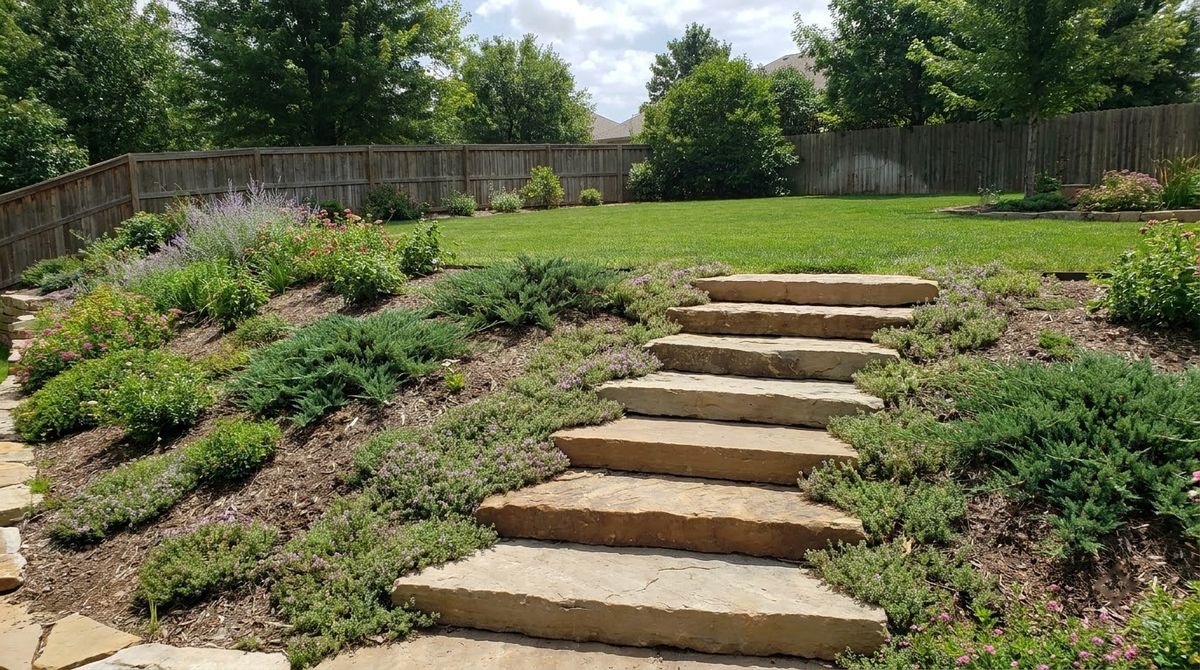
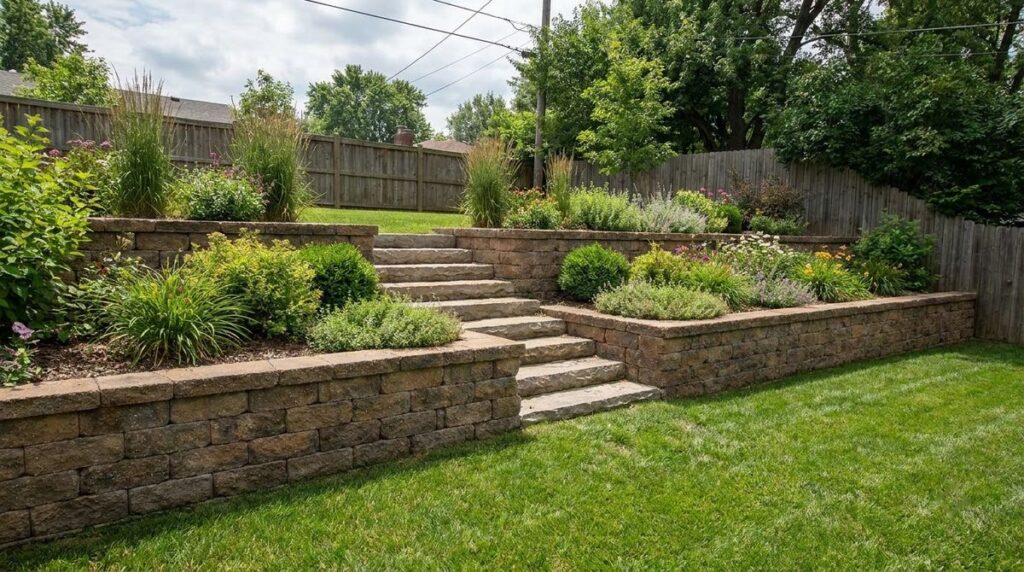
15. Block stairs through a terrace wall
Block stairs built into a terrace wall use the same units as the wall, so steps and wall read as one piece. Earth-Kind adds a landing or rest area at least every 20 steps. Rise, run, layouts and the build sequence are in the guide to retaining wall stairs and their rise and run.
- Slope: terraced slopes with walls from ideas 10 and 11.
- Pick it if: you are building terraces anyway and want access between levels.
Flat spots: patio, seating and decks
Flat spots give a sloped yard a place to stop. The two ideas here create level ground either by digging into the hill or by building out over it, and both usually need more planning than planting does.
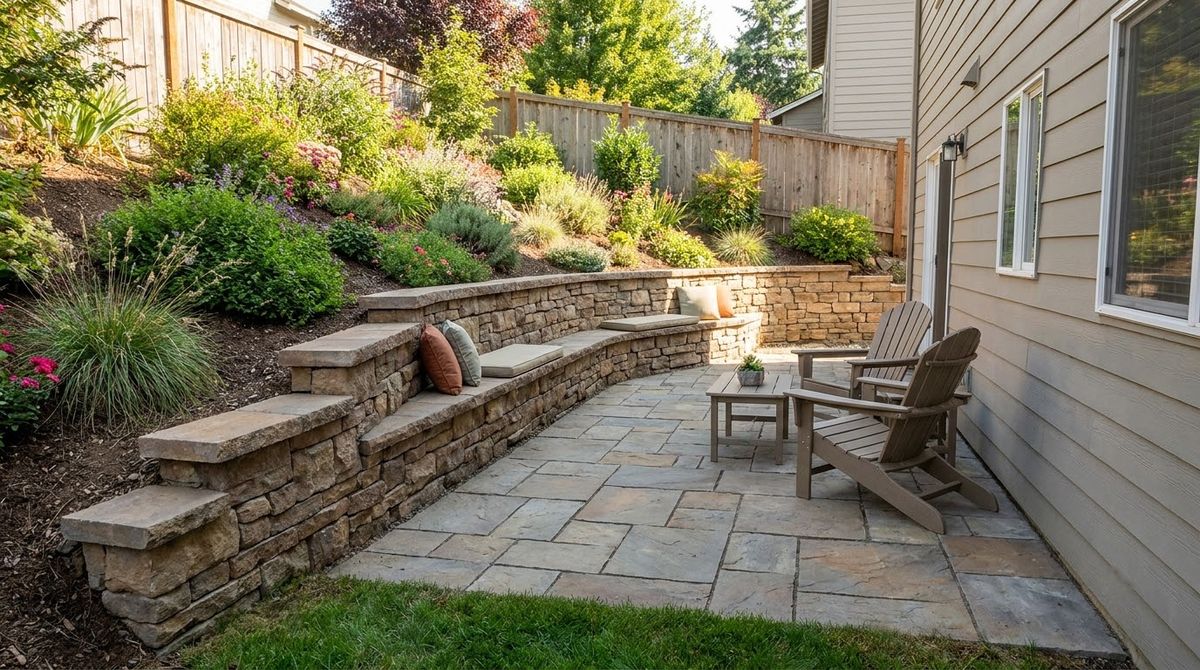
16. Patio cut into the slope
A patio cut into the slope sits on level ground dug out of the hill, with a low wall along the uphill edge that doubles as built-in seating. Keep that wall low enough for a DIY build, per MSU’s foot-or-two guidance, and pitch the patio surface slightly away from the house so rain runs off.
- Slope: gentle to moderate, where the cut stays shallow.
- Pick it if: you want a sitting area near the house without building a deck.
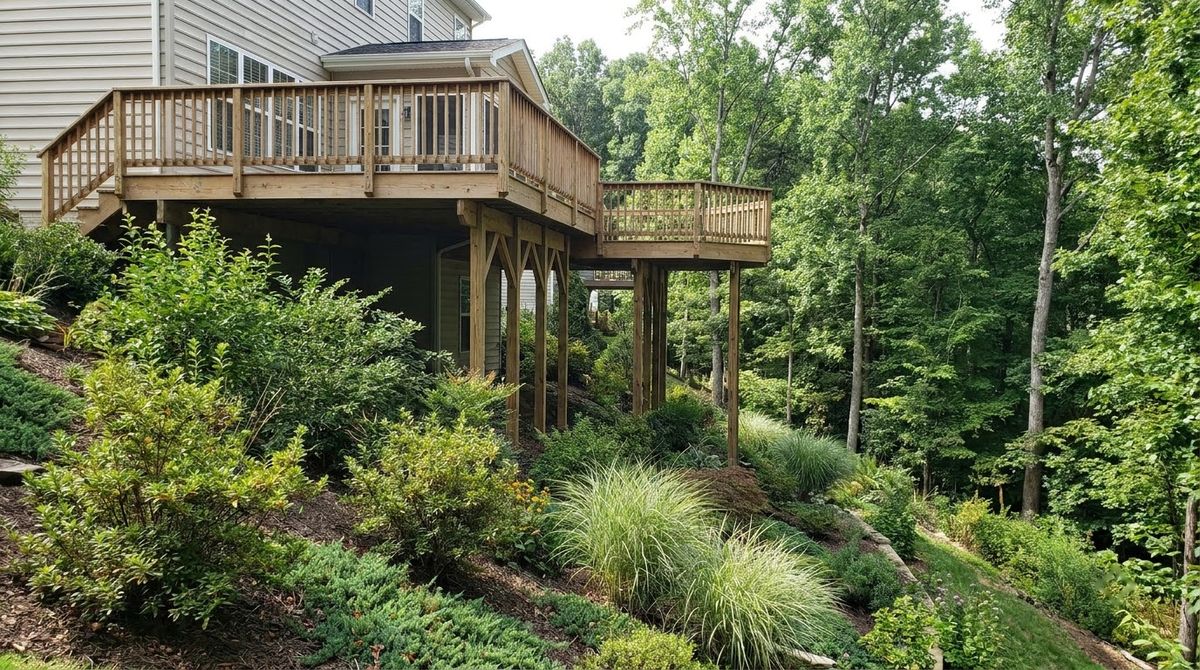
17. Deck over the steepest drop
A deck turns a drop-off too steep for walls into usable space without moving soil. Posts carry the load down to footings, so the slope beneath stays planted and untouched. Deck footings, height and permits fall under your local building code, so check with your local building department before you plan one.
- Slope: very steep ground where a wall would be tall and expensive.
- Pick it if: the view is downhill and you want the space at house level.
Which sloped backyard idea to pick: verdict by situation
- Gentle slope, under 20 percent: keep lawn where you can mow it, add a switchback or gravel path (13) and a rain garden at the bottom (8).
- Moderate slope, 20 to 33 percent: swap the bank for groundcover, grasses or shrubs (1–3) with about 2 inches of mulch (5).
- Steep slope, 33 to 50 percent: plant through coir netting (4), or cut earth terraces (9) with low walls (10).
- Very steep, over 50 percent: structure first: two-tier walls built to a plan (11) or a deck (17), then plant what is left.
- Water problem: fix drainage before planting, with a dry creek bed (7) and a rain garden (8).
- Want usable space: terraces with beds (12) or a cut-in patio (16), connected by steps (14–15).
Mistakes to avoid on a sloped backyard
- Leaving soil bare. Plant and mulch right after you grade; on slopes over 33 percent, add a blanket or netting.
- Using plastic on the slope. Penn State Extension notes many homeowners have regretted plastic or synthetic sheeting on a slope; use natural fiber netting that breaks down.
- Building one tall DIY wall. MSU Extension suggests homeowner walls stay at a foot or two; taller walls take equipment, drainage and often a permit.
- Stacking terraces too close. Walls closer than twice the lower wall’s height load the lower wall and need engineering, per Allan Block.
- Blocking the drainage line. Filling the low swale sends water somewhere new, often toward the house.
- Putting a rain garden on the slope itself. UW Extension keeps rain gardens on ground under 12 percent.
- Building a single step. Earth-Kind calls it an invisible tripping hazard; use at least two.
Frequently asked questions
What is the cheapest way to landscape a sloped backyard?
Plants and mulch are the cheapest way to landscape a sloped backyard. The NRCS homeowner guide says slopes under 33 percent have a good chance of controlling runoff with plants and mulch alone. Use spreading groundcovers, native grasses or shrubs, about 2 inches of mulch, and add coir netting only on steeper banks.
When does a slope need terracing?
The NRCS homeowner erosion guide says slopes steeper than 50 percent, or 2:1, need structures such as retaining walls, rock or terraces, because plants alone rarely take. Terraces also help on gentler slopes when you want flat space; MSU Extension notes they break a long hillside into shorter steps that erode less.
What ground cover is best for a steep slope?
For sun, MSU Extension lists prostrate junipers, ivies, rugosa rose and sedums, which tolerate little watering. Penn State Extension adds native grasses and sedges such as river oats and Pennsylvania sedge, which root deeply. Above 33 percent, plant them through coir netting so soil stays put while roots spread.
How do you stop erosion on a sloped backyard?
Cover the soil and slow the water. Plant deep-rooted groundcovers, grasses or shrubs, mulch about 2 inches deep, and pin coir or jute netting on slopes between 33 and 50 percent. Give runoff a stable path with a dry creek bed, and on slopes over 50 percent add terraces or retaining walls.
How tall can a DIY terrace wall be?
MSU Extension suggests homeowners doing their own construction keep retaining walls to about a foot or two high, because soil and water press hard on a wall. Taller walls need proper base, drainage and often a permit and an engineer; check with your local building department before building one.
Sources
- USDA Natural Resources Conservation Service, Prevent Soil Erosion on Your Property: A Homeowner’s Guide to Erosion Control (Southern California Watershed Recovery, hosted by UC ANR; checked October 2026).
- Mississippi State University Extension, Gardening on Steep Slopes (checked October 2026).
- Penn State Extension, Native Groundcovers Can Solve Tough Challenges in the Landscape (updated August 2024).
- University of Wisconsin Extension and Wisconsin DNR, How to Build a Rain Garden (checked October 2026).
- Allan Block, Terraced Retaining Walls and Wall Design (checked October 2026).
- Texas A&M AgriLife Extension, Earth-Kind Landscaping: Landscape Construction (checked October 2026).