The cheapest backyard walkways cost $0 to about $4 per linear foot in materials for a 3-foot-wide path: free arborist wood chips, a mown grass strip, recycled asphalt millings, road base, pea gravel and natural decomposed granite. The 14 cheap backyard walkway ideas below run from free to about $28 per foot for stepping stones, well under the $45 to $75 per foot of installed concrete pavers.
Key takeaways
- Loose fill is the budget tier. At 4 inches deep on a 3-foot path, most gravel, shell and DG options cost about $1 to $4 per foot in materials, from HomeGuide’s cubic-yard prices.
- Arborist wood chips are often free. Washington State University Extension notes they are free in many urban areas; keep them 4 to 6 inches deep.
- A pro-built gravel path is about $10 per foot with a crusher-run base, fabric and edging, according to HomeGuide.
- Stepping stones and brick cost more, about $6 to $28 per foot in materials, because stone and brick are priced per square foot.
- Gravel is a poor choice for anyone using a cane or walker, or for a path you shovel all winter.
| Idea | Best for | Difficulty | Materials cost per foot (3 ft wide) |
|---|---|---|---|
| 1. Mown grass path | Lawns, meadows, temporary routes | Easy | $0 |
| 2. Free arborist wood chips | Garden and woodland paths | Easy | $0 if free; $1–$4 bought |
| 3. Bark mulch path | Paths between beds | Easy | About $1–$4 |
| 4. Recycled asphalt millings | Long utility paths | Moderate | About $1–$2 (pickup) |
| 5. Road base or crusher run | Firm, compacted routes | Moderate | About $1–$2.30 |
| 6. Crushed limestone | Paths that stay level | Moderate | About $1.30–$2 |
| 7. Pea gravel | Casual garden paths | Easy | About $1.70–$3; ~$10 installed |
| 8. Crushed shell | Coastal yards | Easy | About $1.30–$1.70 |
| 9. Natural decomposed granite | Dry climates, low traffic | Moderate | About $1.50–$3.70 |
| 10. Stabilized decomposed granite | Firm main paths | Moderate | About $3.70–$8.30 |
| 11. Stepping stones in lawn | Short garden crossings | Easy | About $6–$25 |
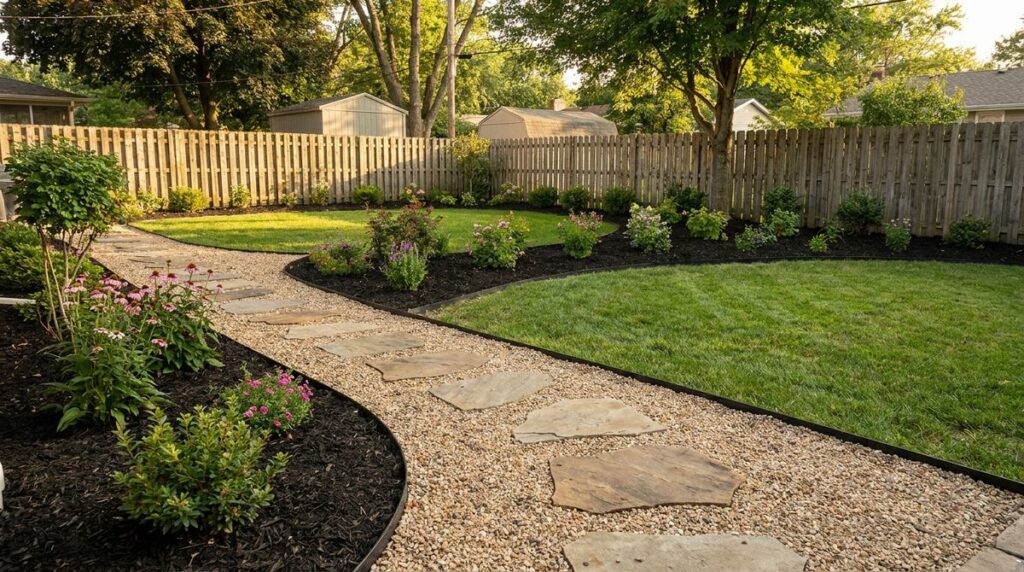
| 12. Stepping stones in gravel | Paths with a finished look | Moderate | About $8–$28 |
| 13. Brick on sand | Cottage and older homes | Hard | About $6–$15 new; less used |
| 14. Urbanite (broken concrete) | Salvage-minded DIY | Hard | About $1–$2.30 for the base |
Materials only for a 3-foot-wide path, 4 inches of fill, worked from HomeGuide price guides updated 2023–2026; delivery, edging and tools extra. For comparison, HomeGuide puts installed concrete pavers at $15–$25 per sq ft (2026), or $45–$75 per foot at this width.
Free and nearly free walkway ideas
Free and nearly free walkway ideas use what is already in the yard or what a tree crew would otherwise haul away. They suit garden paths and back corners more than the main route to a door, because soft surfaces wear, wash and need topping up every year or two.
1. Mown grass path
A mown grass path costs nothing beyond mowing: leave the lawn or meadow around it taller and cut a strip at regular height. It works for light foot traffic and temporary routes you may later pave. Heavy daily use wears a bare line, so move the route or step up to stepping stones (idea 11).
2. Free arborist wood-chip path
Arborist chips are the mix of wood, bark and leaves that tree services grind on site. Washington State University Extension notes that in many urban areas they are available free of charge, and recommends keeping wood chips 4 to 6 inches deep to control weeds. Ask local tree services whether they drop loads in your area.
- Cost per foot: $0 when the chips are free; about $1–$4 when bought (idea 3 pricing).
- Upkeep: chips break down, so plan to top the path up as it thins.
- Skip it for a path to the front door or one that floods.
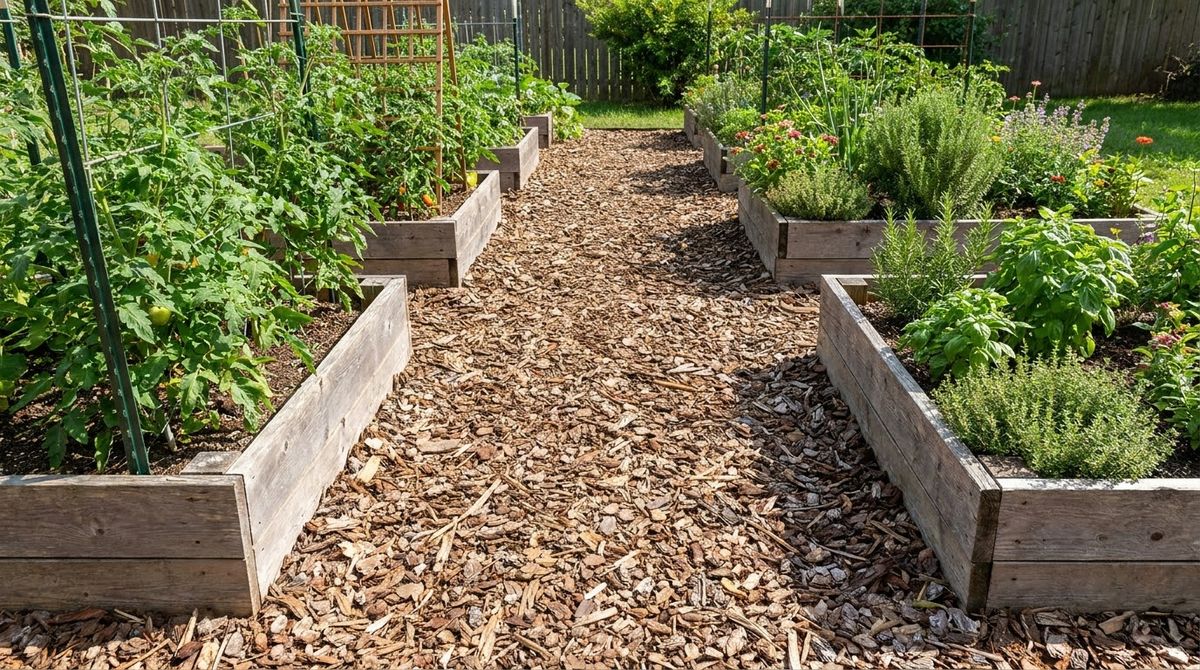
3. Bark mulch path
A bought bark or shredded-wood mulch path looks tidier than arborist chips and costs little. HomeGuide puts mulch at $2 to $8 per bag or $25 to $100 per cubic yard for materials (2025). At 4 inches deep and 3 feet wide, one cubic yard covers about 27 feet of path, so about $1 to $4 per foot.
Crushed stone and recycled aggregate paths
Crushed stone and recycled aggregate paths are the best value for a walkway you use every day. Angular stone locks together when compacted, so it stays firmer underfoot than round pebbles. Prices below are from HomeGuide’s gravel guide, updated December 2025, and exclude delivery, which can cost as much as the stone on a small order.
4. Recycled asphalt millings
Asphalt millings are ground-up old pavement. HomeGuide lists them at $25 to $50 per cubic yard without delivery, or up to $100 per cubic yard delivered in small loads. That works out to about $1 to $2 per foot with pickup, closer to $3.70 delivered.
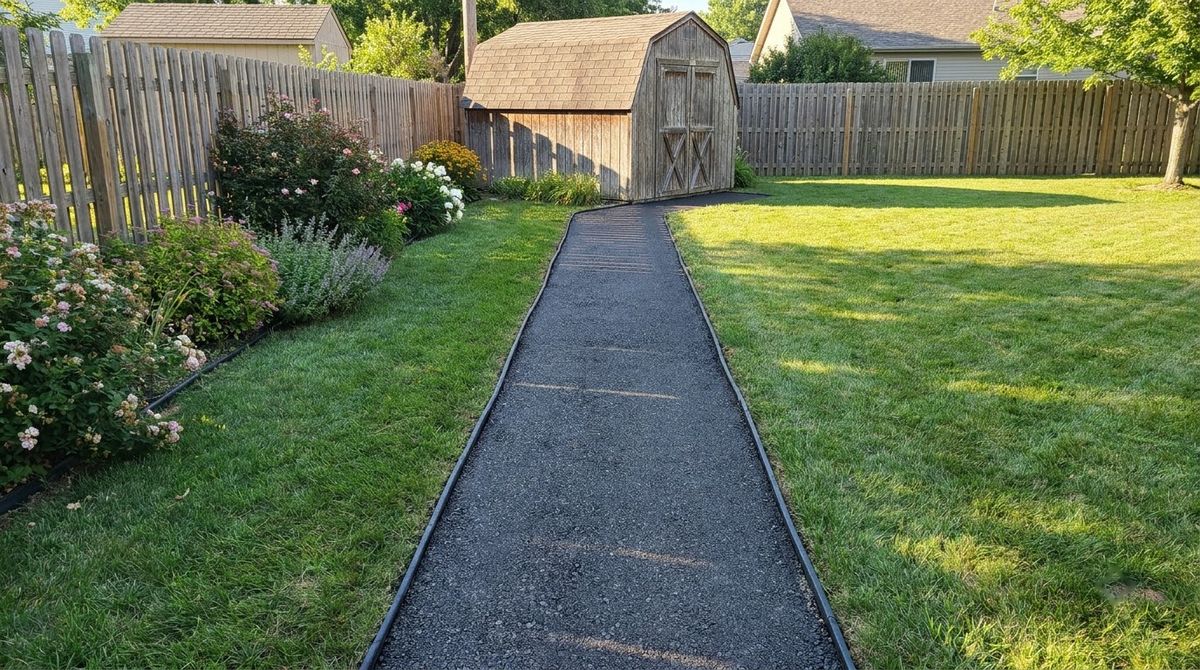
5. Road base or crusher run
Road base, also sold as crusher run, 3/4-inch minus or dense-grade aggregate, mixes stone with fines that compact into a firm surface. HomeGuide prices road base at $25 to $62 per cubic yard and crusher run at about $50, or roughly $1 to $2.30 per foot. It is also the base layer under most other ideas on this list.
6. Crushed limestone
Crushed limestone costs $35 to $54 per cubic yard in bulk, according to HomeGuide, or about $1.30 to $2 per foot. Bags run $3 to $5 each, so bulk is the cheaper route past a few yards. HomeGuide notes crushed limestone stays stable without an extra base layer, which saves a step on firm soil.
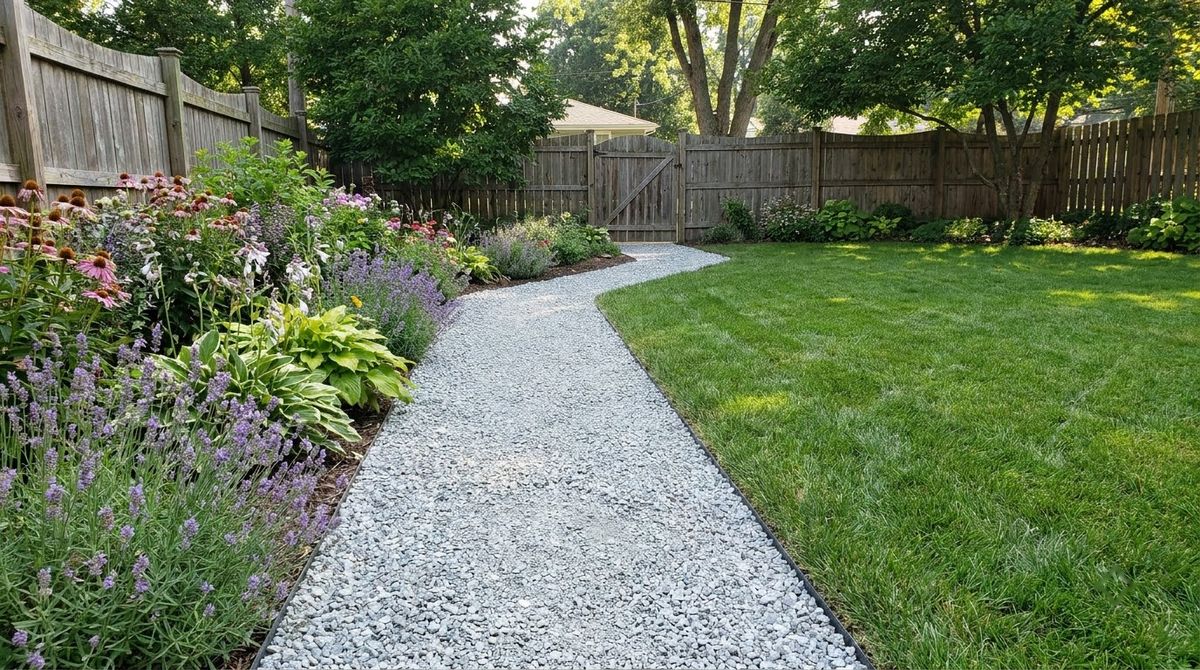
7. Pea gravel path
Pea gravel is the classic cheap garden path. HomeGuide lists it at $45 to $80 per cubic yard for materials (December 2025), about $1.70 to $3 per foot, and puts a finished gravel walkway with a crusher-run base, landscape fabric and edging at about $10 per linear foot for a 3- to 4-foot path.
Smooth stone shifts slightly underfoot, and HomeGuide suggests a 2-inch layer of base rock first for stability. The layer depths and steps are in the gravel garden path build guide, and the edging choices are compared in types of landscape edging.
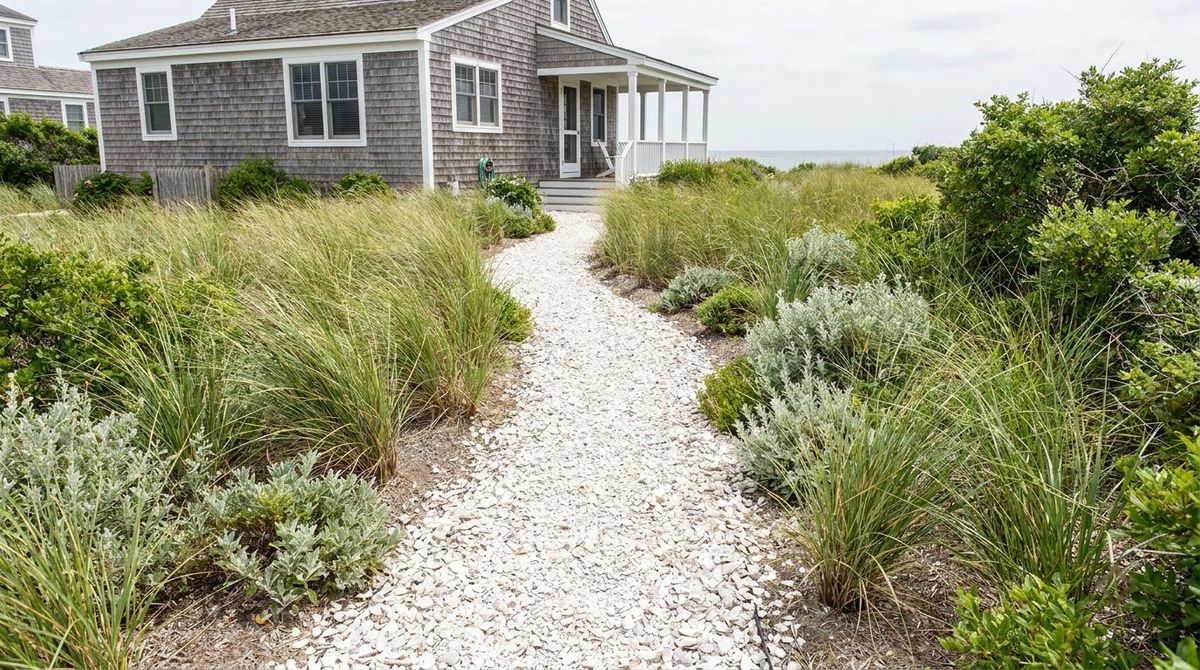
8. Crushed shell path
Crushed oyster or clam shell is a coastal alternative to gravel, priced by HomeGuide at $35 to $45 per cubic yard, or about $1.30 to $1.70 per foot. HomeGuide notes prices depend on the shell type and location.
Decomposed granite paths
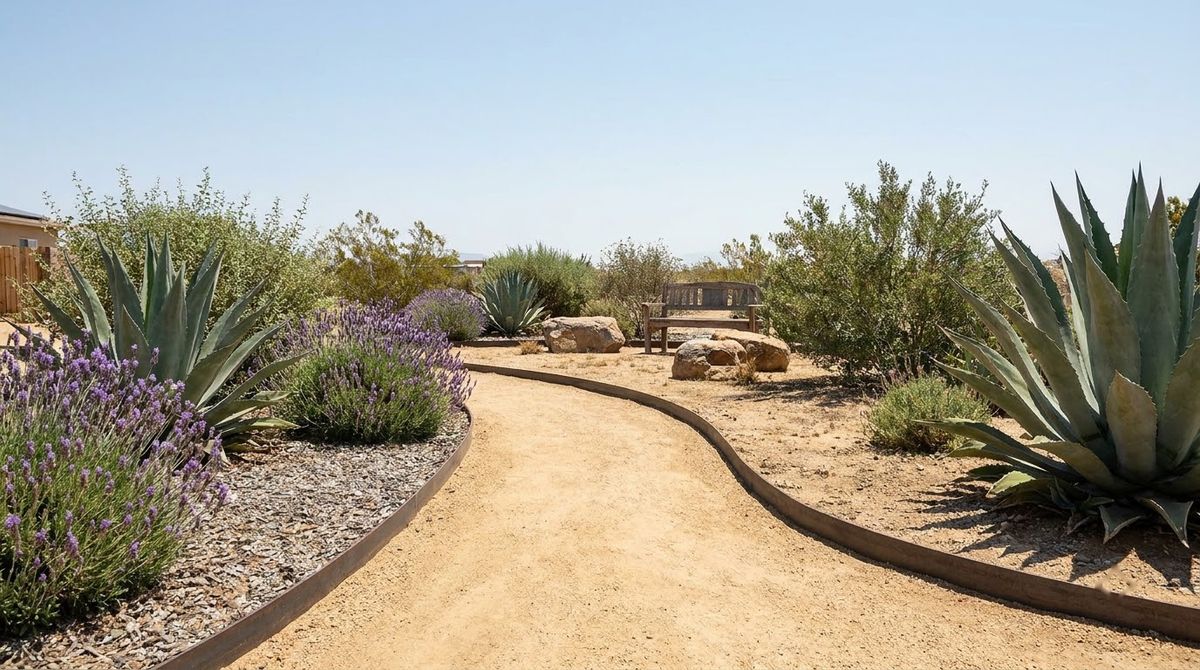
Decomposed granite paths use weathered granite fines that pack almost like a soft pavement. HomeGuide’s decomposed granite guide (July 2024) separates natural DG, which erodes in rain, from stabilized DG with a binder mixed in, which it calls the better choice for walkways.
9. Natural decomposed granite
Natural DG costs $40 to $100 per cubic yard before delivery, according to HomeGuide, or about $1.50 to $3.70 per foot at 4 inches deep. It suits dry climates and low-traffic garden paths. HomeGuide notes it is more likely than stabilized DG to erode in rainfall, so keep it off slopes.
10. Stabilized decomposed granite
Stabilized DG costs $100 to $225 per cubic yard, HomeGuide reports, or about $3.70 to $8.30 per foot. The binder makes the surface firmer and slower to erode than natural DG, which is why it is the DG to pick for a main backyard route. It still needs a graded, compacted base and an edge to hold it.
Stepping stone, brick and salvaged walkway ideas
Stepping stone, brick and salvaged walkway ideas cost more per foot than loose fill, but they give a harder, cleaner surface. Flagstone is priced per square foot, so a single line of stones costs far less than a fully paved path of the same length.
11. Stepping stones in lawn
HomeGuide puts flagstone materials at $6 to $25 per square foot (2023). A single line of stones covering about 1 square foot per foot of path costs roughly $6 to $25 per foot.
That is a fraction of the $15 to $32 per square foot HomeGuide gives for fully paved, dry-laid flagstone. Set each stone flush with the soil so the mower passes over it.
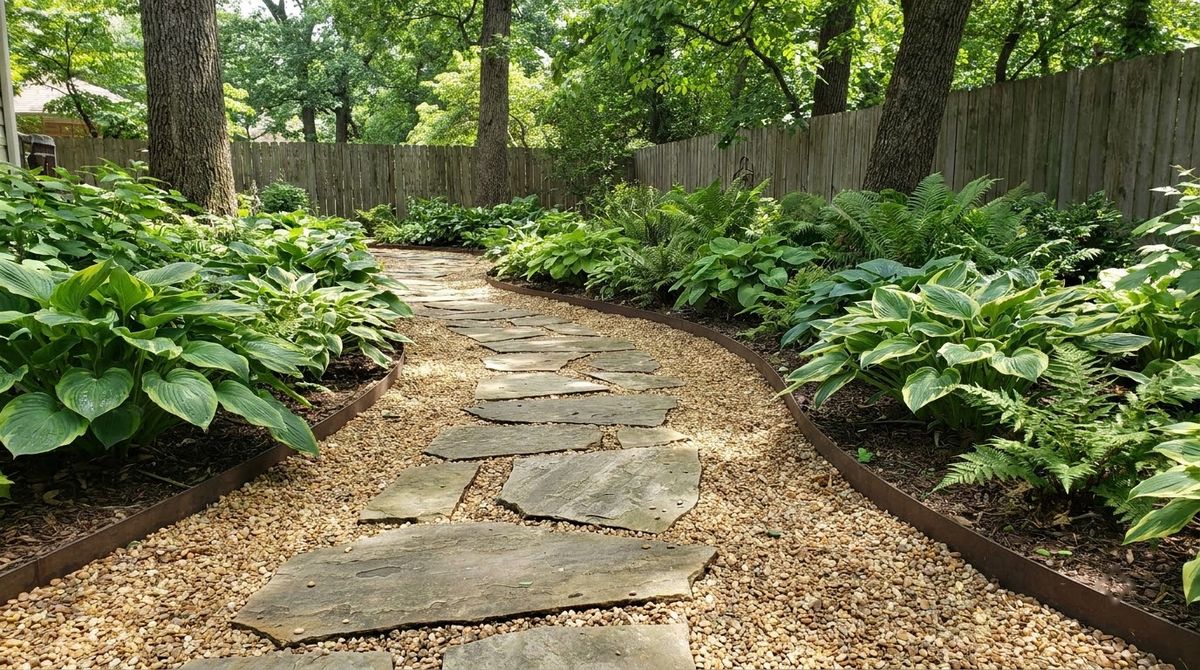
12. Stepping stones in gravel
Stepping stones set into pea gravel combine ideas 7 and 11: about $6 to $25 per foot for stone plus about $1.70 to $3 for gravel infill, or roughly $8 to $28 per foot. The stones carry most of the traffic, so the gravel shifts less than on an all-gravel path.
13. Brick on sand
Brick pavers cost $2 to $5 per square foot for materials, according to HomeGuide’s brick price guide (2023), or about $6 to $15 per foot at 3 feet wide. The same guide lists used and antique bricks at $0.25 to $2 each. Lay them flat on a compacted base and sand bed, inside an edge.
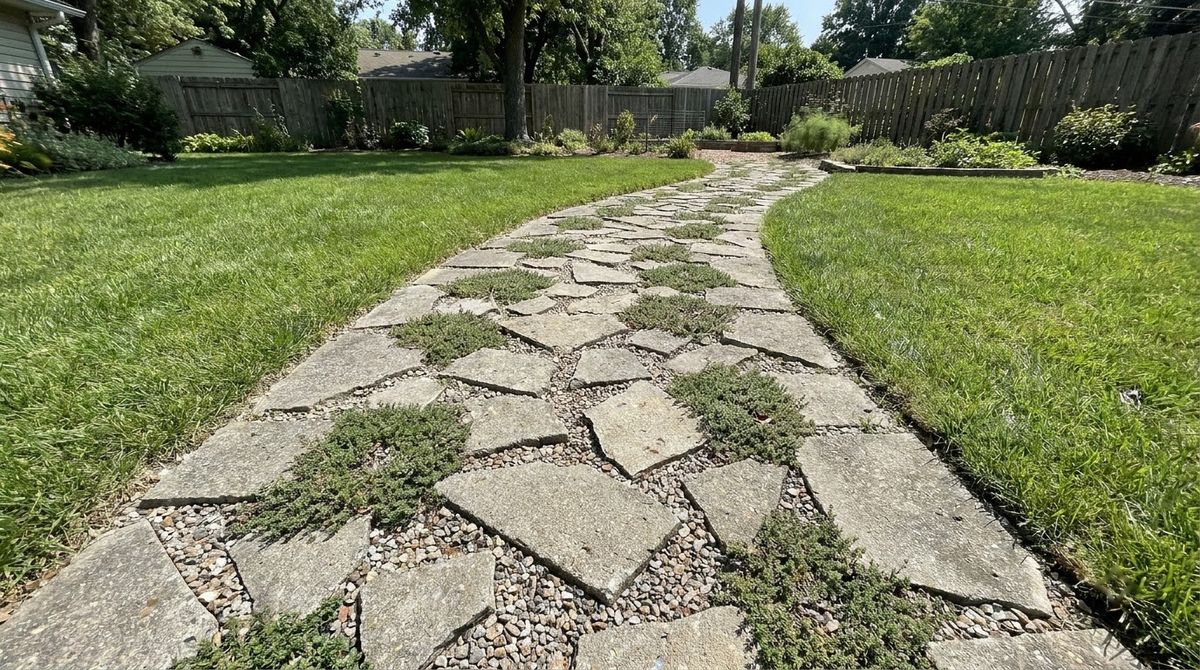
14. Urbanite (broken concrete) path
Urbanite is broken slab from a demolished patio or driveway. Concrete Network notes it is usually free if you haul it away, and that it installs much like stone or pavers, with sand, gravel or ground cover in the gaps. Your cost is the bed: about $1 to $2.30 per foot for 4 inches of road base.
- Pick pieces of even thickness so the path sits level.
- Plan the weight: slab pieces are heavy to move by hand.
- Avoid pieces from parking lots stained with oil or fuel.
How to work out the cost per foot of your walkway
The cost per foot of your walkway comes from three numbers: width, depth and the bulk price. Every figure above assumes a 3-foot path with 4 inches of material, which is 1 cubic foot per foot of length, so one cubic yard (27 cubic feet) covers about 27 feet.
- Find the volume: length × width × depth in feet, divided by 27, gives cubic yards.
- Price it: multiply by the supplier’s price per cubic yard.
- Add delivery: HomeGuide lists pea gravel truckloads of 2 to 7 tons at $120 to $700 delivered, and mulch delivery at $50 to $150.
- Add the edge and base: loose fill needs edging on a lawn, and pea gravel needs a compacted base.
A wider path scales the cost directly: a 4-foot path costs a third more per foot than a 3-foot path. HomeGuide suggests 2.5 to 3 feet for single-file backyard paths and at least 4 feet for a front walkway two people share.
Cheap backyard walkway ideas: which to pick by situation
Choosing among cheap backyard walkway ideas depends on how often you walk it, what it connects and how wet the ground gets. Pick by situation, not by the lowest number in the table.
- Pick free wood chips for paths between vegetable or shrub beds where a soft, replaceable surface is fine.
- Pick road base or crushed limestone for a daily route to a shed or gate on a tight budget.
- Pick pea gravel for a casual garden path, with edging and a base if it gets regular use.
- Pick stabilized DG in a dry climate when you want a firm, smooth main path without paving.
- Pick stepping stones for a short crossing through lawn, or set in gravel for a finished look.
- Pick brick or urbanite when you have salvaged material and time, but little cash.
Paths on a slope add steps or low walls; check the retaining wall cost per square foot before you budget a terraced route, because the wall usually costs more than the path.
When not to use a cheap walkway
Do not use a cheap walkway when the surface has to stay smooth, firm and clear year-round. HomeGuide lists three cases where gravel is a poor fit: paths you shovel often in snow, households where someone uses a cane or walker, and people who prefer to walk barefoot.
- Front entries: the main route to a door gets the most traffic; poured concrete, at $4 to $12 per square foot installed (HomeGuide, 2025), or about $12 to $36 per foot at 3 feet, is the cheapest hard surface.
- Wet, low ground: mulch and natural DG wash out; fix the drainage first.
- Steep slopes: loose fill migrates downhill and needs steps or terraces.
Frequently asked questions
What is the cheapest walkway material?
Free arborist wood chips and a mown grass strip cost nothing in materials. Among bought materials, recycled asphalt millings, road base and crushed shell are the cheapest, at about $1 to $2 per foot for a 3-foot path 4 inches deep, from HomeGuide’s cubic-yard prices. Delivery can cost more than the material itself on a small order.
How much does a gravel walkway cost per foot?
Pea gravel alone costs about $1.70 to $3 per foot for a 3-foot path, 4 inches deep, from HomeGuide’s $45 to $80 per cubic yard price. A finished gravel walkway with a crusher-run base, landscape fabric and edging costs about $10 per linear foot installed for a 3- to 4-foot path, according to HomeGuide.
Is decomposed granite cheaper than pavers?
Yes, by a wide margin. HomeGuide prices stabilized decomposed granite at $100 to $225 per cubic yard, about $3.70 to $8.30 per foot of 3-foot path, while installed concrete pavers cost $15 to $25 per square foot, about $45 to $75 per foot. DG needs topping up and an edge; pavers last longer with less upkeep.
How deep should a wood chip path be?
Washington State University Extension recommends keeping wood chip mulch 4 to 6 inches deep to control weeds. On a path, start at the deeper end, because foot traffic and decay compress the chips. Top the path up as it thins, and rake chips back onto the path when they spread into beds.
Can I make a walkway with broken concrete?
Yes. Broken concrete, called urbanite, is laid much like flagstone, with sand, gravel or ground cover in the joints. It is usually free if you haul it away, so your main cost is a compacted gravel bed of about $1 to $2.30 per foot. Choose pieces of similar thickness so the walking surface stays level.
Sources
- HomeGuide, How Much Does Crushed Stone or Gravel Cost? (updated December 19, 2025).
- HomeGuide, Pea Gravel Prices (updated December 19, 2025).
- HomeGuide, Decomposed Granite Cost (updated July 30, 2024).
- HomeGuide, Flagstone Prices Per Ton, Pallet, SF and Type (updated June 24, 2023).
- HomeGuide, Brick Prices (updated April 5, 2023).
- Washington State University Extension, Using Arborist Wood Chips as a Landscape Mulch, FS160E (2015).
- Also used: HomeGuide cost guides for mulch (April 2025), concrete patios (July 2025), flagstone patios (October 2023) and paver walkways (January 2026); Concrete Network, Urbanite: Recycled Concrete (checked October 2026).